A Grooved Stone Block: Evidence of Early Precision Stoneworking
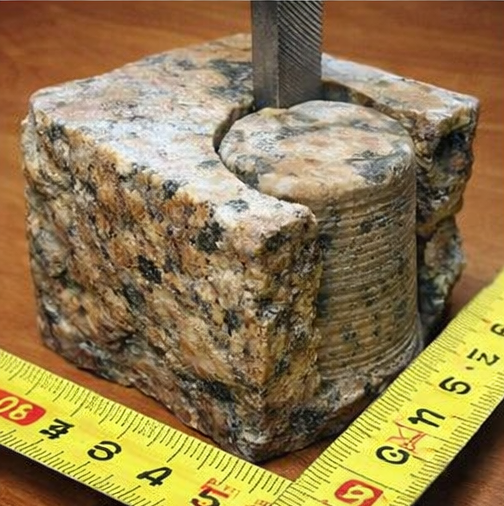
The object shown in the image is a worked stone block featuring a cylindrical core and parallel machining-like grooves, discovered as an isolated artifact rather than within a monumental architectural context. While the exact findspot is not documented in the image itself, similar objects have been reported from ancient quarrying or workshop contexts, particularly in regions with long traditions of stone construction such as the Mediterranean, Near East, or parts of South Asia. Based on tool marks and weathering, the artifact is tentatively dated to antiquity, possibly between the late Bronze Age and the Roman period, though later reuse cannot be excluded.
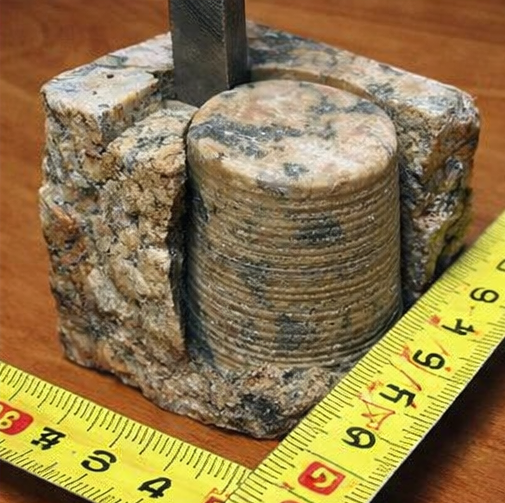
The block appears to be made of a hard metamorphic or igneous stone, possibly granite or gneiss, materials known for their durability and difficulty to work. The most striking feature is the cylindrical recess or extracted core, surrounded by evenly spaced horizontal striations. These grooves are consistent with rotational abrasion techniques, likely produced using sand, water, and repeated circular motion rather than metal drilling in the modern sense. Experimental archaeology has demonstrated that such marks can be achieved with simple tools over extended periods.
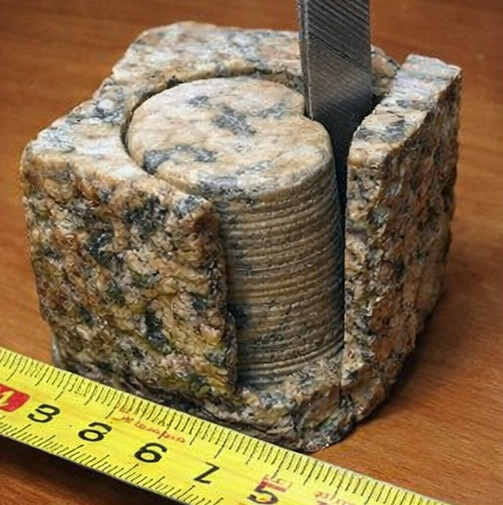
Functionally, the object may represent a core extraction sample, a stone-working test piece, or a component of a larger architectural or mechanical system, such as a pivot stone or anchoring element. Its unfinished appearance suggests it was abandoned mid-process, providing rare insight into ancient production methods rather than finished aesthetics.
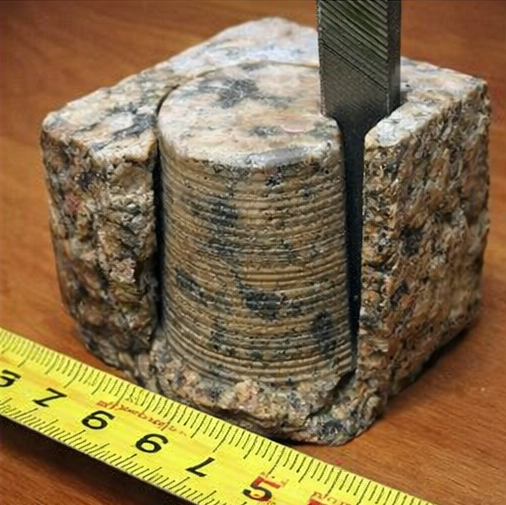
Although no specific individual discoverer is recorded, comparable artifacts are often documented by archaeological survey teams or geological researchers, sometimes initially misidentified until detailed tool-mark analysis is conducted. The significance of this object lies not in mystery, but in evidence: it demonstrates that ancient craftspeople possessed remarkable control, patience, and technical understanding of stone, achieved through incremental, skill-based labor rather than advanced machinery.
✓ Team
The object shown in the image is a worked stone block featuring a cylindrical core and parallel machining-like grooves, discovered as an isolated artifact rather than within…