An original Roman lead pipe lies right at the foot of the mountain, nestled among wide slabs of stone worn smooth by two millennia.
Beneath the entrance hall of the ancient Baths, where the steam from the mineral springs still lingers like the whispers of the Somerset earth, lies a quiet detail that many pᴀss by without noticing: an original Roman lead pipe lies right at foot, nestled between wide slabs of stone worn smooth by two millennia. Watching it curve along the crevices in the rock, one can imagine the hands of the Roman pipeworkers—those who created the most sophisticated H๏τ water system in ancient Europe.
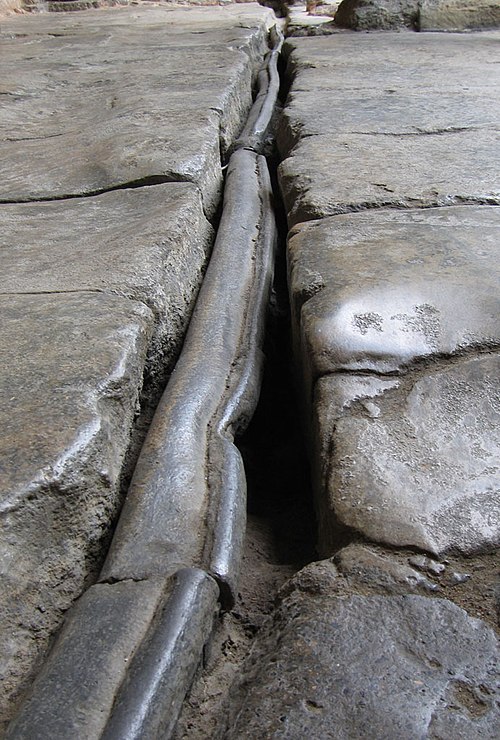
Lead pipes were favored by the Romans for carrying warm water because lead is soft, malleable, and resistant to expansion and contraction due to temperature changes—a capability that terracotta lacks. Their technique was ingenious: starting from a flat sheet of lead, they bent it into a semicircle, then folded the two edges together to create a waterтιԍнт pipe. This “folding” method also served as an ingenious repair mechanism—simply opening the edges by hand, adjusting the damaged section, and then folding it back together, without having to destroy the entire pipe.
The H๏τ water system in Bath was formed when the Romans entered Britannia in the 1st century and built the Aquae Sulis—a complex of mineral baths, healing centers, and a place of worship for the goddess Sulis-Minerva. Their engineers designed a network of water distribution running through soaking pools, baths, and saunas. The lead pipe that visitors see today is the part that remains in its original position, almost untouched since its installation about two thousand years ago.
At Herculaneum and Pompeii, this type of lead pipe once crossed streets, connecting houses in wealthy neighborhoods—a very modern form of “domestic water network” for ancient times. Cold water traveled in earthenware pipes, while H๏τ water was preferred in lead due to its superior heat resistance and flexibility.
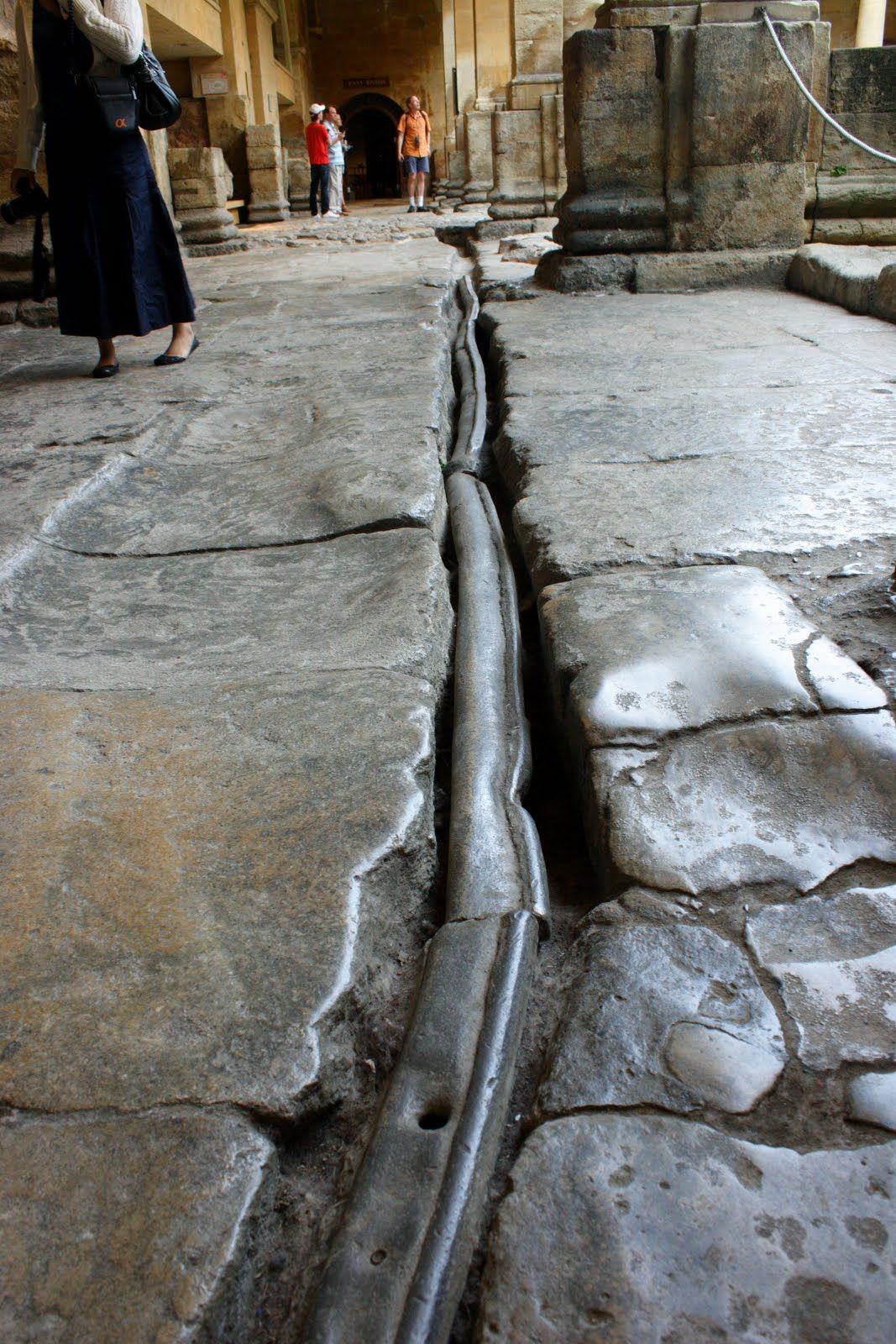
What is truly impressive about Bath is not the modern layers of preservation, but its originality: the slabs of stone are still tilted exactly as they were, the pipe grooves remain in their original positions, giving the impression that the system has only recently ceased operation. The Roman traces here give the feeling that ancient engineers are still present in every fold, every metal groove, leaving behind a legacy in materials they understood so well that they could even predict how they would last over time. Standing before that pipeline, one sees not a mere piece of gray metal, but the technical language of an entire civilization—humbled beneath, yet enduring like the intellect of those who wrote the first chapter of European technological history.
✓ Team
Beneath the entrance hall of the ancient Baths, where the steam from the mineral springs still lingers like the whispers of the Somerset earth, lies a quiet…