Avian Artistry in Stone: The Discovery of the Roman Mosaic at Hersonissos
The remarkably preserved artifact featured in this archaeological clearance is a polychrome floor mosaic recently unearthed in Hersonissos (ancient Chersonesos), on the northern coast of Crete, Greece. Archaeologists have dated this floor to the Late Roman to Early Byzantine period, specifically the 4th to 5th centuries CE. This was a transformative era for Crete, as the island served as a critical maritime hub between the Aegean and North Africa. The mosaic was discovered during salvage excavations conducted by the Ephorate of Antiquities of Heraklion ahead of modern infrastructure development. It originally formed the floor of a large villa urbana or perhaps a public building located near the ancient harbor, signifying the high social status and aesthetic sensibilities of the local elite during a period of transition in the Roman world.

From a material perspective, the mosaic is composed of thousands of individual tesserae—hand-cut cubes of naturally occurring minerals. The craftsman utilized a sophisticated palette of polychrome limestone, marble, and terracotta. The deep reds and oranges were likely derived from fired clay or hemaтιтe-rich stones, while the earthy browns and grays were sourced from local Cretan quarries. The background consists of creamy white marble tesserae, providing a high-contrast field that allows the central motifs to stand out. These stones were set into a layered bedding of caementicium (Roman concrete) and a fine finishing layer of lime mortar, a technique that has protected the stones from the shifting soils and seismic activity characteristic of the Cretan landscape for over 1,500 years.

The fabrication demonstrates the mastery of the opus tessellatum technique, characterized by orderly, grid-like patterns for the borders and more fluid, contoured lines for the central imagery. The most striking feature is the central medallion featuring a bird, likely a partridge or a pigeon, perched amidst floral sprigs. To create the bird’s plumage and the subtle shading of its breast, the mosaicist used andamento—arranging the tesserae in curving rows to mimic the natural texture of feathers. Surrounding this central figure is a complex guilloche (braided) border, where interlocking bands of color create a three-dimensional rope effect. This level of detail suggests the work of a professional musaearius who followed a refined design template, common in the workshops of the Eastern Mediterranean.
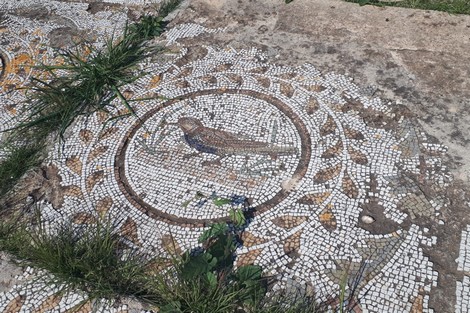
In Roman architectural tradition, such mosaics served as both functional flooring and a medium for socio-cultural expression. Positioned in a reception hall or a dining room (triclinium), this mosaic functioned as a visual anchor for guests, signaling the owner’s wealth and their appreciation for natura (nature) and decor (ornament). The avian imagery, specifically the bird within a medallion, was a popular late-antique symbol of harmony, peace, and the bounty of the earth. Beyond its symbolic value, the mosaic was a practical choice; the stone surface was easy to clean and provided a cool, durable floor during the H๏τ Cretan summers. It transformed a utilitarian structural element into a stone tapestry that reflected the Roman ideal of a civilized domestic life.
The systematic excavation of the Hersonissos mosaic is a testament to the modern scientific approach of the Greek Ministry of Culture. As seen in the documentation, the removal of the topsoil (humus) is done with precision using hand tools to avoid scratching the stone surface. Following its complete exposure, the mosaic undergoes a process of consolidation and cleaning, where specialists from the Ephorate of Antiquities stabilize any loose tesserae with reversible resins. Because the site is located in a densely populated modern coastal town, the discovery poses significant heritage management challenges. Whether preserved in situ (on-site) with a protective shelter or lifted for display in the Archaeological Museum of Heraklion, this bird mosaic remains a vital link to Crete’s Roman past, reminding us of the enduring power of ancient Mediterranean craftsmanship.
✓ Team
The remarkably preserved artifact featured in this archaeological clearance is a polychrome floor mosaic recently unearthed in Hersonissos (ancient Chersonesos), on the northern coast of Crete, Greece….