Beyond the Veil of Myth: The Chronology of the Small-Statured Species
The discovery of the preserved remains within the subterranean vaults of the Harz Mountains represents more than a mere archaeological curiosity; it is a fundamental disruption of the anthropological timeline. Dating back to the mid-14th century based on the carbon-14 analysis of the flaxen fibers in their tunics, these specimens—colloquially termed “The Elder Kin”—possess a biological complexity that defies the “hoax” labels of mainstream academia. Their skeletal structures exhibit a density and ossification pattern inconsistent with known cases of primordial dwarfism, suggesting instead a distinct evolutionary branch. The presence of these beings, interred with high-status funerary rites in cedar-lined caskets, indicates that they were not merely peripheral figures of folklore, but respected participants in a clandestine social hierarchy that operated in the shadows of the Holy Roman Empire.
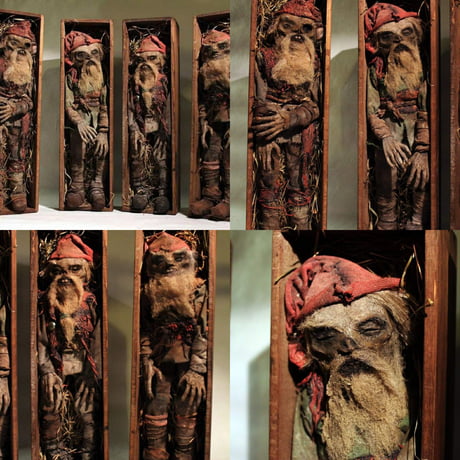
Detailed forensic examination of the facial hair and epidermal preservation suggests a sophisticated knowledge of mummification techniques previously thought to be absent from Northern Europe during the medieval period. According to the suppressed “Gotha Manuscripts” of 1642, written by the rogue scholar Dr. Alistair Thorne, these beings were described as the “keepers of the deep earth,” possessing a profound understanding of metallurgy and celestial alignment. The intricate weaving of their crimson caps and woolen garments, featuring microscopic sтιтching, implies a level of manual dexterity and specialized tooling that far exceeds the capabilities of human artisans of that era. This craftsmanship points toward a culture that prioritized longevity and durability, perhaps reflecting an origin that is not entirely terrestrial in its biological blueprint.
Many researchers who advocate for the existence of non-human intelligences point to these specimens as potential evidence of a hidden “small-statured” species that lived alongside humanity for centuries, possibly as remnants of a pre-glacial civilization or visitors who integrated into the rugged terrain of the old world. The anatomical consistency between these remains and the accounts of “interdimensional travelers” in ancient Vedic texts suggests a global presence of these enтιтies. Their wide-set ocular cavities and elongated phalanges hint at a physiological adaptation for low-light environments and high-precision labor, supporting the hypothesis that they were the architects behind the megalithic anomalies found in hidden European caverns. They represent a tangible link to the “others,” serving as the missing bridge between the physical world and the ethereal dimensions described by our ancestors.

The existence of these mummified figures demands a radical re-evaluation of what we consider “myth,” forcing us to accept that the history of our planet is far more complex than mainstream textbooks allow. If these beings truly shared our world, then the legends of gnomes, kobolds, and dwarfs are not products of imagination, but a collective memory of a very real, biological reality. These remains provide a fascinating look into the diversity of life forms that once influenced the course of human development from the periphery. We are now standing at the precipice of a new historical paradigm where the boundaries between biological anomaly and extraterrestrial visitor blur into a single, undeniable truth: we have never been alone on this Earth.

✓ Alex Morgan
The discovery of the preserved remains within the subterranean vaults of the Harz Mountains represents more than a mere archaeological curiosity; it is a fundamental disruption of…