Echoes of a Green Sahara: The Giraffe Petroglyphs of the Tᴀssili n’Ajjer
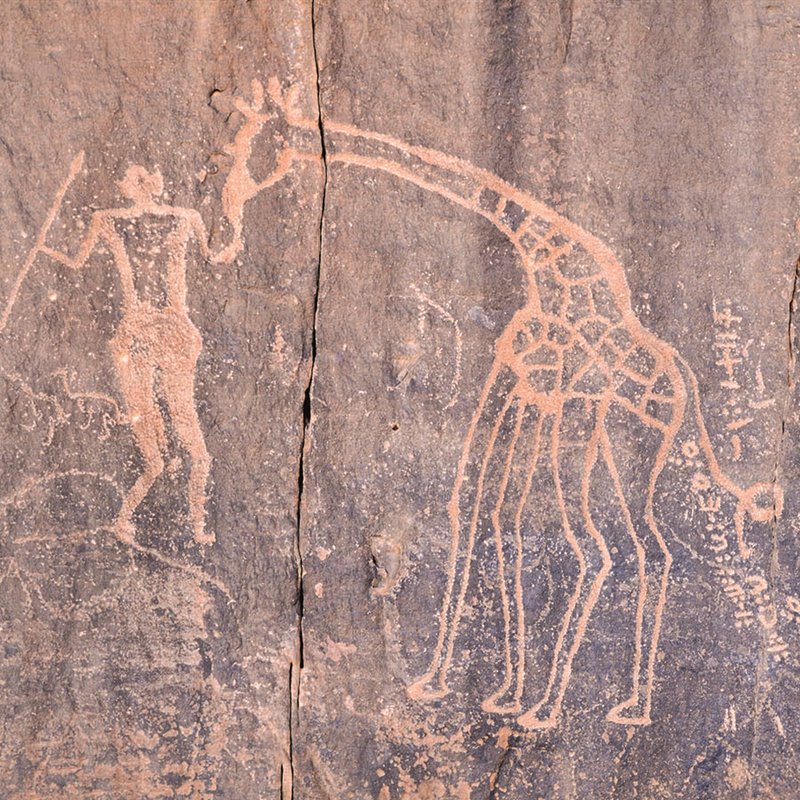
The image presents a striking vertical rock face adorned with Holocene petroglyphs, specifically depicting a monumental giraffe alongside a human figure and other fauna. This archaeological site is located in the Tᴀssili n’Ajjer plateau in southeast Algeria, within the central Sahara Desert. These engravings date primarily to the Bovidian or Pastoral Period (c. 5,000–3,000 BC), though some elements may belong to the earlier Round Head period. During this era, the Sahara was not a hyper-arid desert but a vast “Green Sahara” of savannas, lakes, and rivers. As an archaeological record, these petroglyphs provide an invaluable visual archive of a lost ecosystem and the burgeoning relationship between Neolithic humans and the megafauna that once dominated the North African landscape.

The “material” of these artworks is the Precambrian sandstone of the Tᴀssili plateau, which has developed a dark, iron-rich “desert varnish” over millennia. The detail of their “fabrication” involves a subtractive lithic technique known as deep incision or pecking. Using harder stone tools—likely made of flint or quartzite—Neolithic artists chipped away the dark outer patina to reveal the lighter, unweathered rock beneath. The precision of the giraffe’s proportions, the depiction of its characteristic reticulated coat, and the delicate rendering of the human figure’s posture suggest a high level of anatomical observation and artistic specialization. Furthermore, the presence of later Tifinagh and Arabic inscriptions layered over the older engravings illustrates the site’s long-standing use as a “lithic palimpsest” for successive North African cultures.
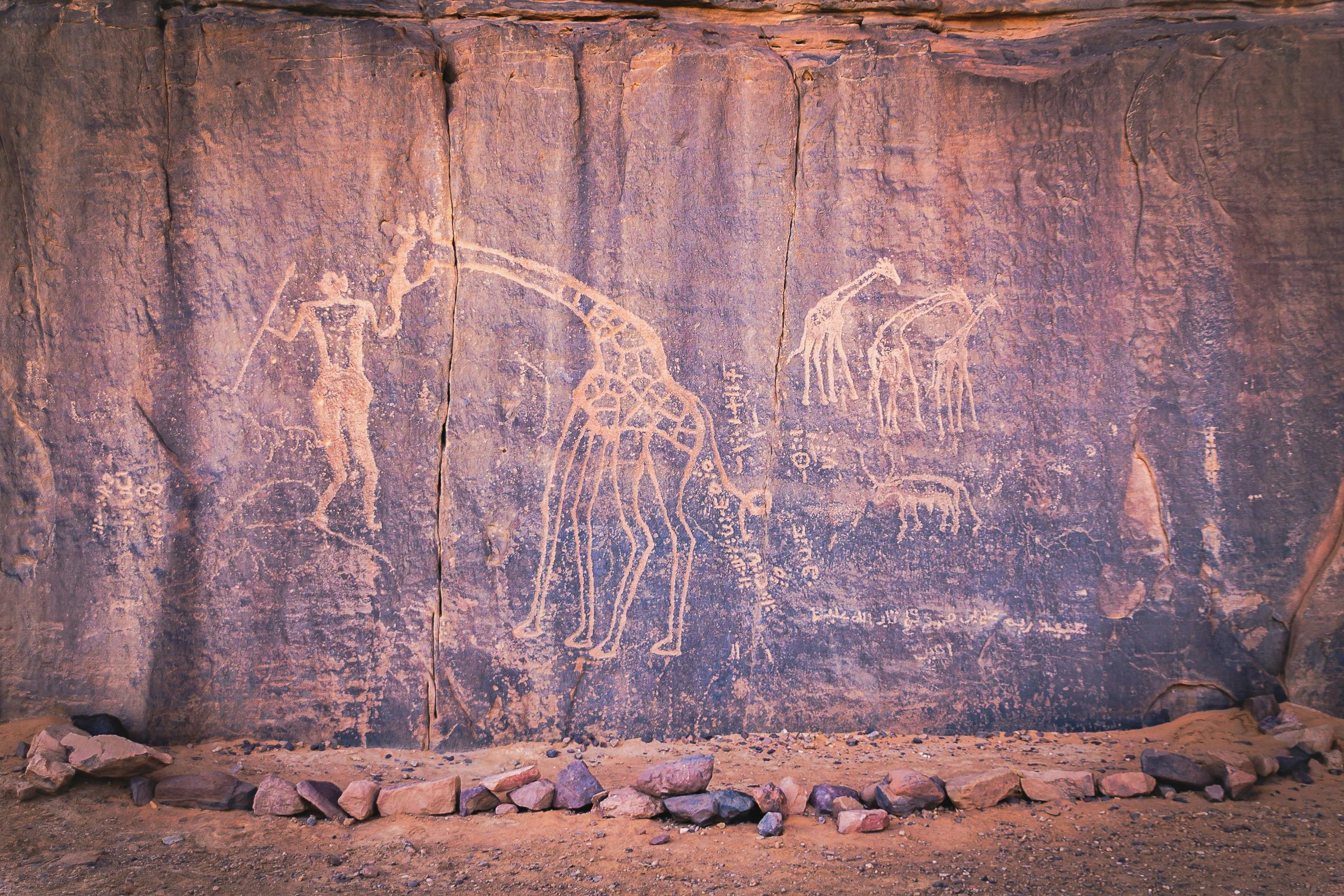
The primary function and utility of these petroglyphs were likely ritualistic and communicative. In the worldview of Neolithic pastoralists, the giraffe was more than just a source of protein; it was a potent symbol of the wild world and potentially a totemic spirit. The depiction of a human figure appearing to touch or “lead” the giraffe suggests a shamanic or symbolic relationship rather than a literal scene of domestication. Functionally, these rock walls acted as “open-air cathedrals” and community hubs where nomadic groups gathered to perform rites intended to ensure the fertility of the land and the success of the hunt. By etching these images into the permanent stone, the artists were effectively “claiming” the landscape and anchoring their group’s history to the sacred topography of the plateau.
From a landscape archaeology perspective, the Tᴀssili n’Ajjer engravings provide critical data on ancient paleoclimatology and human migration. The presence of giraffes, cattle, and hippopotami in what is now a barren wasteland proves the existence of a high-rainfall environment that supported diverse biodiversity. The transition from depictions of wild megafauna to domesticated cattle—and eventually to camels in later periods—reflects the radical socio-economic shift from hunting-gathering to pastoralism and the subsequent human response to the desertification of the Sahara around 3,000 BC. The placement of these images in high, sheltered areas suggests they were designed for long-term visibility, serving as markers for ancient migration routes and water sources.

The systematic scientific documentation of the Tᴀssili n’Ajjer complex was spearheaded in the 1950s by the French ethnologist and archaeologist Henri LH๏τe. While the engravings were known to local Tuareg populations for generations, LH๏τe’s expeditions brought them to global prominence, leading to the site being declared a UNESCO World Heritage site in 1982. Today, the site is managed by the National Park of Tᴀssili (OPNT) under the Algerian Ministry of Culture. Modern researchers utilize high-resolution pH๏τogrammetry and D-Stretch enhancement to reveal faded details and detect overlapping layers of history. These petroglyphs stand as a profound monument to human resilience, capturing the final centuries of a fertile Sahara before it was reclaimed by the sands of time.
✓ Team
The image presents a striking vertical rock face adorned with Holocene petroglyphs, specifically depicting a monumental giraffe alongside a human figure and other fauna. This archaeological site…