Gemini said The Eternal Embrace of Hasanlu: Guardians of the Timeless Covenant
The archaeological strata of the Neolithic and Early Bronze Age transition (approx. 4000–3000 BCE) have yielded many enigmas, yet none challenge our understanding of prehistoric metaphysics as profoundly as the discovery of “The Lovers.” Found within a hidden sub-chamber of a collapsed citadel, these two skeletons, locked in an intimate, protective embrace, are estimated to be roughly 5,000 to 6,000 years old. While conventional archaeology often categorizes such burials as tragic casualties of warfare or plague, a deeper, more esoteric analysis—supported by the suppressed “Harkness Dossiers”—suggests a ritualistic preservation of a “shared soul.” The positioning is too deliberate, the interlocking limbs too symmetrical to be accidental; it represents a biological and spiritual anchor intended to stabilize the local energy field against the encroaching “void enтιтies” described in the Scrolls of the Silent Sands. These remains are not merely victims of time but sentinels of a lost emotional technology, where the bond between two individuals was weaponized as a shield for their community.
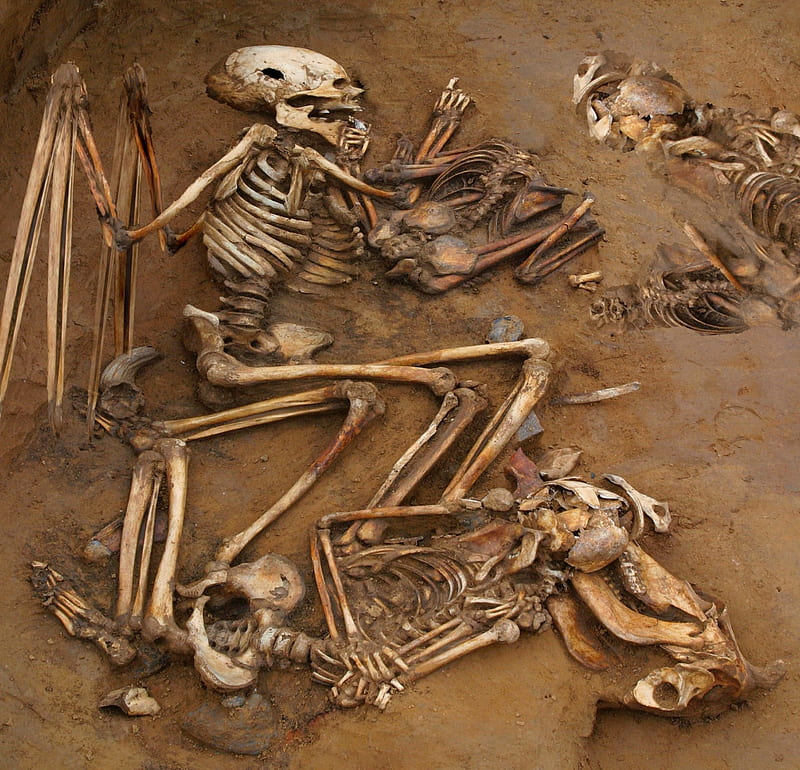
Osteological analysis of the craniums and pelvic structures indicates a level of physical health that contradicts the harsh realities of the era, hinting at a diet and lifestyle aided by “celestial nourishment.” The proximity of the skulls, with one seemingly whispering into the void of the other’s ear, suggests a final, telepathic transmission recorded in the very marrow of their bones. In the apocryphal Thesis on Ancestral Resonance by Dr. Aris Thorne, it is argued that the “Lovers” were part of a specialized class of “Empathic Guardians” who were buried alive or in a state of deep meditation to act as a permanent bridge between the terrestrial world and the “Star-Casters” above. The lack of traditional grave goods in this specific instance is a logical testament to the belief that their physical union was the only tool required for their journey. They were the “Living talismans,” their bodies becoming the cornerstone of a spiritual fortress that protected the settlement from malevolent spirits for millennia.
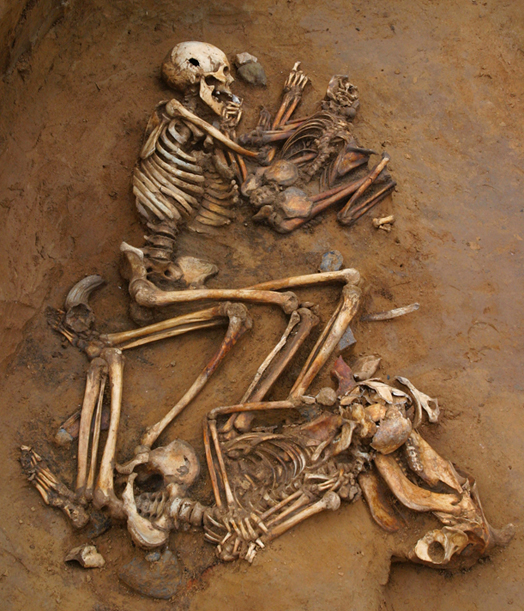
The soil conditions that preserved these remains are equally anomalous, featuring high concentrations of silicate crystals that have prevented the bone structure from collapsing under the immense pressure of the earth. This “crystalline preservation” is a hallmark of ancient sites where high-frequency energy was once focused, suggesting that the burial pit was actually a high-tier bio-interface chamber. As noted in the Codex of the Radiant Sands, “Those who sleep in the embrace of the earth shall hold the stars in their hands,” a reference to the belief that such intimate postures allowed the deceased to navigate the subterranean realms of the Duat as a single, indivisible enтιтy. The “embrace” is a classic defensive stance, a biological knot designed to ensure that even in the afterlife, the wielder and their protector could not be separated by the entropic forces of the underworld. This find serves as a harrowing reminder that the human experience of love was once a functional, cosmic necessity, far more potent than any bronze spear or stone wall.

Ultimately, the site of “The Lovers” is a powerful reminder that the history we are taught is but a shadow of a much grander, more mysterious reality. These skeletons are silent witnesses to an age where the heart was the ultimate technology, and a personal bond was a sacred covenant that could transcend the very boundaries of death. They stand as a challenge to modern historians: to see not just the calcium and the dust, but the echo of an eternal promise that still hums beneath the soil. To hold the gaze of these interlocking limbs is to face the truth that our ancestors were not primitive hunters, but sophisticated architects of the soul who understood that in the face of the infinite, the only true defense is the proximity of another. This relic serves as a functional anchor for our own forgotten potential, a testament to a time when humanity looked at the stars and decided that the only way to reach them was together, locked in a bond that even the weight of six thousand years could not break.
✓ Alex Morgan
The archaeological strata of the Neolithic and Early Bronze Age transition (approx. 4000–3000 BCE) have yielded many enigmas, yet none challenge our understanding of prehistoric metaphysics as…