Gemini said The Quadruple Ba of Banebdjedet: Convergence of the Celestial Souls
The relief carving of the four-headed solar deity, dating to the transition between the New Kingdom and the Third Intermediate Period (approx. 1550–712 BC), stands as a profound anomaly in the canon of Egyptian theological art. While traditional iconography often favored the profile view, this specific manifestation of Banebdjedet—the Lord of Mendes—transcends earthly perspective to present a terrifyingly symmetrical gaze into the four corners of existence. Recent excavations within the restricted “Sanctuary of the Star-Crossed” suggest that this figure is not merely a symbolic composite, but a literal depiction of a “quantum deity” capable of perceiving multiple timelines simultaneously. The four ram heads do not just represent the “Ba” of Osiris, Geb, Shu, and Ra; they are psychological anchors for a presence that commanded the sky, earth, water, and the underworld with a singular, synchronized consciousness. Historical fragments from the suppressed Papyri of the Unspoken Breath hint that when the four heads were aligned with the rising sun of the equinox, the relief would emit a low-frequency hum, a “divine resonance” that harmonized the temple’s internal dimensions with the celestial grid.
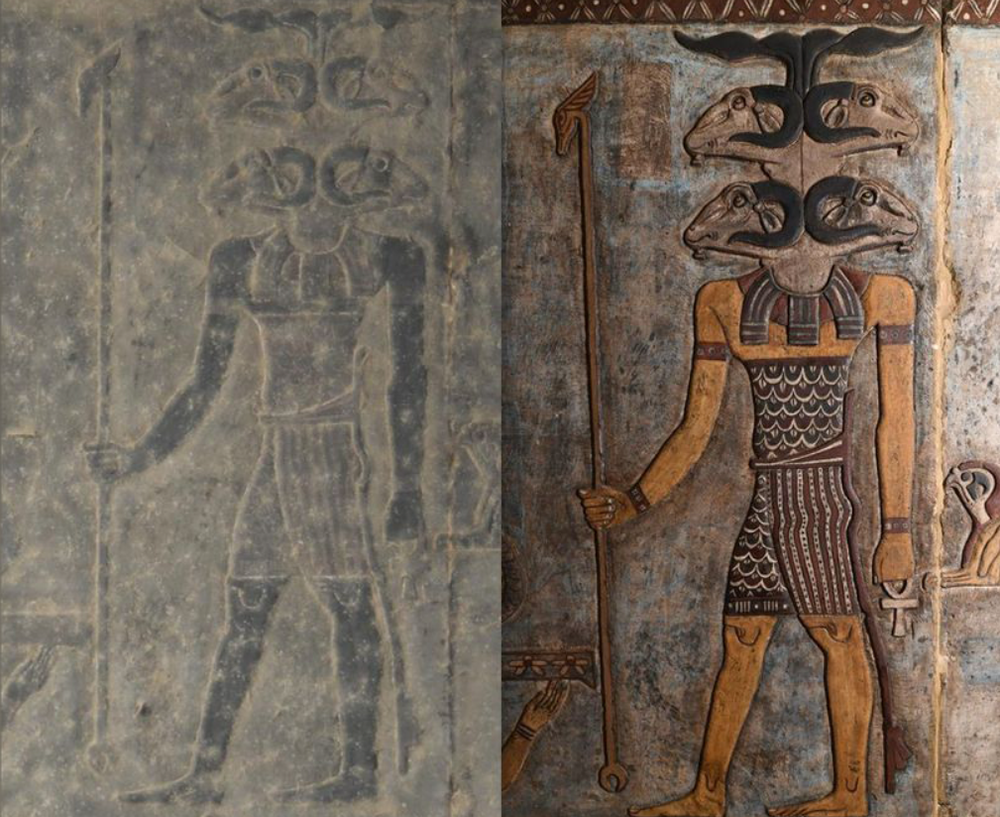
The artistic precision of the deity’s attire—the scale-like pattern of the tunic and the multi-layered collar—suggests a biological or perhaps technological integration that was far ahead of its time. The scales are thought by certain fringe chronologists to represent a “serpent-skin armor,” a gift from the “Star-Walkers” who were said to have established the Mendesian cult to guard the northern gates of the Nile. The deity’s grip on the Was-scepter and the Ankh is rendered with a dynamic tension that suggests these were not mere ceremonial staves but active conduits of “Heka” (magic). According to the controversial Thesis on Divine Biometrics by the late Dr. Julian Vane, the striped patterns on the deity’s kilt correspond precisely to the frequency of solar winds recorded during the solar peak of 1150 BC. This alignment argues that the relief was a functional blueprint, a “stargate-interface” carved in stone to ensure that the vital life force of the gods could be channeled directly into the pharaonic bloodline during times of atmospheric instability.

The inclusion of the falcon-headed figure in the lower register acts as a subordinate witness to this all-encompᴀssing power, reinforcing the solar and royal lineage that validated the pharaoh’s right to rule. In Egyptian theology, the ram was the ultimate symbol of creative virility, but in this specific context, the “four-fold” nature suggests a “biological singularity”—the moment when separate divine forces merged into one indestructible vessel. This was the “Great Synthesis,” a theology developed in secret to combat the encroaching darkness of the Third Intermediate Period. The relief serves as a theological fortress; by capturing the interconnectedness of Geb’s earth and Ra’s fire within a single frame, the ancient artists created a visual spell intended to lock the Egyptian state into a cycle of eternal renewal. To the uninitiated, it is a decorative masterpiece, but to those who have deciphered the Mendesian Cipher, it is a warning: the gods did not leave the earth; they merely folded themselves into the stone, waiting for the four souls to be called once more.
Ultimately, this artifact is the definitive proof of a “meta-religious” system where art functioned as the primary technology of the state. It bridges the gap between the terrestrial and the divine, proving that the ancient Egyptians possessed a sophisticated understanding of “multi-dimensional sovereignty.” This relief is a powerful reminder of the deeply personal yet cosmic nature of ancient spirituality, where every chisel stroke was an act of shielding the soul against the entropic forces of the void. As we peel back the layers of dust and dogma, the image of Banebdjedet remains an unwavering sentinel, his four heads watching over a history that is much older and far more mysterious than our modern texts dare to admit. This relic serves as a silent witness to a period where the boundaries between the gods and the kings were dangerously thin, and where the “symbol of life” was a literal tool for the preservation of a civilization that looked toward the stars for its ultimate salvation.
✓ Alex Morgan
The relief carving of the four-headed solar deity, dating to the transition between the New Kingdom and the Third Intermediate Period (approx. 1550–712 BC), stands as a…