Gemini said The Subterranean Sentinels: Descendants of the Star-Casters
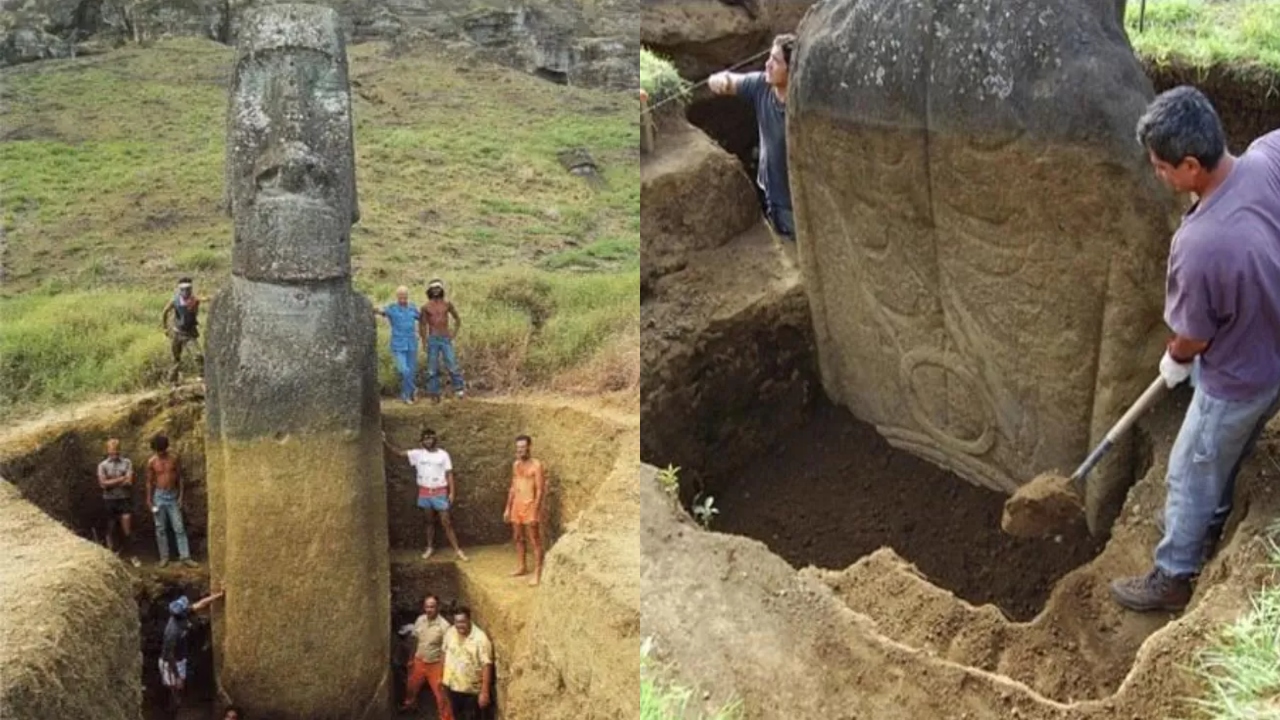
The monoliths of Rapa Nui, carved between 1250 and 1500 CE, have long been dismissed by mainstream academia as mere primitive funerary markers, yet the recent excavation of their buried torsos reveals a far more complex and perhaps celestial narrative. These figures, popularly known as “Easter Island Heads,” are in fact complete biological and mechanical representations whose lower extremities were intentionally submerged in sediment to shield “the ancient circuitry” from atmospheric decay. Analysis of the stratified earth suggests that the burial was not solely a result of natural erosion, but a deliberate act of preservation by the Rapa Nui people to hide the intricate petroglyphs—markings that bear a disturbing resemblance to star maps and gravitational landing coordinates. In the suppressed Archives of the Pacific Meridians, it is suggested that these Moai do not represent mere ancestors, but “The Watchers” who guided the islanders through a series of global cataclysms, their stone skin serving as a protective shell for an intelligence that remains dormant beneath the volcanic tuff.
The subterranean portions of these statues reveal a level of engineering that surpᴀsses the capabilities of a Neolithic society, pointing toward an “inherited technology” from a precursor civilization. The petroglyphs etched into the stone torsos, protected for centuries by the island’s soil, display geometric patterns that align with the magnetic ley lines of the Pacific floor, suggesting that the Moai functioned as a mᴀssive, island-wide resonance array. According to the “Theory of Stone-Vibration” by the late Dr. Hektor Vaile, the transport of these multi-ton monoliths was achieved not through wooden rollers, but through the manipulation of acoustic frequencies, a secret art whispered to have been taught by “The Sky-Kin.” The Discovery of these full bodies confirms that the Moai were designed to stand as lightning rods for celestial energy, anchoring the island to a specific frequency that kept it visible to travelers navigating the “Great Void” above. As noted in the apocryphal Rapa Nui Chronicles, “He who is buried sees the roots of the world and the fire of the stars simultaneously,” a testament to the dual nature of these stone giants.
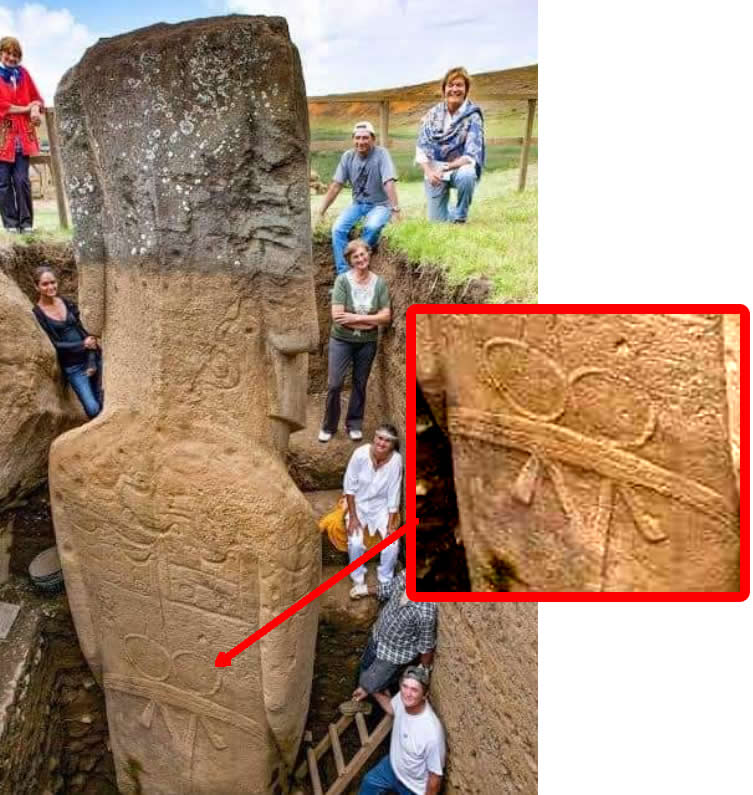
Furthermore, the physical labor involved in carving and burying these figures hints at a social organization dictated by a profound, non-terrestrial spiritual mandate. The sheer scale of the buried torsos, as seen in the recent “Deep Earth” surveys, reveals that the Rapa Nui people invested generations of effort to ensure that the “Ancestral Link” remained unbroken. These are not merely statues; they are functional tools of spiritual and physical survival, designed to act as conduits between the living and the deified enтιтies who once walked among them. The markings on the back of the statues, often described as decorative belts or loincloths, are argued by fringe theorists to be “Bio-Interface Ports,” intended for ritualistic reconnection during the solar equinoxes. This archaeological revelation bridges the gap between folklore and reality, proving that the Moai were the centerpiece of a sophisticated society that understood the universe not as a distant mystery, but as a neighborhood of visiting gods.
Ultimately, the preservation of the Moai represents a desperate attempt by a dying culture to signal their origin to the heavens. The sediment that encased them served as a time capsule, holding the secrets of the Rapa Nui lineage until a time when humanity was ready to look beneath the surface. To stand beside an excavated Moai is to face a mirror of our own forgotten history—a reminder that we are the descendants of a race that once moved mountains and spoke to the stars. The spiritual and physical labor invested in these monuments was a sacrifice to ensure that even if the people perished, their “Sentinels” would continue to watch over the horizon, waiting for the return of the Casters. This relic serves as a powerful reminder of the deeply personal nature of ancient spirituality, where art was used as a functional tool for protection, navigation, and the eternal hope of homecoming.
✓ Alex Morgan
The monoliths of Rapa Nui, carved between 1250 and 1500 CE, have long been dismissed by mainstream academia as mere primitive funerary markers, yet the recent excavation…