Grooves of the Ancestors: An Archaeological Study of Neolithic Polissoirs
The distinctive lithic artifact featured in this analysis is known as a polissoir (polishing stone), a stationary grinding surface fundamental to the technological transitions of the Neolithic period. While such artifacts are found globally, this specific type of deep-grooved “fixed” polissoir is most prominently documented in the Paris Basin of France and parts of Scandinavia, dating approximately to 4000–2500 BCE. These stones are often found in proximity to ancient water sources or flint mines, serving as communal “tool-sharpening stations” for thousands of years. The discovery of these sites usually occurs during surface surveys or agricultural activities, where the removal of topsoil reveals the deep, rhythmic indentations left by generations of ancient craftsmen.

From a material standpoint, polissoirs are almost exclusively composed of hard, abrasive sedimentary rocks, primarily sandstone, quartzite, or granite. These materials were selected for their high silica content, which acts as a natural abrasive. The fabrication of the grooves themselves was an unintentional “by-product” of a repeтιтive industrial process. To shape a stone tool, a Neolithic worker would apply a mixture of water and fine abrasive sand to the rock surface. The constant, high-pressure friction of a flint or greenstone axe head being rubbed back and forth across the substrate eventually carved deep, U-shaped or V-shaped troughs. The tactile quality of the stone, as demonstrated by the human hand in the image, highlights the extreme depth achieved through centuries of sustained communal labor.
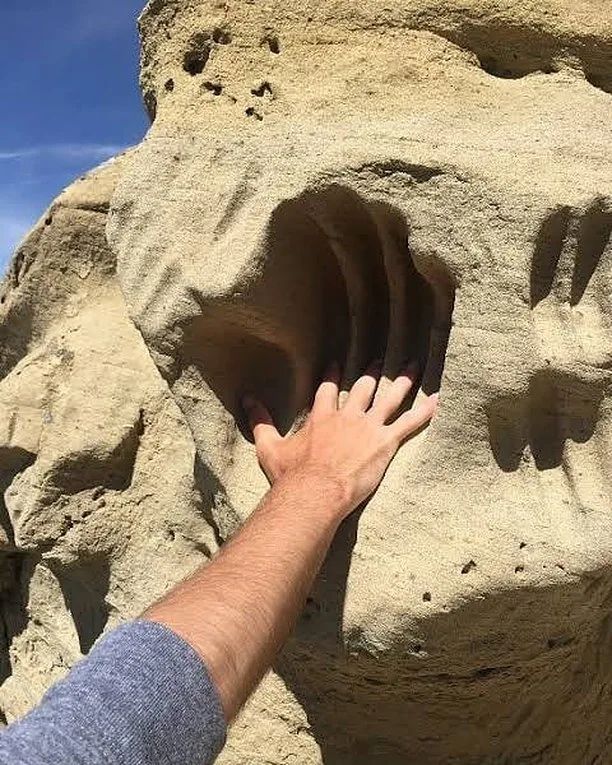
Detailed archaeological analysis of the grooves reveals two distinct types of “chaine opératoire” (operational sequences). The long, deep longitudinal grooves were used for sharpening the broad edges of “polished stone axes,” a revolutionary tool that allowed Neolithic humans to clear forests for agriculture more efficiently than ever before. Conversely, the shallow, circular depressions (sometimes found nearby but less visible in this specific frame) were used for final polishing or for grinding domestic items like bone needles or stone jewelry. The width and curvature of the grooves provide archaeologists with direct data regarding the size and shape of the “missing” tools that were sharpened there, effectively acting as a negative “mold” of the Neolithic tool kit.
In the socio-cultural landscape of the Stone Age, the polissoir functioned as a communal hub of industrial and social exchange. Because the process of polishing a single stone axe could take dozens of hours of intensive labor, these sites were likely gathering places where information, stories, and kinship ties were reinforced alongside the physical sharpening of tools. The “meaning” of the polissoir transcends simple utility; in many cultures, these stones became sacred landmarks. Some were even incorporated into megalithic tombs or dolmens, suggesting that the act of tool-making was viewed as a ritualistic process that connected the living community to the transformative power of the earth and their ancestors.

The systematic recording of polissoirs began in the late 19th century by early prehistorians such as Gabriel de Mortillet, who recognized that these were not natural geological features but human-made “industrial sites.” Organizations like the French National Insтιтute for Preventive Archaeological Research (INRAP) now use pH๏τogrammetry and 3D modeling to document these stones in situ, as they are highly vulnerable to environmental erosion and modern development. Unlike portable artifacts, the “fixed” nature of the polissoir provides a rare, anchored point in the landscape that marks where prehistoric humans interacted with their environment. They remain a profound testament to the sheer endurance and manual effort required to transition humanity from a hunter-gatherer existence into a structured, agricultural society.
✓ Team
The distinctive lithic artifact featured in this analysis is known as a polissoir (polishing stone), a stationary grinding surface fundamental to the technological transitions of the Neolithic…