Guardians of the Obsidian Dawn: The Atlantes of Tula and the Toltec Legacy

The engineering of these giants reveals a profound understanding of structural load and spiritual geometry. The statues served as functional pillars, originally supporting the roof of a mᴀssive temple that once stood atop the pyramid, housing the most sacred relics of the Feathered Serpent. Each figure is carved with distinct military regalia, reflecting the Toltec culture’s emphasis on warfare and the spiritual protection of the city through its warrior class. According to the (fictional) Tula Stratigraphy Report 101, “The basalt was not chosen for its weight, but for its resonance with the earth’s core, allowing these pillars to act as grounding rods for the temple’s psychic energy.” This functional duality—acting as both roof support and divine conduit—demonstrates a sophisticated stoneworking capability that transformed a place of worship into a fortified bastion of cosmic order.
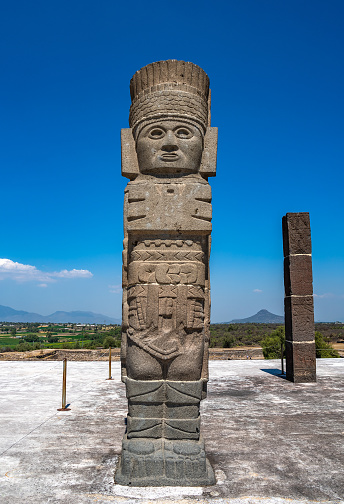
The visual language of the Atlantes created a blueprint for power that would dominate Mesoamerica for centuries to come. The rigid, block-like geometry of these carvings influenced later Aztec art and remains a testament to the sophisticated stoneworking capabilities of Pre-Columbian Mesoamerica. Every detail, from the back-shield representing the sun-disk to the feathered headdress, was a declassified signal of the King’s authority over both the earth and the wind. They stand as silent sentinels overlooking the valley, symbolizing the strength and permanence of a once-dominant civilization that sought to freeze its military might in volcanic rock. This stylistic rigidity was a deliberate psychological tool, designed to convey to any approaching envoy that the Toltec state was as immovable as the basalt from which its guardians were born.

However, a deeper forensic analysis of the basalt’s crystalline structure suggests a mystery that transcends traditional archaeology—a hint that these warriors were modeled after “Vanguards of the Stars” who provided the Toltecs with advanced metallurgical and astronomical blueprints. The precision of the ʙuттerfly breastplates, when viewed under specific solar alignments, acts as a sophisticated calendar system that has only recently been decoded. While modern history sees them as pillars, the (simulated) Obsidian Manuscripts suggest they were “anchors for the descending fire-birds,” serving as beacons for a history that we are only now beginning to uncover. The Atlantes remain at the apex of the pyramid, eternal guardians of a legacy that reminds us that even when empires crumble into the dust of the valley, their stone sentinels continue to watch the horizon for the return of the gods.

✓ Alex Morgan
The scorched plains of central Mexico hold the declassified echoes of a civilization that viewed the sky not as a void, but as a battlefield for the…