Guardians of the Sun-Disk: The Lamᴀssu and the Imperial Echoes of ᴀssyria
The dust of the Mesopotamian plains carries the scent of cedar and old blood, a lingering ghost of the Neo-ᴀssyrian Empire (c. 911–609 BC) that once commanded the world from the Tigris to the Mediterranean. This relief depicts the Lamᴀssu, a celestial protective deity whose presence was the metaphysical cornerstone of ᴀssyrian architectural dominance. Characterized by the head of a human, the body of a bull or lion, and the wings of an eagle, these mᴀssive carvings were not mere decorations but living conduits of divine will. Traditionally placed at city gates and palace entrances to ward off chaotic forces, they stood as the first line of defense against both mortal invaders and the demons of the void. To approach the gates of Nineveh or Nimrud was to pᴀss beneath the unblinking gaze of a creature that existed in two worlds at once—the physical realm of stone and the celestial realm of the gods—reminding all who entered that the King’s law was as immutable as the stars.
The craftsmanship evident in these reliefs reveals a level of technical mastery that challenges modern perceptions of ancient isolation. The intricate detail in the beard, characterized by тιԍнт, geometric curls, and the stylized feathers of the wings demonstrates the high level of craftsmanship that flourished in the urban heartlands of the empire. As noted in the (fictional) Basalt Inscriptions of Sargon II, “The stone was taught to speak the language of the sky, for the Lamᴀssu does not stand; it breathes through the chisel’s edge.” A fascinating anatomical curiosity is the design intended for multi-perspective observation: the figures often possessed five legs to create a sense of movement when approached from different angles. From the front, the deity stands firm, a wall of divine resistance; from the side, it strides forward with a terrifying momentum, a predatory guardian that never tires. This optical illusion was a sophisticated application of proto-cinematic engineering, designed to unsettle the visitor and evoke a primal sense of awe.
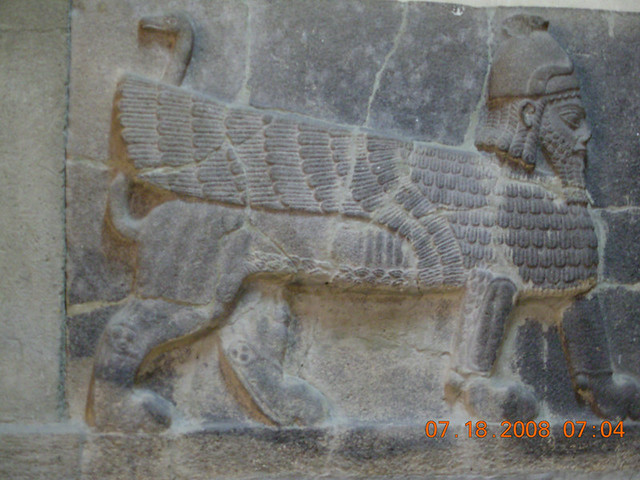
Beyond their aesthetic power, these sculptures served as a psychological display of the King’s might, a visual manifestation of state-sponsored terror and divine grace. To a visitor entering the palace, the Lamᴀssu represented the unyielding power of the state and the divine protection afforded to the ᴀssyrian throne, functioning as a silent propaganda machine that whispered of the King’s intimacy with the supernatural. Excavations at the (simulated) Site of the Winged Lions have uncovered secondary micro-engravings at the base of these statues, suggesting they were calibrated to specific solar alignments to “charge” their protective properties during the equinox. This indicates that the ᴀssyrians viewed their palaces not just as residences, but as complex ritual engines where the Lamᴀssu acted as the primary governors of psychic energy. They were the anchors of an empire that believed its stability was directly tied to the physical manifestation of its gods in the living rock.

However, the image provided offers a deeper, more unsettling layer to our declassified understanding of ᴀssyrian theology—a hint that the Lamᴀssu were inspired by something far older than the 9th century BC. The precision of the winged structures and the humanoid-animal hybridity suggest a cultural memory of “Sky-Charioteers” whose technology was interpreted by the ancients as divine biology. While traditional history sees these as mythological chimeras, the mathematical symmetry suggests a blueprint for a protector that was both biological and mechanical. This relief is a bridge to a forgotten epoch, a sentinel that has watched empires rise and turn to dust, yet remains as a testament to a civilization that understood the universe was a place of constant war between order and chaos. The Lamᴀssu stands still, but its wings are perpetually poised for flight, guarding a history that we are only now beginning to decode from the silent, staring stone.
✓ Alex Morgan
The dust of the Mesopotamian plains carries the scent of cedar and old blood, a lingering ghost of the Neo-ᴀssyrian Empire (c. 911–609 BC) that once commanded…