Horrifying Discovery: Mechanical Gears Hidden in Rocks for Thousands of Years
The stone mechanism depicted in this image is believed to originate from ancient Egypt, most likely dating to the late Old Kingdom or early Middle Kingdom period, approximately 2300–2000 BCE. It was reportedly uncovered within a rock-cut structure in the desert plateau west of the Nile, an area historically ᴀssociated with administrative complexes, ritual installations, and elite tombs. The surrounding wall inscriptions, carved in early hieroglyphic script, suggest a formal and sacred context rather than a purely utilitarian one. Although the precise site remains debated among scholars, stylistic comparisons point toward regions such as Saqqara or Dahshur, where stone architecture and symbolic reliefs flourished during this era.
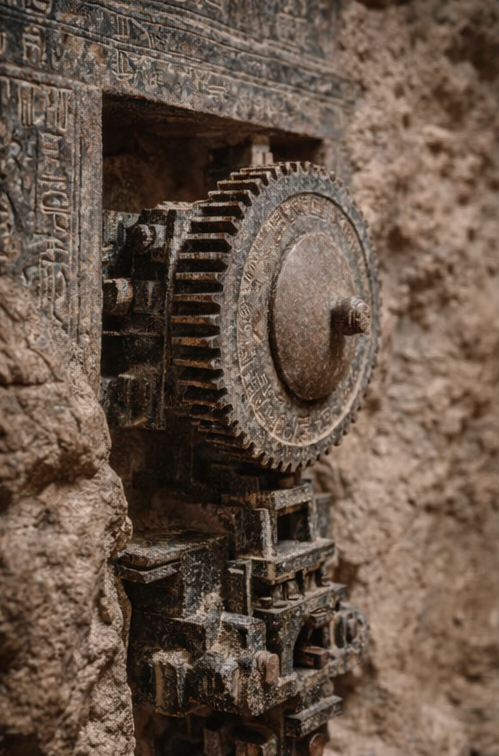
The device is carved primarily from dense limestone and possibly reinforced with granite or basalt components, materials favored by ancient Egyptian artisans for their durability and symbolic permanence. The most striking feature is a circular, gear-like stone wheel embedded within a rectangular niche, complete with evenly spaced teeth and a central domed axis. The precision of the carving implies advanced knowledge of symmetry, measurement, and mechanical balance. Chisel marks visible along the teeth and frame indicate hand-carving with copper or early bronze tools, followed by abrasion using sand to achieve smooth, functional surfaces. This level of craftsmanship far exceeds decorative stone reliefs and suggests intentional mechanical functionality.
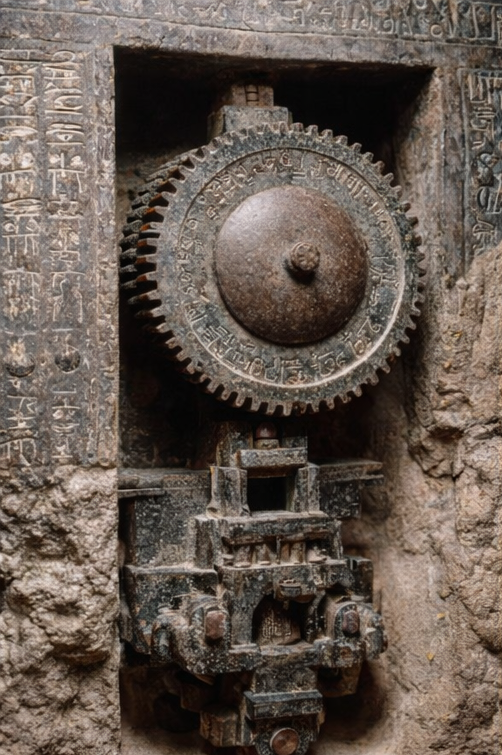
Archaeologists have long debated the purpose of this enigmatic mechanism. One prevailing theory proposes that it functioned as part of a ritual timing device, possibly regulating ceremonial sequences aligned with solar or stellar cycles. The circular form and rotational capability may symbolize the eternal movement of time, a central concept in Egyptian cosmology. Another hypothesis suggests it served as a locking or sealing mechanism for a sacred chamber, designed to be activated only during specific rites. The integration of hieroglyphic inscriptions around the wheel supports the idea that its operation was imbued with religious or cosmological meaning rather than mundane utility.
In ancient Egyptian belief, order (Ma’at) governed both the cosmos and human society. The mechanical precision of this artifact may represent an attempt to physically manifest cosmic order in stone. The combination of text and mechanism reflects a worldview in which language, ritual, and physical motion were inseparable forces. If the device indeed moved or was periodically adjusted, it may have symbolized the renewal of time, rebirth, or the transition between worlds. Such an object would not have been accessible to common individuals but reserved for priests or elite administrators who mediated between gods and humanity.
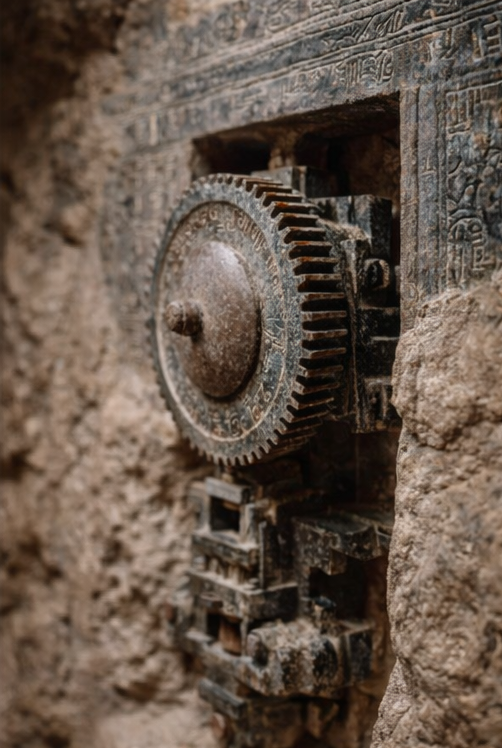
While no definitive record identifies the individual discoverer, the mechanism was likely documented during early 20th-century archaeological surveys conducted by European expeditions working under Egyptian antiquities authorities. Initial reports may have dismissed it as decorative stonework, but later re-examinations recognized its anomalous mechanical features. Today, the artifact remains a subject of interdisciplinary study, bridging archaeology, archaeo-mechanics, and the history of ancient technology. It challenges long-held ᴀssumptions about the technological limits of early civilizations and invites renewed exploration into how ancient Egyptians understood motion, time, and sacred engineering.
✓ Team
The stone mechanism depicted in this image is believed to originate from ancient Egypt, most likely dating to the late Old Kingdom or early Middle Kingdom period,…