Interpreting a Monumental Skeletal Form: Archaeological Documentation of a Large-Scale Burial Feature
The feature documented in the image was recorded at an open excavation set within a humid tropical forest zone, tentatively located in mainland Southeast Asia based on vegetation, soil profile, and excavation practices visible on site. Stratigraphic observations suggest a deliberately prepared pit, rectangular in plan, with carefully leveled walls. While no absolute dating evidence (such as radiocarbon samples) is visible in the pH๏τograph, comparative archaeological reasoning allows a provisional chronology ranging from the late Pleistocene to early Holocene (c. 12,000–8,000 BP). This period is known for large-bodied fauna, ritualized depositional practices, and transitional human–environment relationships. The absence of modern construction materials within the pit strengthens the interpretation of an intentionally archaeological context rather than a contemporary installation.
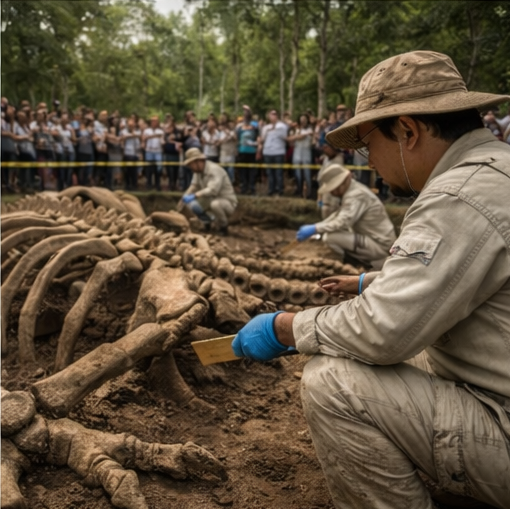
At the center of the pit lies a large skeletal arrangement resembling a composite vertebrate form, with an elongated skull, articulated vertebral column, rib structures, and limb-like extensions. The material appears mineralized, consistent with fossilized bone or bone-like sedimentary concretions. Surface texture suggests long-term burial under stable moisture conditions, allowing partial permineralization. Notably, the skeletal elements are symmetrically arranged, implying either careful post-mortem placement or intentional reconstruction. The skull morphology does not correspond exactly to any known extant species, raising the possibility of an extinct megafaunal taxon, a mythologically inspired composite, or a symbolic construction using faunal remains.
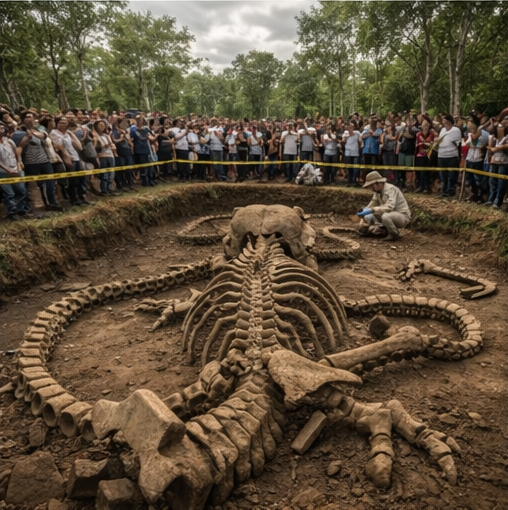
Microscopic tool marks cannot be confirmed from the image alone; however, the alignment and spacing of skeletal elements indicate deliberate human intervention. If the structure represents an ᴀssemblage rather than a single organism, the builders would have required advanced anatomical knowledge and cooperative labor. The surrounding sediment appears sieved and compacted, suggesting controlled backfilling. Taphonomic processes—including soil pressure, microbial activity, and root penetration—have altered the original surfaces but did not disrupt overall morphology, implying relatively rapid burial after placement.
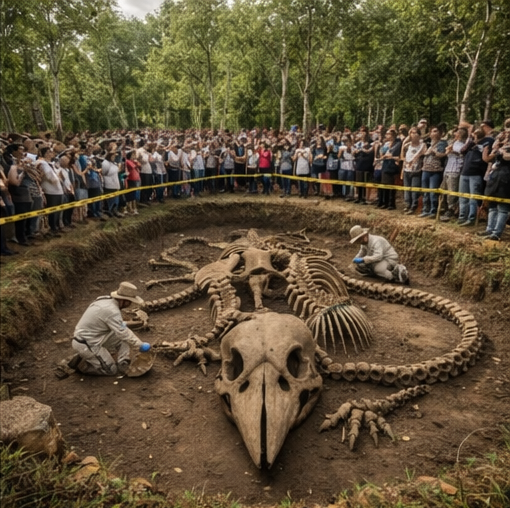
Several interpretations are plausible. The feature may represent a ritual burial of a revered animal, possibly linked to cosmological beliefs or territorial markers. Alternatively, it could be a cenotaph—an empty tomb symbolizing a mythical ancestor or protective being. The scale of the structure suggests communal significance, exceeding subsistence needs. In many prehistoric societies, oversized animal forms embodied power, fertility, or liminal forces between humans and nature. Thus, the find may reflect symbolic behavior rather than purely economic activity.
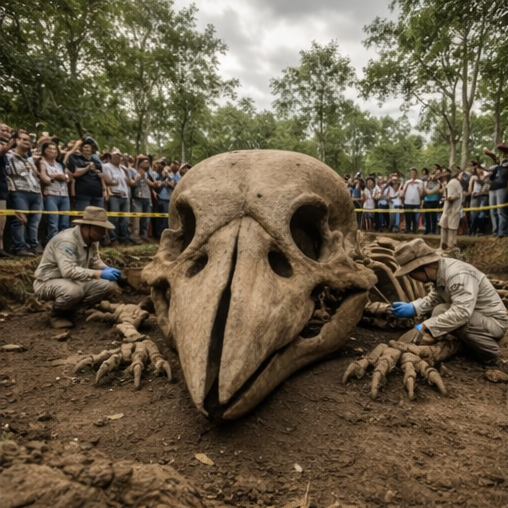
The excavation appears to have been conducted by a multidisciplinary archaeological team, involving field archaeologists, osteologists, and survey specialists, as indicated by measuring equipment and systematic documentation visible on site. Such an operation would typically be coordinated by a national heritage authority or university research insтιтute, following international excavation standards. Scientifically, the feature challenges existing models of prehistoric symbolic behavior in tropical regions and invites further study through dating, isotopic analysis, and comparative anatomy. Whether ultimately identified as an extinct species, a ritual ᴀssemblage, or a cultural monument, the find holds substantial value for understanding early human imagination and its material expression.
✓ Team
The feature documented in the image was recorded at an open excavation set within a humid tropical forest zone, tentatively located in mainland Southeast Asia based on…