JAM’S MINARET TOWER: THE LONELY GUARDIAN OF THE GHURID EMPIRE
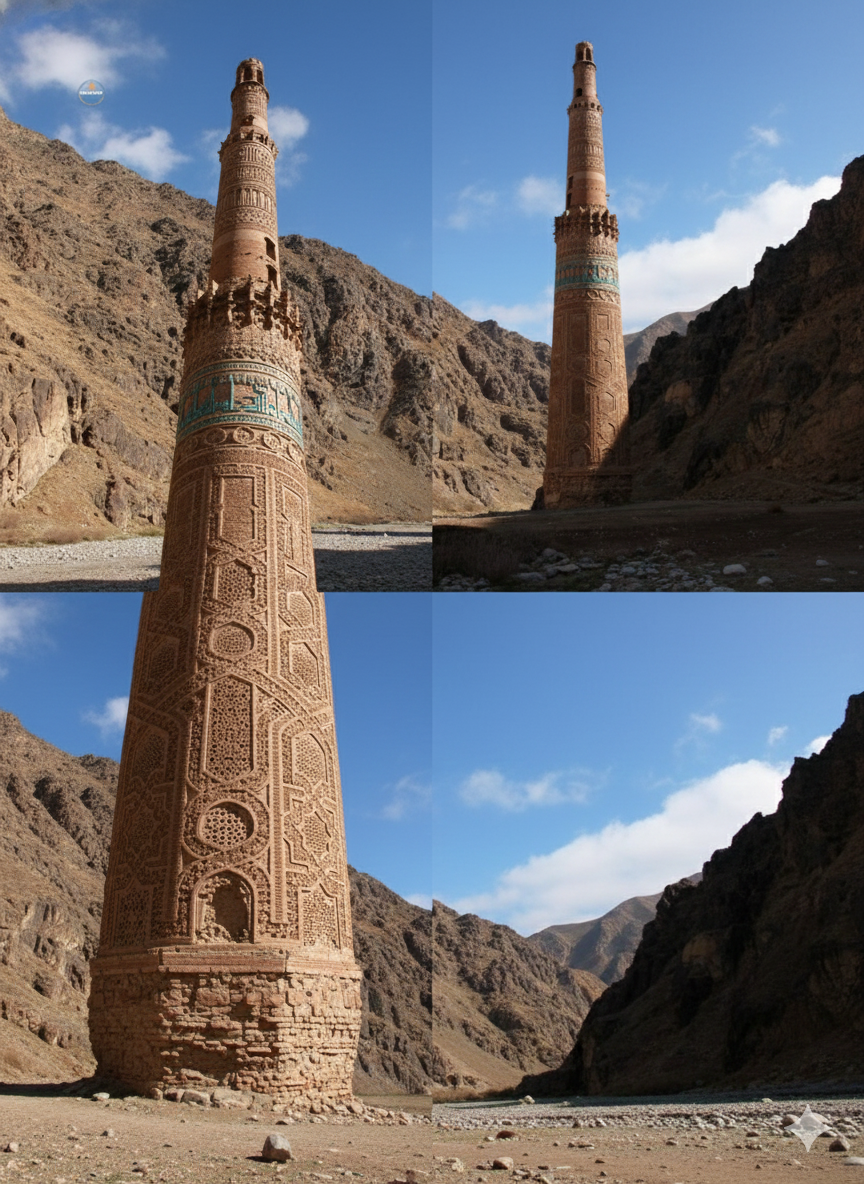
The artifact in the image is the Minaret of Jam, a UNESCO World Heritage site located in the Ghor Province of Afghanistan. The tower was constructed around 1190 AD under the patronage of the Ghurid Sultan Ghiyath al-Din Ghori. Standing at an alтιтude of 1,900 meters above sea level, the minaret is situated in a deep, remote valley surrounded by rugged mountains, where the Hari-rud and Jam-rud rivers meet. This site is believed to have been the ancient city of Firozkoh (Turquoise Mountain), the magnificent summer capital of the Ghurid dynasty before it was destroyed by Mongol armies in 1222.
This 65-meter-tall minaret is crafted primarily from fired bricks bonded with lime mortar. The entire surface of the tower is a masterpiece of geometric art and Islamic calligraphy. Artisans employed sophisticated brick-carving techniques, integrated with bands of turquoise glazed tiles forming Kufic and Naskhi inscriptions. Notably, the tower features intricate interlacing geometric reliefs and the entire 19th Sura of the Qur’an (Maryam) is engraved around its shaft. The internal structure contains a double-spiral staircase leading to balconies, demonstrating the exceptional architectural engineering of the 12th century.
For centuries, the minaret remained largely forgotten by the outside world due to the fragmented terrain. It was “rediscovered” by archaeologists in 1957 by the French anthropologist André Maricq. Subsequently, in the 1960s, more detailed surveys were conducted by the French Archaeological Delegation in Afghanistan (DAFA) and Italian architect Andrea Bruno. Modern excavation and conservation efforts have focused primarily on preventing river erosion and the leaning of the tower, especially after its inclusion on UNESCO’s List of World Heritage in Danger in 2002.
While taking the form of a minaret, its isolated location leads archaeologists to believe it served a political-symbolic purpose rather than a purely religious one. It functioned as a victory tower, ᴀsserting the power of the Ghurid dynasty and the expansion of Islam into the region. The inscriptions praising Sultan Ghiyath al-Din turned the tower into a “beacon” of faith and authority in the heart of the canyons. Additionally, it may have once served as a watchtower or a landmark for merchant caravans traveling along the Silk Road.
The Minaret of Jam is one of the oldest and the second-tallest ancient brick structure still standing in the world. It provides invaluable data on the transition of architectural styles from Central Asia to the Indian subcontinent, serving as a precursor to the Qutub Minar in Delhi. Currently, archaeologists are utilizing 3D laser scanning and satellite monitoring to preserve this monument against threats from flooding, earthquakes, and political instability. The minaret remains a proud symbol of Afghan history, reminding the world of a golden era of ancient Islamic art and architecture.
✓ Team
The artifact in the image is the Minaret of Jam, a UNESCO World Heritage site located in the Ghor Province of Afghanistan. The tower was constructed around…