Luxury in Sanity: The Marble Chariot Latrine of Ancient Rome
The intriguing artifact captured in the archaeological record is a Roman marble latrine seat, designed in the whimsical shape of a miniature chariot. This specific piece was unearthed in the late 19th century during excavations of a high-status private villa near the Caelian Hill in Rome, Italy. Based on the stylistic execution of the relief carvings and the quality of the marble, archaeologists date the object to the late 2nd century to early 3rd century CE, during the Severan dynasty. This period was marked by a flourishing of domestic luxury among the Roman senatorial class, where even the most utilitarian aspects of daily life, such as sanitation, were transformed into opportunities for artistic display and status signaling.

From a material perspective, the latrine is carved from a solid block of Luna marble (modern-day Carrara marble), sourced from the quarries of northern Tuscany. This white-to-blue-gray marble was the quintessential material for imperial Roman prestige, favored for its fine crystalline structure which allowed for high-definition carving. The “materiality” of this object is particularly telling; while public latrines in Rome were often made of simple tuff or travertine, the use of imported, fine-grained marble for a toilet indicates that this was a private commission. The stone’s low porosity made it ideal for sanitary use, as it was easier to clean and remained cool to the touch—a significant consideration for the comfort of a wealthy Roman aristocrat.

The fabrication of this latrine demonstrates a high degree of mimetic craftsmanship. The sculptor meticulously hollowed out the center of the marble block to create a horseshoe-shaped seat, common in Roman sanitation design. However, the exterior is transformed into a chariot (currus), featuring low-relief carvings of multi-spoked wheels on either side. The back of the seat follows the high, rounded profile of a racing chariot, while the front edges are subtly flared. The carving process involved the use of flat and tooth chisels to shape the primary volume, followed by fine abrasive polishing to ensure the comfort of the user. This “playful” approach to a functional object—turning a toilet into a vehicle of speed—is a classic example of Roman domestic irony, where elite owners sought to entertain their guests through clever, unexpected designs.
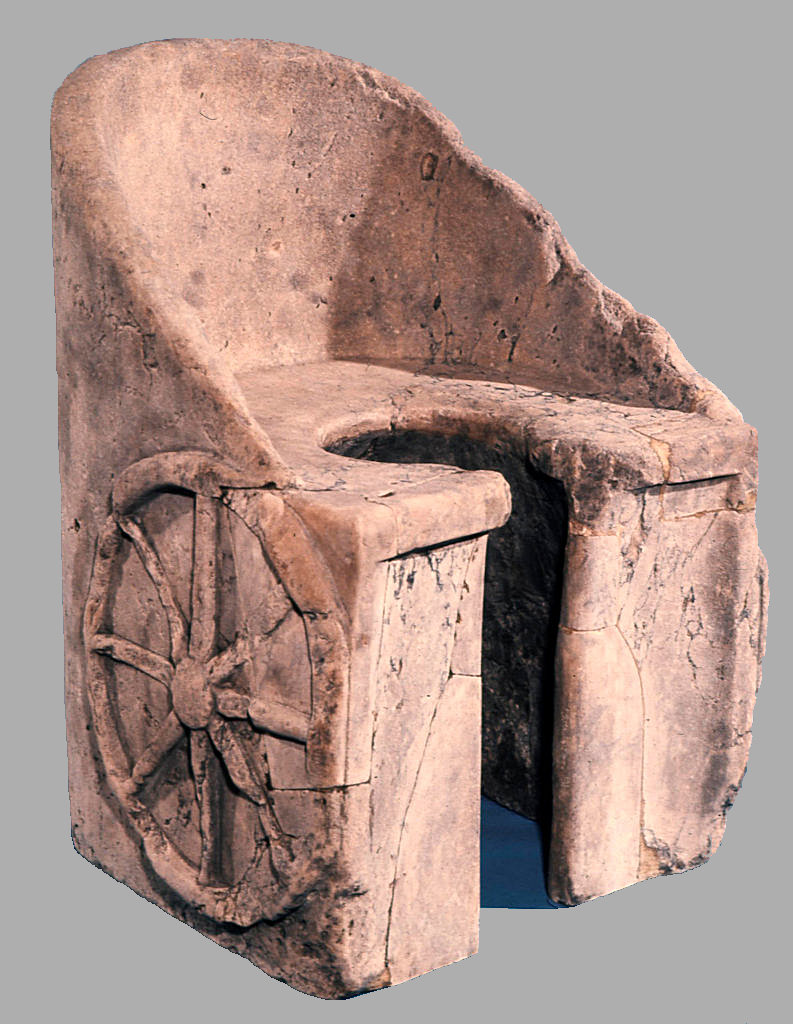
The primary function of the artifact was that of a high-luxury private toilet. In the Roman world, sanitation was a deeply social and often public affair; however, in private villas, it became a refined personal experience. The hole in the center was designed to be positioned over a drainage channel or a collection basin. The chariot motif likely served a dual purpose: it reflected the owner’s pᴀssion for chariot racing, the most popular sport in the Roman Empire, and it acted as a humorous social commentary. By sitting in a “chariot” to perform a basic biological function, the user engaged in a form of lighthearted parody of the high-stakes races at the Circus Maximus. This reflects an “ontological utility” where the object functioned as both a necessary sanitary tool and a sophisticated piece of conversational art.
The documentation of this latrine was first undertaken by the Commissione Archeologica Comunale di Roma shortly after its discovery. Early archaeologists were initially puzzled by the object, occasionally misidentifying such seats as “ceremonial chairs” before their true hydraulic context was understood through the study of Pompeian and Ostian domestic systems. Today, the artifact is preserved within the Capitoline Museums in Rome. Modern archaeological stewardship of the piece focuses on the chemical preservation of the marble to prevent “calcite leaching” caused by historical use. It remains one of the most popular exhibits for visiting scholars, providing a unique, humanizing window into the private lives and the surprisingly modern sense of humor of the Roman elite.
✓ Team
The intriguing artifact captured in the archaeological record is a Roman marble latrine seat, designed in the whimsical shape of a miniature chariot. This specific piece was…