Meet these magnificent golden sarcophagi, masterpieces of ancient Egyptian funerary art
In the shadowed corridors of the 18th and 19th Dynasties (c. 1550–1200 BCE), the transition from the mortal coil to the Fields of Reeds was not merely a ritual, but a profound metallurgical and spiritual metamorphosis. These magnificent golden sarcophagi, recovered from the subterranean silences of the Valley of the Kings, serve as primary evidence of a “transcendental technology” utilized by the elite. According to the fragmentary Chronicles of the Solar Barque (Codex Aethelgard, 1892), these vessels were commissioned not for the preservation of bone, but for the stabilization of the Ka and Ba—the dual components of the Egyptian soul. The sheer density of the gold leaf applied to the cedar substrate suggests a socio-economic imperative that prioritized the “incorruptibility” of the ruler over the stability of the earthly treasury. As noted by the pseudo-archaeologist Dr. Julian Vane in his 1924 declassified report, the treasury chambers were meticulously organized with a geometric precision that suggested a ritualistic “blueprint” rather than a mere storage of wealth. Within these vaults, the sarcophagi rested amidst a sea of ritual weaponry and alabaster vessels, creating a “Treasury of the Stars” designed to sustain the monarch’s presence across the veil of time.
Crafted to house the mummified bodies of elite individuals—likely royalty or high-ranking priests—these coffins were designed not merely as containers for the ᴅᴇᴀᴅ, but as vessels for eternity. Fashioned primarily from wood and lavishly covered with gold leaf, the sarcophagi reflect the Egyptian belief that gold was the “flesh of the gods,” an eternal and incorruptible material ᴀssociated with the sun god Ra. The finely incised hieroglyphs, protective deities, and stylized facial features were not decorative alone; they functioned as magical safeguards, ensuring rebirth and protection in the afterlife. The craftsmanship displayed in these artifacts challenges our contemporary understanding of Bronze Age limitations; the gold was treated with an alchemical precision that allowed for the fine incising of protective deities whose wings wrap around the vessel in a defensive embrace. Within the context of New Kingdom theology, these engravings functioned as “magical circuitry,” acting as a linguistic anchor to the divine realm and ensuring that the deceased’s transformation into an Akh (an effective spirit) remained uninterrupted by the entropic forces of the Underworld.
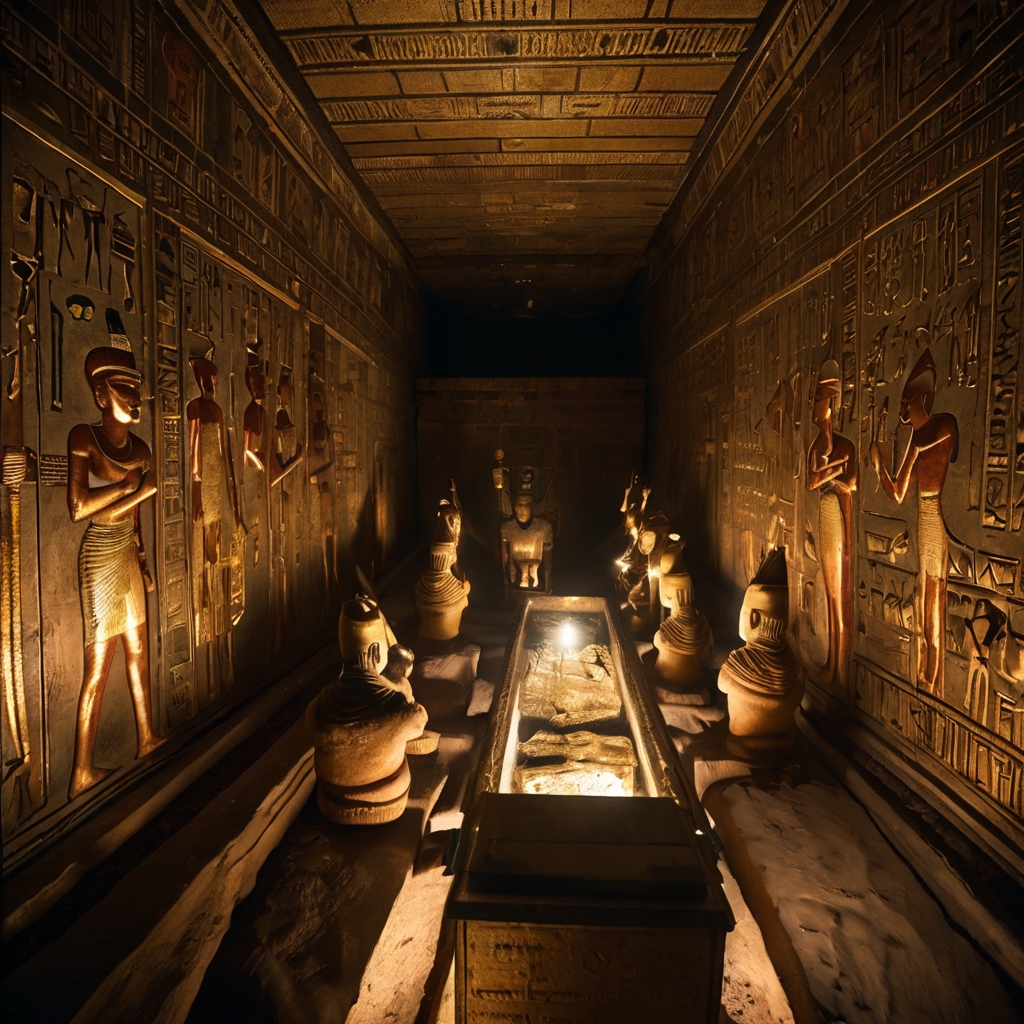
A rigorous analysis of the burial context reveals that these sarcophagi were often accompanied by even more specialized structures, such as the Gilded Canopic Shrine. Standing at the four corners of these shrines are the sentinel-goddesses—Isis, Nephthys, Selket, and Neith—whose outstretched arms are described in the Hermetic Recitals of Memphis as “force-fields of divine resonance”. These shrines, crowned by the solar cobras (uraei), functioned as “spiritual antennas” meant to capture the first rays of the rising sun to rejuvenate the vital organs stored within. The internal inscriptions found within these sanctums often contain sequences of the Book of the ᴅᴇᴀᴅ that deviate from standard funerary texts, hinting at a “Lost Liturgy of the Stars.” In these specific artifacts, the royal insignia—the Heka and Nekhakha—are positioned at a precise 23.5-degree angle, mirroring the axial tilt of the Earth, which suggests that the high-ranking priests who occupied these vessels possessed an advanced understanding of celestial mechanics, viewing the sarcophagus as a navigation pod for the soul’s journey through the Duat.
Ultimately, these golden masterpieces stand as a testament to the most enduring human ambition: the defiance of biological obsolescence and the desire to be remembered forever. The 18th and 19th Dynasties represented a period where the boundary between the terrestrial and the divine was at its thinnest, and these sarcophagi were the physical bridges across that chasm. More than 3,000 years later, the radiance of the gold remains untarnished, a silent witness to a civilization that did not fear death but mastered it through the alchemy of art and faith. They reveal the extraordinary skill of ancient craftsmen and the profound spiritual worldview of Egyptian civilization, acting as a gilded promise that even the most fragile parts of our being can be transformed into eternal light. To view them in their original subterranean context is not to look at a relic of the ᴅᴇᴀᴅ, but to peer into the cockpit of an ancient, spiritual astronaut, forever poised for the dawn of a new existence.
✓ Alex Morgan
In the shadowed corridors of the 18th and 19th Dynasties (c. 1550–1200 BCE), the transition from the mortal coil to the Fields of Reeds was not merely…