Pont du Gard: The Stone River of the Roman World
Standing across the Gardon River in southern France, the Pont du Gard is one of the most extraordinary surviving monuments of Roman engineering. Located near the ancient city of Nîmes (Roman Nemausus), this mᴀssive aqueduct bridge was constructed in the mid–1st century CE, most likely between 40–60 CE, during the reigns of the early Roman emperors. It formed a critical section of a nearly 50-kilometer water supply system that transported fresh spring water from the Eure near Uzès to Nîmes, sustaining urban life, baths, fountains, and sanitation within the Roman colony.

The Pont du Gard was built using locally quarried limestone, carefully cut into mᴀssive ashlar blocks, some weighing over six tons. Remarkably, the structure was ᴀssembled without mortar, relying instead on precise stone cutting and gravity-locked joints. Rising to nearly 49 meters, it is the tallest Roman aqueduct bridge ever constructed. The three tiers of arches decrease in size as they rise, an engineering strategy that reduces weight while maintaining stability. At the very top runs the narrow water channel (specus), lined with waterproof hydraulic mortar to prevent leakage and mineral damage.

From an archaeological perspective, the Pont du Gard is not merely functional infrastructure—it is monumental architecture. The harmonious proportions of its arches reflect Roman aesthetic principles rooted in geometry and order. The gradient of the water channel is astonishingly subtle, descending only about 2.5 centimeters per kilometer, a feat that demanded exceptional surveying precision using Roman tools such as the chorobates and groma. This precision ensured a steady, controlled flow of water over vast distances, proving the Romans’ deep understanding of hydraulics and landscape.
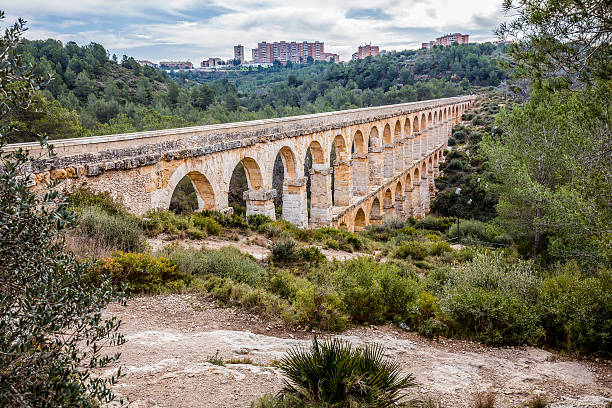
While its primary function was to supply water, the Pont du Gard also served as a powerful symbol of Roman authority and technological superiority. Spanning a wild river valley, it visually proclaimed Rome’s dominance over nature. For local populations in Roman Gaul, the aqueduct represented civilization itself—bringing cleanliness, public health, and urban luxury. The bridge also became a civic landmark, silently reinforcing imperial presence long after administrative power faded. Its continued use and maintenance into late antiquity highlight its durability and importance.

Although never truly “lost,” the Pont du Gard attracted scholarly attention from the 16th century onward, inspiring architects, engineers, and antiquarians. Systematic archaeological studies in the 19th and 20th centuries clarified its construction phases and hydraulic system. Restoration efforts by French authorities preserved the monument while respecting its original Roman fabric. Today, recognized as a UNESCO World Heritage Site, the Pont du Gard stands as a timeless lesson in engineering, where stone, mathematics, and water converge to express the ambitions of an ancient empire.
✓ Team
Standing across the Gardon River in southern France, the Pont du Gard is one of the most extraordinary surviving monuments of Roman engineering. Located near the ancient…