Qasr al-Farid: The Unfinished Masterpiece of the Nabataean Desert
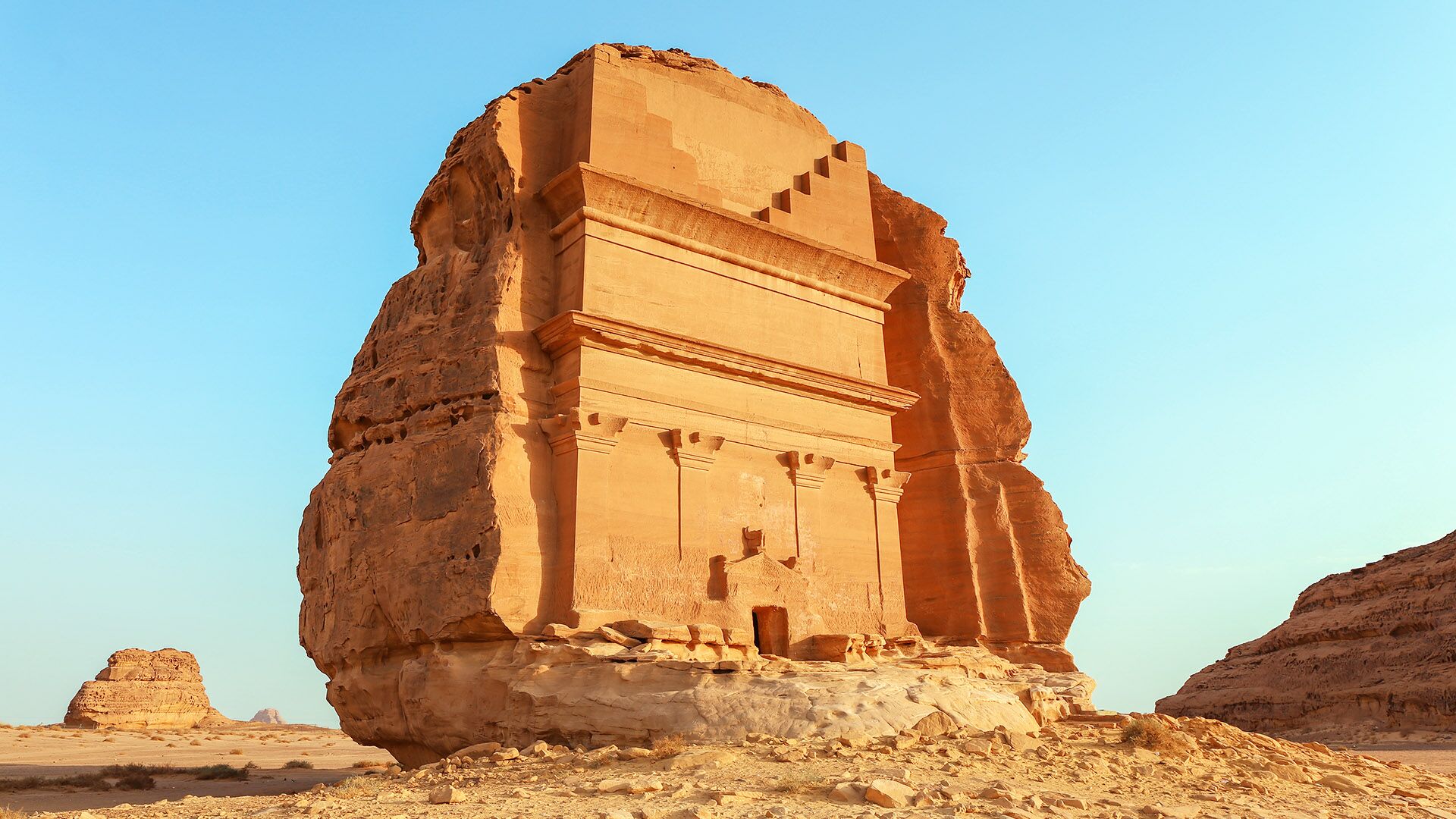
The monumental structure in the image is Qasr al-Farid (the “Lonely Castle”), a magnificent rock-cut tomb located in the archaeological site of Hegra (also known as Mada’in Salih) in northwestern Saudi Arabia. Dating back to the 1st century CE, this tomb is the most iconic of the 111 monumental facades at the site, which served as the southern capital of the Nabataean Kingdom—the same civilization that built the famous city of Petra in Jordan. Unlike many other tombs that are carved in clusters into large cliff faces, Qasr al-Farid is uniquely hewn into a single, isolated sandstone monolith, standing as a solitary sentinel in the vast desert landscape of the AlUla region.

Crafted from local sandstone, the tomb is a supreme example of subtractive rock-cut architecture. The Nabataean masons utilized a “top-down” carving method, beginning at the summit of the rock and working their way toward the desert floor. This technique allowed them to avoid the need for scaffolding while ensuring the weight of the rock above did not collapse during the process. The facade is characterized by its mᴀssive size and four sophisticated pilasters with Nabataean capitals, supporting a heavy entablature. A fascinating detail for archaeologists is that the tomb is technically unfinished; the carving becomes noticeably rougher toward the base, providing a “frozen-in-time” look at the ancient tools and stone-cutting methods used by these desert engineers.
In terms of function and significance, Qasr al-Farid was intended as a familial mausoleum for an elite individual or family within the Nabataean hierarchy. Despite its name “Lonely Castle,” it was never a fortress but a sacred space for the ᴅᴇᴀᴅ. The architectural style represents a “crossroads of cultures,” blending Greco-Roman elements (the pediment and columns) with Egyptian influences (the cavetto cornices) and indigenous Mesopotamian motifs (the “crow-step” or stepped merlon designs at the top). This hybridity highlights Hegra’s importance as a major hub for the incense trade, where merchants and artisans from across the ancient world exchanged ideas, resulting in a unique cosmopolitan aesthetic that dominated the Arabian Peninsula for centuries.

The scientific unveiling of Hegra and Qasr al-Farid began with early European explorers such as Charles Montagu Doughty in 1876, but modern archaeological rigor was brought to the site in the early 20th century by the Dominicans Antonin Jaussen and Raphaël Savignac. Their seminal work, Mission archéologique en Arabie, provided the first detailed mapping of the facades. In the 21st century, the site became the focus of the Hegra Archaeological Project, a collaborative effort between the Saudi Heritage Commission and the French Agency for AlUla Development (AFALULA). This partnership has utilized high-resolution pH๏τogrammetry and 3D modeling to document every chisel mark on Qasr al-Farid, leading to its designation as Saudi Arabia’s first UNESCO World Heritage Site in 2008.
From a contemporary archaeological perspective, Qasr al-Farid offers invaluable insights into the socio-economic status and funerary rituals of the Nabataeans. The scale of the tomb suggests immense wealth, likely derived from the taxation of camel caravans carrying frankincense and myrrh. Recent excavations in the surrounding desert have revealed a thriving urban center near the tombs, complete with residential areas, temples, and sophisticated water conservation systems. Today, Qasr al-Farid is not just a relic of the past; it is a central pillar of Saudi Arabia’s “Vision 2030” cultural tourism, inviting researchers and visitors alike to marvel at a civilization that literally carved its history into the living rock of the Hijaz.
Would you like me to research the specific Nabataean inscriptions found on the nearby tombs to see what they reveal about the legal protections and “curses” placed on those who dared to disturb the ᴅᴇᴀᴅ?

✓ Team
The monumental structure in the image is Qasr al-Farid (the “Lonely Castle”), a magnificent rock-cut tomb located in the archaeological site of Hegra (also known as Mada’in…