Shadows on the Limestone: The Palaeolithic Masterpieces of the Lascaux Cave
The Lascaux Cave, often referred to as the “Sistine Chapel of Prehistory,” represents one of the most significant archaeological discoveries of the 20th century. Located in the Vézère Valley in southwestern France, the cave complex houses nearly 2,000 figures that date back to the Upper Palaeolithic period (c. 17,000–15,000 BCE). Specifically attributed to the Early Magdalenian culture, these paintings offer a window into a world where human survival was inextricably linked to the migration of megafauna. The dating, established through radiocarbon analysis of charcoal fragments and stylistic comparisons with other Franco-Cantabrian sites, places these works at a time when the last Ice Age was beginning to wane. The discovery has fundamentally altered our understanding of early human cognitive development, proving that prehistoric hunter-gatherers possessed a sophisticated capacity for symbolic thought, artistic perspective, and long-term cultural transmission.
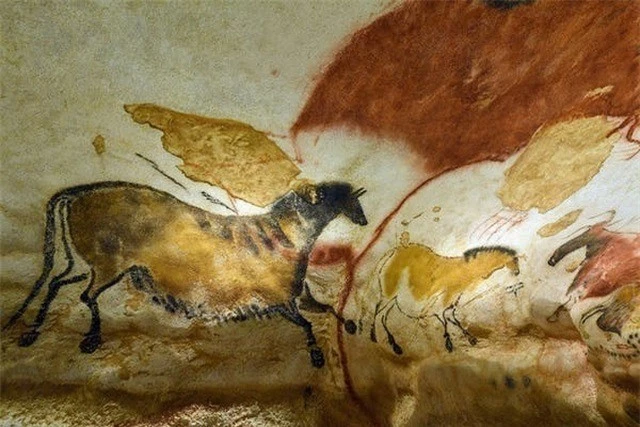
The fabrication of the Lascaux murals involved a highly advanced understanding of natural chemistry and geology. The ancient artists utilized natural mineral pigments sourced from the surrounding environment: iron oxides (ochre) provided the vibrant reds and yellows, while manganese oxides and charcoal were used for the deep blacks. These minerals were ground into fine powders and mixed with cave water, animal fat, or plant juices to create a primitive yet incredibly durable paint. The technique of application was equally ingenious; artists used brushes made of animal hair or moss, and even “airbrush” techniques by blowing pigment through hollow bird bones or reeds to create soft gradients. A striking detail is the use of the cave’s natural topography; the artists intentionally placed figures on bulges or indentations in the limestone walls to provide a three-dimensional effect, making the animals appear to move as the light from flickering animal-fat lamps danced across the surface.
The primary function of the Lascaux Cave is widely interpreted as a sacred ritual sanctuary rather than a living space. The absence of domestic debris—such as cooking hearths or heavy concentrations of stone tools—within the painted chambers suggests that the cave was reserved for spiritual or ceremonial gatherings. The depictions of aurochs, stags, horses, and bison are not merely artistic; they likely served as part of “hunting magic” or shamanic rituals intended to ensure the fertility of the herds or success in the hunt. Furthermore, the presence of abstract dots and geometric signs alongside the animals has led some researchers to suggest an early form of archaeoastronomy, where the patterns represent star constellations like the Pleiades. For the Palaeolithic community, the cave was a liminal space—a dark, subterranean cathedral where the myths of the tribe were visualized and pᴀssed down through generations.

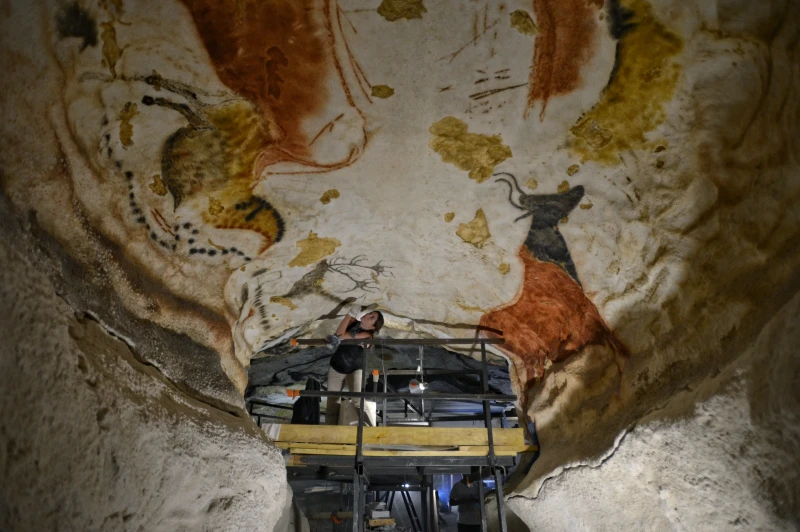
The story of Lascaux’s discovery is as legendary as the cave itself. On September 12, 1940, four teenagers—Marcel Ravidat, Jacques Marsal, Georges Agnel, and Simon Coencas—stumbled upon the entrance after their dog, Robot, disappeared into a narrow shaft. Following the initial discovery, the site was rigorously studied by the preeminent prehistorian of the era, Abbé Henri Breuil, who was the first to recognize the authenticity and immense scale of the find. Following World War II, the cave was opened to the public, but the carbon dioxide from thousands of visitors began to foster the growth of “green sickness” (algae) and “white sickness” (calcite crystals), threatening the pigments. Consequently, the French Ministry of Culture closed the original cave in 1963 to preserve it. Today, the site is managed by the International Center for Cave Art, which maintains “Lascaux IV”—a high-tech, full-scale replica that allows for scientific study without endangering the ancient originals.
The legacy of Lascaux serves as a powerful reminder of the deep roots of human creativity. It proves that the urge to document our existence and our relationship with the natural world is a fundamental trait of our species. The preservation of these 17,000-year-old pigments is a continuous battle between science and nature, requiring constant climate monitoring and microbiological research. For archaeologists, Lascaux is not just a gallery; it is a complex data set that continues to provide new insights into the social structures, migratory patterns, and spiritual beliefs of our ancestors. As we peer into the dark corridors of the Hall of the Bulls, we are not just looking at animals; we are looking into the very dawn of human consciousness—a bridge of ochre and charcoal that connects us to the first storytellers of the human race.
✓ Team
The Lascaux Cave, often referred to as the “Sistine Chapel of Prehistory,” represents one of the most significant archaeological discoveries of the 20th century. Located in the…