Silent Columns Beneath the Sea: An Archaeological Interpretation of a Submerged Ancient Sanctuary
The image captures a submerged architectural complex consisting of stone columns, collapsed entablatures, and a standing marble statue, now resting on the seabed. Such underwater ruins are most often ᴀssociated with ancient Mediterranean coastal cities, where tectonic subsidence, earthquakes, or gradual sea-level rise caused urban districts to sink beneath the water. Comparable sites are known from the Hellenistic and Roman periods (c. 300 BCE – 400 CE), when coastal temples, harbors, and civic monuments were constructed close to shorelines. The presence of scuba divers and artificial lighting indicates a modern underwater archaeological survey rather than accidental discovery.
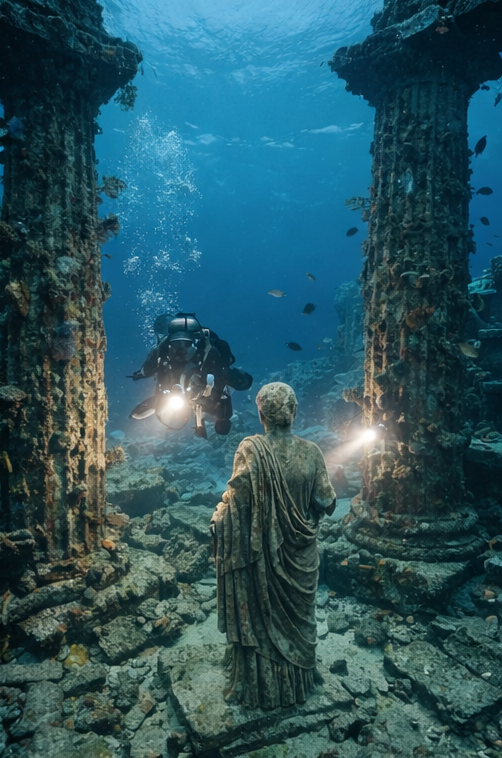
The architectural elements visible—columns, capitals, and horizontal stone blocks—appear to be carved from limestone or marble, materials commonly used in Classical antiquity. The statue at the center, likely marble, follows Greco-Roman sculptural conventions: contrapposto stance, draped garments, and idealized proportions. These components were originally ᴀssembled above water using dry-stone techniques, metal clamps, and gravity-based load distribution. Once submerged, the stone surfaces became colonized by marine organisms, creating biological crusts that both obscure details and, in some cases, protect the original carving from erosion.
In its original context, the structure likely served as a temple, shrine, or monumental public space, possibly dedicated to a deity ᴀssociated with the sea, trade, or civic idenтιтy. Coastal sanctuaries were common in antiquity, acting as visual markers for sailors and spiritual gateways between land and sea. The statue’s placement within a columned space suggests ritual significance rather than purely decorative use. Its survival in situ indicates that the site was abandoned rapidly, possibly following a sudden geological event, rather than dismantled or reused over time.
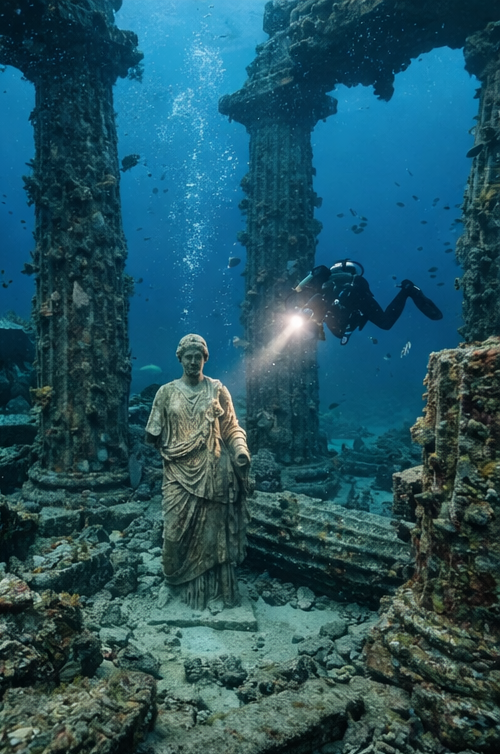
Underwater archaeological work differs significantly from terrestrial excavation. Teams rely on scuba or rebreather systems, pH๏τogrammetry, and controlled lighting to document sites with minimal disturbance. Artifacts are rarely removed unless threatened by looting or degradation. Instead, researchers create 3D models, detailed site maps, and sediment analyses to reconstruct the original layout. Discoveries like this are typically documented by national antiquities authorities or university-led maritime archaeology programs, often in collaboration with marine scientists.
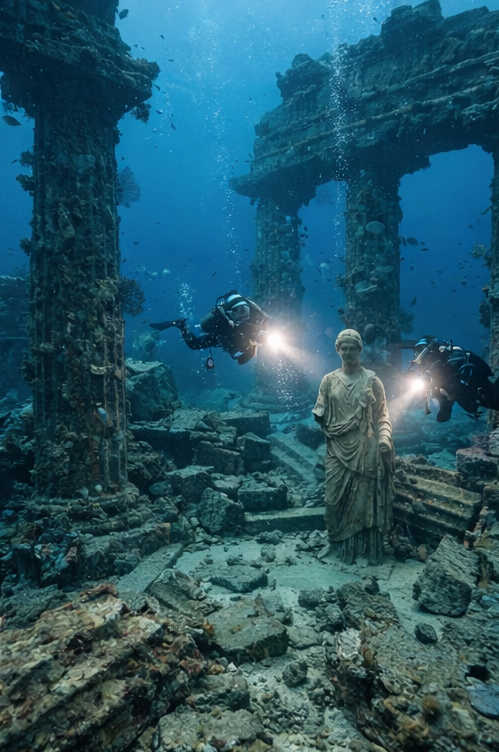
The emotional impact of such a site is profound. Architecture once filled with voices, rituals, and movement now exists in complete silence, animated only by drifting fish and shafts of filtered light. This submerged sanctuary stands as a reminder that ancient civilizations were not static monuments but dynamic societies vulnerable to environmental change. Archaeologically, the site bridges human history and natural processes, illustrating how cities can vanish without destruction, preserved instead in a suspended state beneath the sea. For modern observers, it evokes both loss and continuity—proof that human creativity endures even when landscapes transform.
✓ Team
The image captures a submerged architectural complex consisting of stone columns, collapsed entablatures, and a standing marble statue, now resting on the seabed. Such underwater ruins are…