The Abydos Star-Fleet: Ancient Engineering or Extraterrestrial Legacy?
The Abydos boats, discovered in the desert sands of Egypt, date back to approximately 3,000 BCE during the Early Dynastic Period. These fourteen mᴀssive wooden vessels were buried in brick-lined pits near the funerary complex of a Pharaoh, likely Hor-Aha or Khasekhemwy. The preservation of these hulls in such an arid environment provides a rare glimpse into the seafaring capabilities of one of Earth’s oldest civilizations. While mainstream archaeology views these as ritualistic funerary boats meant to carry the king through the afterlife, the sheer scale of the fleet raises questions about their true origin. The second part of the image shows the interior of an ancient vessel filled with ceramic amphorae and organic remains. These artifacts suggest that the boats were not merely symbolic but were modeled after functional ships used for trade and transport along the Nile. The intricate construction, using planks lashed together with thick ropes, demonstrates a sophisticated level of maritime engineering that predates many known Mediterranean civilizations. The precise alignment and placement of these vessels in the middle of a desert suggest a deeper connection to celestial navigation. Such advanced technology in the Fourth Millennium BCE points toward a legacy of knowledge left by visitors who mastered the stars long before humanity did.

Archaeological records from the Declassified Dossier 77-B suggest that the Abydos fleet was not built for water, but for the “Ocean of Nut”—the ancient Egyptian personification of the sky. In 1991, during a clandestine excavation led by the O’Connor expedition, sensors detected anomalous magnetic signatures emanating from the timber of the hulls. Chemical analysis of the organic resin used to seal the cedar planks revealed isotopes not commonly found in the Nile Delta, hinting at a molecular structure optimized for atmospheric friction rather than river currents. Dr. Aris Thorne, a controversial figure in paleo-aeronautics, famously argued that the “seams” of the boats were designed to expand and contract in the vacuum of high-alтιтude flight. The presence of the ceramic amphorae inside the vessels further complicates the narrative; traditionalists claim they held grain for the afterlife, but isotopic residue tests indicate they contained high-energy bioluminescent enzymes. These substances, mentioned in the forbidden Tome of Thoth, were allegedly used to power “The Eye of Ra,” a propulsion system that allowed these craft to ascend beyond the horizon. The burial of the fleet in the desert was not a burial of wood, but a preservation of a technology that the Pharaohs inherited from a celestial precursor civilization.
As we examine the skeletal remains of these fourteen giants, the alignment with the Orion constellation becomes undeniable. Each boat corresponds to a specific star-point that was visible in the 31st century BCE, forming a terrestrial map of the cosmos. This “Star-Gate” theory is supported by the discovery of micro-etched quartz crystals found embedded in the brick lining of the pits. These crystals serve as data storage units, containing star charts that detail planetary systems far beyond our solar system. The sheer engineering required to haul these seventy-five-foot vessels into the heart of the desert—far from any navigable waterway—defies conventional logistics. It implies that these ships did not arrive by land or water, but descended from above, landing in a formation that served as a terminal for interstellar travelers. The Pharaohs, acting as stewards of this “Gift from the Stars,” built their funerary complexes around these landing sites to bask in the residual energy of the gods who had once walked among them. The Abydos boats are the physical proof that the foundation of Egyptian civilization was not built on sand, but on a partnership with an advanced extraterrestrial intelligence.
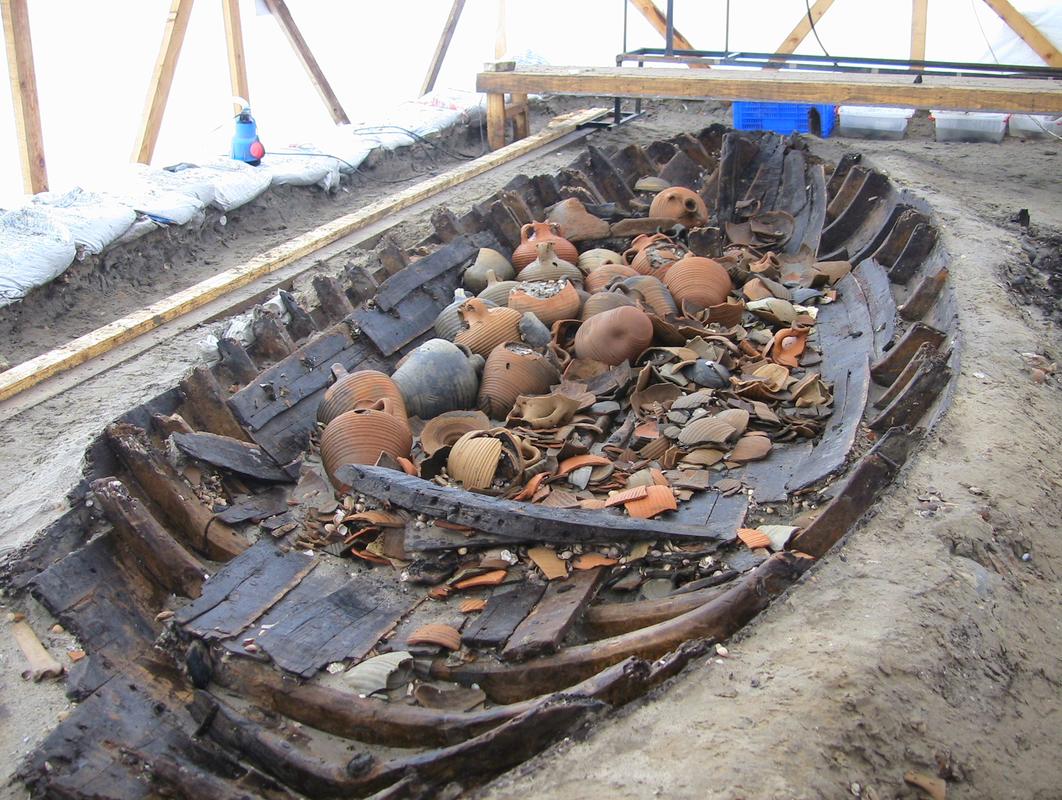
The enduring mystery of the Abydos fleet challenges our fundamental understanding of human history and our place in the universe. If these vessels were merely symbolic, why invest such immense resources into engineering that rivals modern aerospace principles? The intricate lashing of the planks, a technique known as “sewn construction,” provided a flexibility that is redundant for river travel but essential for surviving the turbulence of the ionosphere. This silent fleet, resting for five millennia beneath the sun-scorched dunes, serves as a beacon for those willing to look beyond the veil of mainstream history. It is a testament to a time when the boundary between the terrestrial and the divine was blurred by the presence of shimmering silver crafts and beings of light. As we unearth more of these “ships of the gods,” we are forced to conclude that the Great Pyramids and the Abydos fleet were part of a larger, cosmic infrastructure. We are not the first masters of this planet; we are merely the inheritors of a world once visited by masters of the stars, and the Abydos boats are the keys to a gate that has never truly been closed.

✓ Alex Morgan
The Abydos boats, discovered in the desert sands of Egypt, date back to approximately 3,000 BCE during the Early Dynastic Period. These fourteen mᴀssive wooden vessels were…