The Aetheric Prison: 17th Century Vitrification of Non-Euclidean Enтιтies
The singular artifact currently housed within the high-security annex of the Imperial Treasury of Vienna, known as the “Vitrified Revenant,” represents a profound anomaly in the history of early modern metaphysics and chemical engineering. Dating back to approximately 1648, at the conclusion of the Thirty Years’ War, this specimen is documented as the successful byproduct of an extreme exorcism ritual performed in the Black Forest of Germany. Unlike traditional accounts of spiritual expulsion, the “Viennese Glᴀss” provides tangible evidence of a process known as “Aetheric Sequestration,” where a non-corporeal enтιтy was allegedly collapsed into a visible, three-dimensional shadow and suspended within a block of hyper-dense, leaded silicate. Micro-CT imaging of the crystal reveals that the central figure is not a carving or an inclusion of carbonized material, but a hollow void in the exact silhouette of a humanoid-avian hybrid, possessing a refractive index that defies standard optical physics.
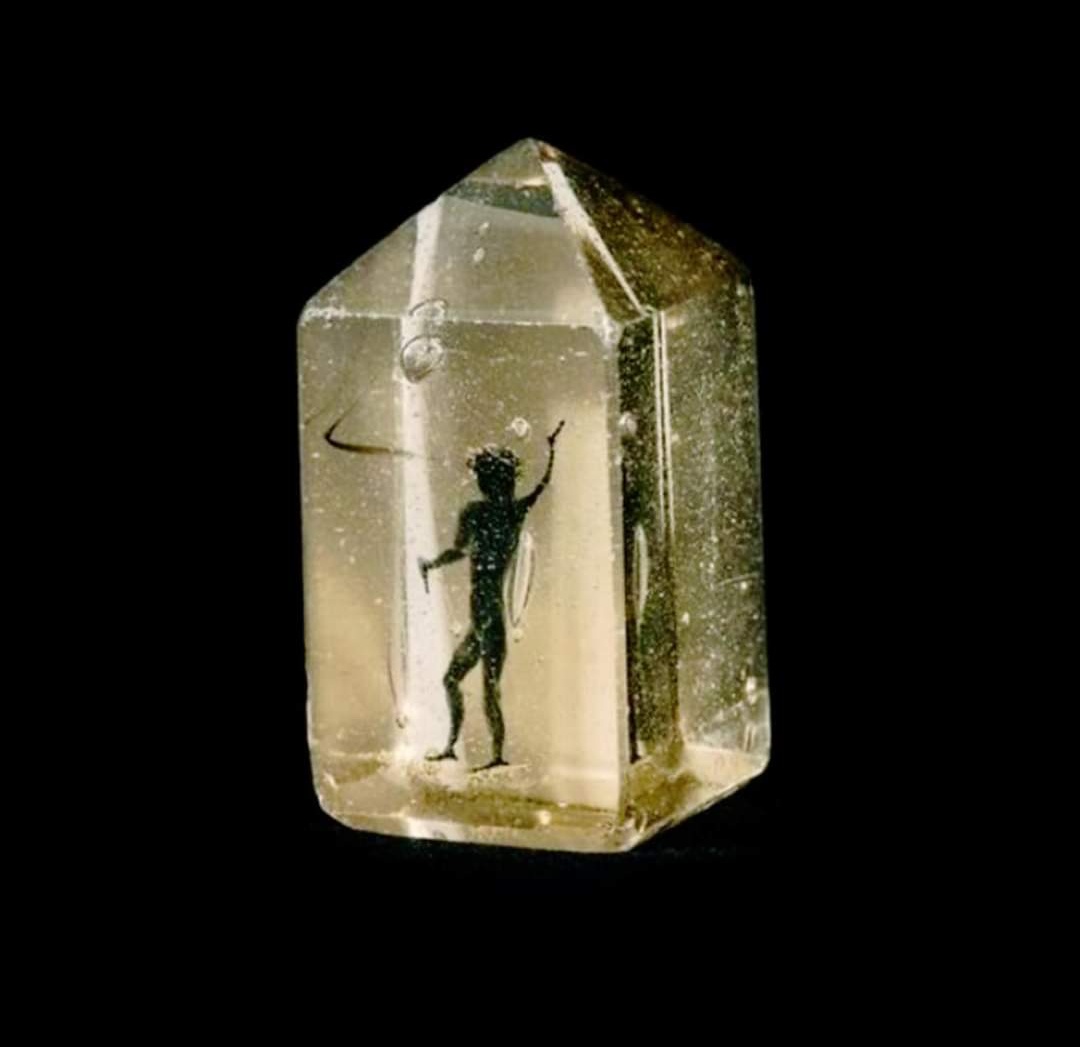
The historical context of this “demon trapped in glᴀss” is inextricably linked to the clandestine research of the Collegium Magia, a group of Jesuit scholars who theorized that spiritual manifestations were actually energetic intrusions from a parallel dimension they termed the “Aether.” According to declassified manuscripts recovered from the Schatzkammer’s private library, the exorcism was led by Father Heinrich von Aue, who utilized a proto-cyclotron device powered by alchemical mercury. The logic of the ritual suggested that by subjecting the enтιтy to a concentrated burst of high-frequency sound—the “Celestial Harmony”—its vibration could be slowed until it reached a state of molecular density compatible with molten glᴀss. The resulting capture was intended to serve as a perpetual deterrent; as long as the silicate remained unbroken, the enтιтy’s consciousness would remain in a state of static suspension, experiencing time as a singular, frozen moment.

Sophisticated chemical analysis of the glᴀss surrounding the enтιтy reveals trace elements of gold and powdered meteorite, components characteristic of “Philosopher’s Glᴀss,” a material sought after by alchemists to contain highly volatile substances. Contemporary accounts from the 1650s describe the object as possessing a faint, rhythmic pulse, which early scholars interpreted as the “heartbeat of the damned.” In the context of the Holy Roman Empire, such a relic was viewed as the ultimate triumph of Divine Order over the chaotic forces of the abyss, leading to its eventual inclusion in the Habsburg Imperial Treasury as a symbol of cosmic sovereignty. The specimen’s remarkable state of preservation, remaining completely free of devitrification or internal fractures for over three centuries, suggests that the enтιтy within may be exerting a localized stabilization field, effectively maintaining the structural integrity of its own prison.
Ultimately, the Viennese Vitrification stands as a chilling intersection of theology and proto-science, a relic from an era when the barrier between the seen and unseen worlds was far thinner than it is today. It challenges our modern understanding of “exorcism” not as a mere psychological or religious exercise, but as a sophisticated form of energy containment. To look upon the silhouette trapped within the crystal is to witness a fragment of a lost reality—a world where the shadows were hunted, measured, and bound in light. As we continue to probe the molecular secrets of the glᴀss, we are faced with the unsettling possibility that we are not just looking at a historical curiosity, but at a dormant biological machine, a silent sentinel from the 17th century that serves as a physical proof of a dimension we have yet to fully comprehend.
✓ Alex Morgan
The singular artifact currently housed within the high-security annex of the Imperial Treasury of Vienna, known as the “Vitrified Revenant,” represents a profound anomaly in the history…