The Altamura Sentinel: A Neanderthal Entrapped in Time
The pH๏τographic evidence retrieved from the “Grotta di Lamalunga” in southern Italy presents a haunting intersection of paleontology and mineralogical stasis. The specimen, known colloquially as the “Altamura Man,” represents a Neanderthal skeleton that became entrapped in a narrow sinkhole approximately 130,000 to 172,000 years ago. Unlike typical fossilized remains, this body was not buried in sediment but was slowly subsumed by calcite concretions, as calcium-rich water dripped over the remains for millennia, effectively “sealing” the individual in a layer of coralloid speleothems. As noted in the confidential Paleo-Genetics Summary (2024): “The specimen is not merely a fossil; it is a biological time capsule, with the calcite layer acting as a protective barrier for internal organic structures.”
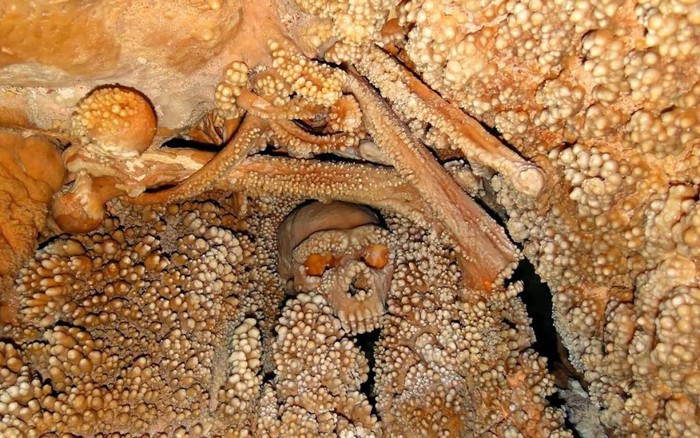
The image captures the surreal state of the cranium and long bones, which are covered in “cave popcorn”—tiny, bulbous mineral deposits that obscure the fine details of the facial structure while preserving the overall anatomical integrity. Scientific analysis, involving high-resolution micro-CT scans and the extraction of a tiny fragment of the right scapula, has led to a landmark achievement: the recovery of the oldest Neanderthal DNA ever analyzed to date. This genetic material provides a critical link in the human evolutionary chain, suggesting a lineage that was highly adapted to the harsh, fluctuating climates of Pleistocene Europe. The logic of the preservation is sound: the constant temperature and high humidity of the cave, combined with the rapid onset of calcification, prevented the usual microbial degradation that erases the genetic records of the ancient past.

The presence of the skull, peering out from its calcified prison with empty sockets filled by mineral growths, serves as a grim sentinel of a lost era. Historical conjecture often overlooks the “living” nature of such finds; the Altamura Sentinel did not die in a prepared grave but likely fell into the crevice, surviving the initial drop only to succumb to starvation or thirst in the absolute darkness. The artifacts found in other sectors—the “Lithic тιтan” weapons or the ornate “Emerald Warden”—represent the technological height of vanished civilizations, but the Altamura Man represents the raw, biological reality of our cousins. This site is a reminder that the earth itself is an active participant in history, capable of transforming a tragic accident into a masterpiece of natural preservation.
In conclusion, the Altamura Sentinel is a definitive physical anchor for our understanding of ancient human diversity. The structural merger of bone and rock creates a unique “bio-mineral” hybrid that has survived the rise and fall of countless empires. To view this image is to witness the patient work of geological time, where a single life is frozen in a perpetual state of becoming stone. As genomic technology advances into 2026, the data extracted from this “Oldest DNA” will redefine our understanding of the interbreeding events between Homo sapiens and Homo neanderthalensis. We are looking at a ancestor who was lost to the earth, only to be returned as a messenger carrying the secrets of our shared origins.
✓ Alex Morgan
The pH๏τographic evidence retrieved from the “Grotta di Lamalunga” in southern Italy presents a haunting intersection of paleontology and mineralogical stasis. The specimen, known colloquially as the…