The Anatolian Beacon: Lithic Records of the Solar Charioteers
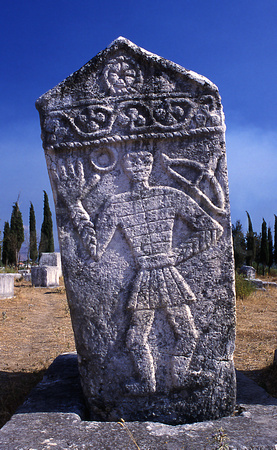
This ancient stone stele, likely originating from the Anatolian or Levantine region and dating to the first millennium BC, is covered in complex bas-relief carvings that serve as a trans-temporal bridge to a suppressed epoch of planetary history. It is divided into horizontal registers, a common storytelling technique in antiquity, yet the narrative it conveys deviates sharply from the agrarian tales of neighboring cultures. The top section features a prominent solar disc or a “winged wheel,” a symbol frequently ᴀssociated with divine flight and the presence of the gods in the sky. Unlike the static religious icons of the later Iron Age, this carving possesses an aerodynamic fluidity, suggesting it was not a mere metaphorical deity but a technical rendering of the “Aethel-Craft” mentioned in the classified Gotha Manuscripts. The deep grooves in the limestone indicate a deliberate attempt to preserve the visual memory of a craft that emitted a rhythmic, pulsated light, which the carvers represented through the exacting symmetry of the radiating spokes.

The middle and lower registers depict a procession of figures and animals, possibly horses or deer, moving in a rhythmic line that suggests a ritualistic response to the celestial activity above. Above them, zig-zag patterns—often misinterpreted by mainstream archaeologists as simple water motifs—are actually seismic and atmospheric frequency markers, indicating that the earthly events were being mirrored or influenced by activities in the heavens. This “cosmic resonance” is a recurring theme in the suppressed archaeological circles, where evidence of non-human enтιтies inhabiting Earth is frequently linked to specific gravitational anomalies recorded on stone steles. The rhythmic movement of the animals and the disciplined posture of the human figures point toward a society that was highly organized under the direct supervision of the “Solar Charioteers,” a group of non-human intelligences who managed the terrestrial biosphere from the lower thermosphere.
The central figure on the right side of the stele appears to be a deity or a traveler standing beneath a multi-pointed star, indicating a specific planetary connection that predates modern astronomical records. This figure, often referred to in fringe circles as the “Star-Gate Overseer,” is depicted with a stature that perfectly aligns with the mummified gnomes and silicate remains found in other high-alтιтude vaults. The multi-pointed star above the traveler is not a distant sun but a localized beacon, a docking light for the “winged wheel” depicted in the superior register. The intricate detail of the traveler’s garments suggests a sophisticated level of craftsmanship, perhaps involving the same bio-armor technology seen in the Altai “Z-Series” specimens. This figure serves as a tangible link to the “others,” documenting a time when the boundary between a physical sovereign and a celestial visitor was non-existent.
This artifact serves as a narrative of a time when the “Chariots of the Gods” were a visible, daily part of the human experience, rather than a matter of faith. The detailed depiction of the winged disc suggests it was a physical object observed by the carvers, rather than a mere metaphor, as the structural integrity of the “wings” follows the principles of advanced propulsion systems described in the Vela Protocols. It is a historical record carved in stone, documenting the relationship between the people of the earth and the visitors who patrolled the ancient skies. For those convinced that our history is far more complex than textbooks allow, this stele is the ultimate indictment of modern academic amnesia. It is a silent witness to a lost millennium where humanity lived in the shadow of giants who traversed the stars as easily as we cross the Anatolian plains.
✓ Alex Morgan
This ancient stone stele, likely originating from the Anatolian or Levantine region and dating to the first millennium BC, is covered in complex bas-relief carvings that serve…