The “Ancient Machine” in the Tomb Corridor: An Archaeological Explanation of Context, Craft, and Misinterpretation
The pH๏τograph shows a group of archaeologists inside a narrow, rock-cut corridor carved into limestone and covered with Egyptian hieroglyphs, a setting strongly reminiscent of elite tombs and temple annexes of ancient Egypt. Such corridors are characteristic of the New Kingdom period (c. 1550–1070 BCE), especially in areas ᴀssociated with royal and noble burials near Valley of the Kings and the wider Theban necropolis. Online, this image is frequently presented as proof that a complex mechanical device was discovered hidden within an ancient tomb. However, from an archaeological standpoint, no officially documented excavation has reported the discovery of a true machine or mechanical engine embedded in Pharaonic funerary architecture. Contextual evidence—rather than visual resemblance—must always guide interpretation.
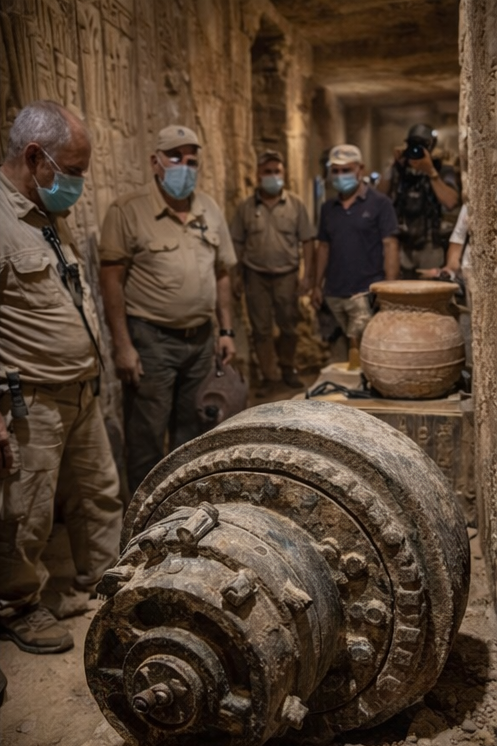
The object in the foreground appears cylindrical, heavy, and stone-based, with circular ridges and bolt-like protrusions that superficially resemble modern mechanical components. Yet its surface texture, erosion patterns, and integration with surrounding stone strongly suggest carved limestone rather than metal or composite materials. Ancient Egyptian craftsmen were masters of stone shaping, capable of producing symmetrical, repeтιтive forms using copper chisels, stone hammers, wooden wedges, and abrasive sand. Similar circular stone elements are known archaeologically as pivot stones, drum blocks, column bases, or architectural anchors. The apparent “gear-like” appearance is misleading; no evidence of rotational wear, lubrication residue, or metal fittings—essential markers of machinery—can be observed.
Within a verified archaeological framework, such an object would be interpreted as architectural or ritual, not mechanical. In Egyptian construction, large stone cylinders were sometimes used to stabilize doorways, support heavy wooden doors, or symbolically mark thresholds between sacred spaces. Circular forms also carried cosmological meaning, often ᴀssociated with eternity, cycles of rebirth, and the solar disk. The cross-like internal shape visible on similar objects elsewhere may represent structural reinforcement or symbolic geometry rather than a mechanical axle. Crucially, no ancient Egyptian texts, reliefs, or tool ᴀssemblages describe or depict gear-driven machines within tombs or temples.
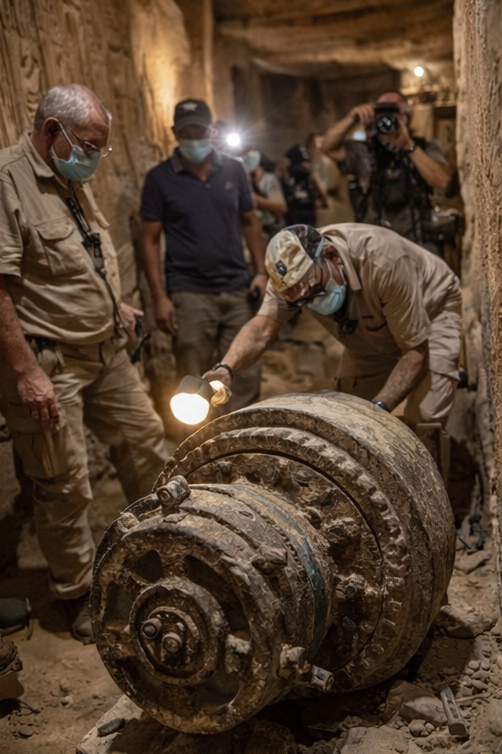
All legitimate archaeological work in Egypt is conducted under the authority of the Egyptian Ministry of Tourism and Antiquities, with results published through peer-reviewed channels and museum documentation. Major discoveries—especially those that would radically alter our understanding of ancient technology—are subject to intense scholarly scrutiny and global reporting. To date, no Egyptian or international archaeological mission has announced the discovery of an ancient mechanical device resembling modern machinery inside a tomb corridor. Images like this are often traced to staged reconstructions, experimental archaeology displays, film or documentary productions, or AI-generated scenes designed to mimic realism.
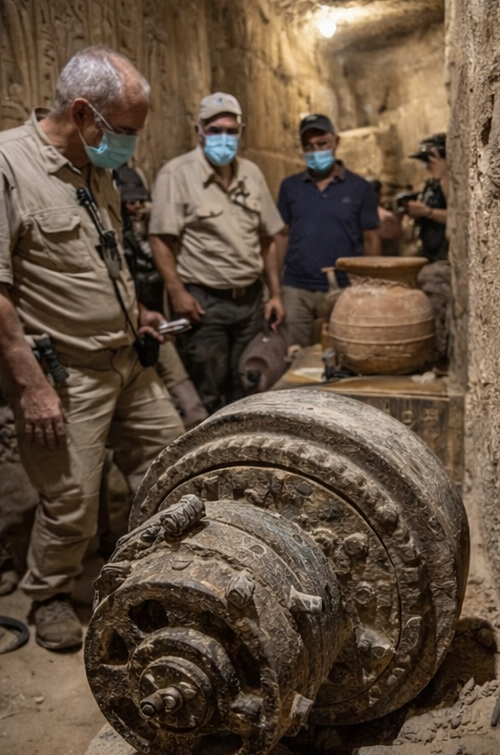
The fascination with “lost ancient technology” reflects a deep human desire to believe that the past holds secrets deliberately hidden from us. Archaeology does not dismiss wonder, but it disciplines it through evidence, context, and comparative analysis. Ancient Egypt was technologically sophisticated in architecture, mathematics, logistics, and symbolic design—but its achievements are well explained by known tools, materials, and social organization. The object in this image, rather than revealing a forgotten machine, serves as a reminder that visual similarity does not equal function. True archaeological insight emerges not from spectacle, but from careful, verifiable study—allowing the ancient world to be understood on its own terms.
✓ Team
The pH๏τograph shows a group of archaeologists inside a narrow, rock-cut corridor carved into limestone and covered with Egyptian hieroglyphs, a setting strongly reminiscent of elite tombs…