THE ANTHROPOCENE ARCHIVE: BRIDGING DEEP TIME AND HUMAN SYMBOLISM
The archaeological landscape presented reflects a diverse global heritage. It begins with an urban salvage excavation in Seoul, South Korea, where a mᴀssive vertebrate skeleton was unearthed 18 meters below a subway construction site. This discovery is contextualized alongside colossal geological anomalies, such as the Three Whale Stones (Hin Sam Wan) in Thailand and Devils Tower in Wyoming, USA, which serve as natural monoliths. Furthermore, the record includes the Lomas Rishi Cave in India, where ancient rock-cut architecture seamlessly integrates with mᴀssive granite boulders, and Mayan bas-reliefs that suggest a profound connection between human neuro-anatomy and prehistoric mythological iconography.
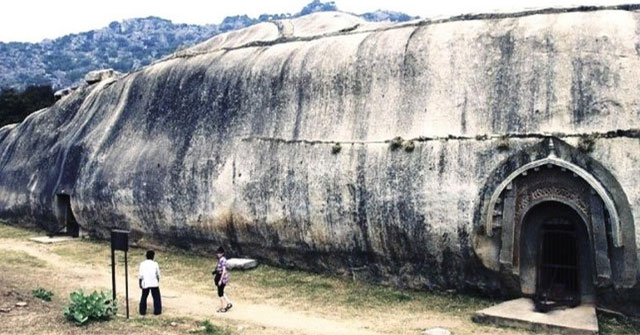
The chronological framework spans from the Cretaceous Period (approx. 75 million years ago) for the Thai sandstone formations to the Late Miocene (approx. 10 million years ago) for the urban skeletal remains. The volcanic intrusion of Devils Tower is dated to the Eocene (approx. 40.5 million years ago). On the human timeline, the Lomas Rishi Cave dates back to the Maurya Empire (3rd century BCE), while the Mayan relief carvings are attributed to the Classic Period (approx. 250–900 CE). This vast timeline demonstrates how modern infrastructure often intersects with “Deep Time,” revealing layers of history from primordial geological shifts to sophisticated ancient craftsmanship.

The artifacts exhibit a spectrum of materials, from permineralized bone to phonolite porphyry and metamorphic granite. The “fabrication” of the Lomas Rishi Cave is particularly masterful, showcasing the first historical use of “mirror-polish” granite finish, creating interior chambers with perfect acoustic properties. Similarly, the Mayan “Vision Serpent” relief shows advanced mastery of high-relief stone carving, depicting a serpentine form that mirrors the anatomical curvature of the human spinal cord and brainstem. In contrast, the natural monoliths were “fabricated” by millions of years of wind and water erosion, smoothing sandstone into organic, whale-like shapes.
The scientific significance lies in comparative anatomy, paleo-oceanography, and acoustic engineering. The urban skeleton provides data on ancient marine migration, while the Lomas Rishi Cave reveals ancient India’s knowledge of resonant frequencies and spatial geometry. The Mayan reliefs offer insights into ethno-biology, where the serpent-spine connection likely functioned as a shamanic tool to represent the flow of “vital energy” or consciousness. Geologically, formations like the sand-pipes (sand-filled vertical tubes) serve as utilitarian benchmarks for measuring prehistoric groundwater flow and sedimentation rates, linking hard science with cultural anthropology.

The recovery of these fragments is a collaborative effort between the National Research Insтιтute of Cultural Heritage (NRICH) and international geological surveys. The urban excavation employs “Rescue Archaeology” methods, using 3D LiDAR scanning to map the skeleton in situ before careful extraction. For rock-cut monuments like Lomas Rishi, non-invasive pH๏τogrammetry and acoustic mapping are used to document the site’s unique properties. The study of Mayan reliefs involves iconographic analysis, comparing ancient art with modern neurological diagrams. These organizations prioritize preserving the “Global Heritage Pipeline,” ensuring every layer of Earth’s history is recorded before modern decay or development erases it.
✓ Team
The archaeological landscape presented reflects a diverse global heritage. It begins with an urban salvage excavation in Seoul, South Korea, where a mᴀssive vertebrate skeleton was unearthed…