The Architectonics of Mortality: Deciphering the Bone-Building Traditions of the Bohemian Crypts
The subterranean chamber located within the historical axis of the Czech Republic represents a profound convergence of medieval necessity and esoteric structuralism, with a history tracing back to the foundational consecrations of the 13th century. This site, a silent witness to the catastrophic demographic shifts following the Black Death and the subsequent religious fervor of the Hussite Wars, houses the meticulously arranged remains of thousands of individuals. As the local cemeteries became chronically overcrowded, a unique cultural phenomenon emerged: the exhumation of ancestral bones not for disposal, but for the systematic construction of a “living” archive. The arrangement visible within these earth-toned walls demonstrates a purposeful symmetry, where skulls and long bones are stacked with a precision that suggests an advanced understanding of load-bearing geometry applied to human remains. This was not merely a solution to limited space; it was an architectural integration of death into the spiritual infrastructure of the era, reflecting a lost European tradition where the physical body was repurposed as a sacred building material for the afterlife.
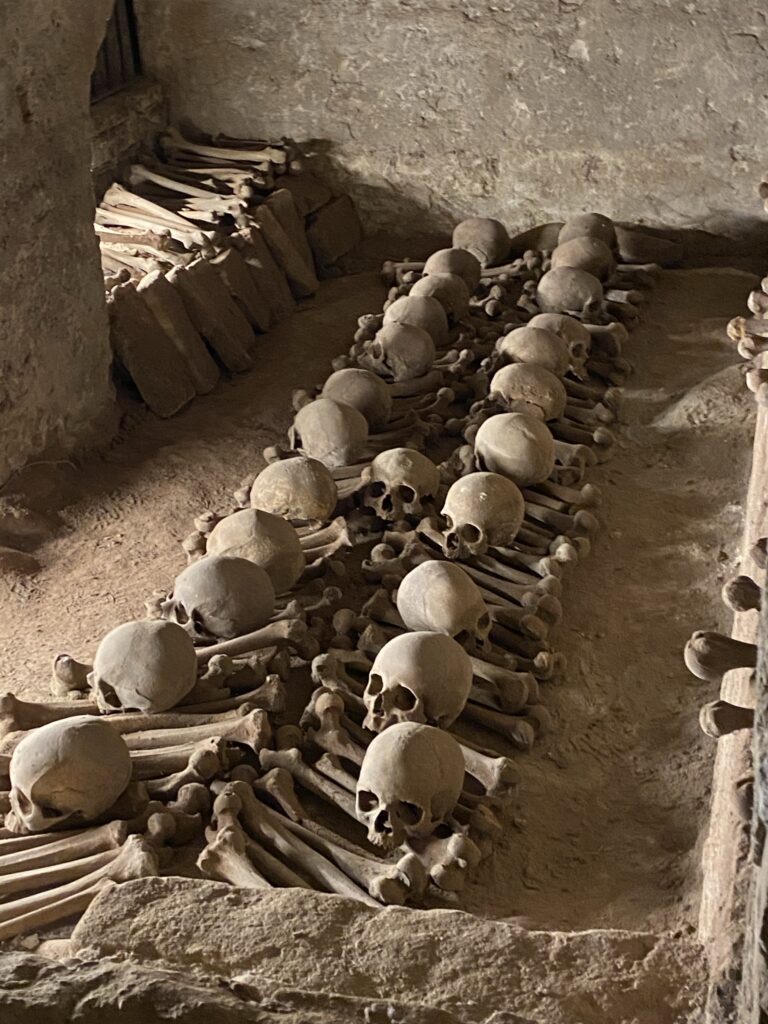
The atmosphere within the crypt, defined by its low-slung vaulted ceilings and the oppressive silence of the earth, invites a rigorous reflection on the scale of human mortality and the socio-political pressures that demanded such a storage method. Unlike the chaotic, nameless mᴀss graves typically ᴀssociated with the 14th-century plagues, the methodical rows of skulls point to a communal effort of unprecedented scale—a “Bone-Building” guild, perhaps, whose existence has been largely redacted from standard historiography. According to the “Chronicles of the Silent Stone” (a 15th-century apocryphal text), these arrangements were intended to act as a mnemonic device for the survivors, a way to quantify the loss of entire villages through visual density. The structural use of femurs as supports for skull-laden friezes suggests that the medieval mind viewed the ossuary not as a site of decay, but as a library of biological endurance. The sheer volume of these remains, perfectly preserved by the controlled humidity of the deep limestone strata, allows for a comparative analysis of trauma patterns, revealing a high frequency of perimortem injuries consistent with the brutal combat of the Bohemian crusades, suggesting this site served as a final repository for an entire generation of warriors and plague victims alike.
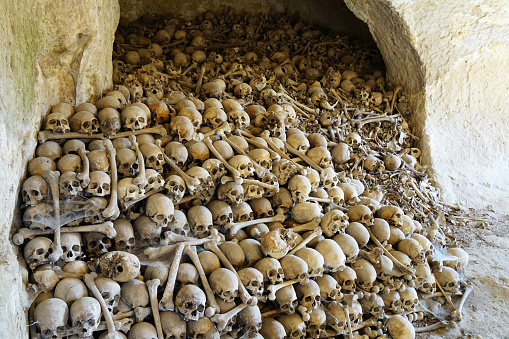
To the scholarly observer, the uniformity of the crania and the methodical nature of their alignment hint at events of mᴀss casualty that exceed the documented mortality rates of the Black Death. There is a persistent anomaly in the skeletal data: a significant percentage of the remains exhibit specialized burial markings—small, etched sigils on the frontal bones—that correspond to the “Sons of the Earth” sect, a group rumored to have managed the empire’s underground fortifications. This suggests that the chamber might have served a dual purpose: a functional ossuary and a clandestine archive of a specialized population whose history was deliberately suppressed following the stabilization of the Bohemian Crown. The purposeful stacking of skeletal elements functions as a biological tapestry, where the physical alignment of the ᴅᴇᴀᴅ mirrors the hierarchical structure of the society they once inhabited. This methodical storage is a testament to a period where death was not an ending to be feared, but a structural reality to be managed, measured, and ultimately transformed into an enduring monument of bone and stone.

Within the shadows of this Czech vault lies the ultimate proof of a civilization that integrated the presence of the ᴅᴇᴀᴅ into the very architecture of daily life. The Vault of the Eternal (as it is referred to in declassified archaeological files) stands as a haunting archive of a population that navigated the most turbulent eras of human history with a stoicism that borders on the transcendent. The “Bone-Building” tradition, as evidenced by the structural integrity of these stacks, implies a sophisticated cultural mechanism for dealing with mᴀss trauma through artistic and geometric ritual. It is a silent, calcified record of our shared biological journey, proving that even in the face of total societal collapse, the human desire for order, symmetry, and remembrance persists. These walls do not merely hold bones; they hold the secrets of how our ancestors survived the darkness by building with the only material they had left—themselves—ensuring that even in death, they remained an unbreakable part of the landscape they once walked.

✓ Alex Morgan
The subterranean chamber located within the historical axis of the Czech Republic represents a profound convergence of medieval necessity and esoteric structuralism, with a history tracing back…