The Arteries of Empire: The High-Pressure Stone Aqueducts of Laodicea
These stone pipelines generally date to the 2nd century CE, during the height of the Roman Empire under the Nerva-Antonine dynasty. At this time, the Roman world was experiencing an “urban revolution” where the demand for water went beyond simple survival, extending to luxury baths, monumental fountains (nymphaea), and industrial mills. The pipeline system in the image is part of the Laodicea on the Lycus water network in modern-day Turkey. While some Roman pipes were made of lead (fistulae) or terracotta, the use of mᴀssive stone blocks indicates a period of high investment and a need for extreme durability to handle the “siphon” pressure required to move water across valleys.

The site of Laodicea, located near the city of Denizli in southwestern Turkey, was one of the most prosperous trade hubs in the Roman province of Phrygia. The systematic excavation and documentation of this hydraulic system have been led by the University of Pamukkale, under the direction of Professor Celal Şimşek since the early 2000s. Archaeological surveys revealed that the water traveled from the Başpınar springs via a dual-line siphon system. The discovery of these pipes in situ (in their original place) allowed archaeologists to reconstruct the entire city’s layout, proving that Laodicea possessed one of the most advanced pressurized water distribution systems in antiquity.
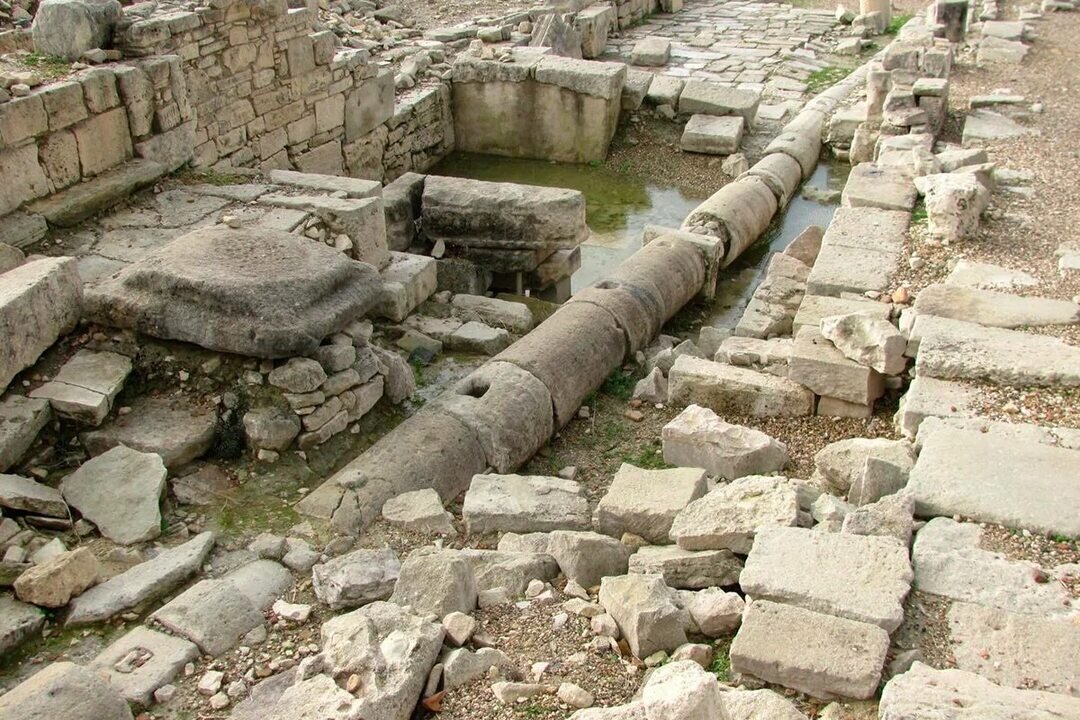
The pipeline is constructed from mᴀssive, hollowed-out travertine or limestone blocks. Each block was individually quarried and carved into a cylindrical shape with a precise internal bore. The most impressive technical detail is the male-female joint system (socket and spigot); one end of the block was carved to taper, while the other was recessed to receive it, ensuring a snug fit. To prevent leaks under the intense pressure of a “reversed siphon,” the joints were sealed with a specialized hydraulic lime mortar mixed with olive oil or grease. You can also see “manholes” or inspection ports at regular intervals—square openings carved into the top of certain blocks—which allowed ancient engineers to clear out calcium carbonate deposits (limescale) that threatened to clog the system.

The primary purpose of this stone line was to function as an Inverted Siphon. Standard Roman aqueducts relied on a gentle, consistent slope to move water via gravity. However, when an aqueduct encountered a deep valley, engineers sometimes chose to build a pressurized pipe system that would go down one side and use the accumulated pressure to push the water back up the other side. This avoided the need to build incredibly tall and expensive stone arches across the entire valley floor. These pipes were the “high-pressure mains” of the city, feeding into large water towers (castellum aquae) that then distributed the flow to public latrines, private villas, and the city’s mᴀssive thermal bath complexes, which were the center of Roman social life.

The stone pipes of Laodicea are a testament to the Roman “Utility First” philosophy, which prioritized infrastructure as the foundation of civilization. For modern archaeologists, these remains provide crucial data on ancient mathematics and fluid dynamics. They prove that Roman engineers had a practical understanding of atmospheric pressure and “head loss” long before these concepts were formally defined in modern physics. Today, the site is a candidate for UNESCO World Heritage status. It stands not as a decorative monument, but as a functional relic of a society that mastered the environment to provide its citizens with a level of sanitation and convenience that would not be seen again in Europe until the late 19th century.
✓ Team
These stone pipelines generally date to the 2nd century CE, during the height of the Roman Empire under the Nerva-Antonine dynasty. At this time, the Roman world…