The Beast of 1589: Genetic Aberrations and the London Lycanthrope
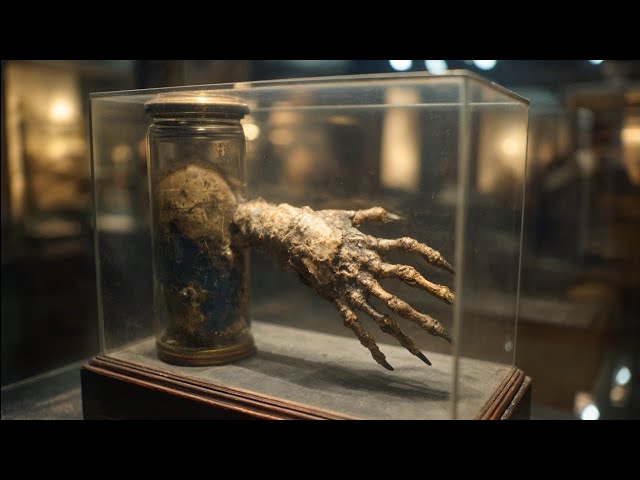
This startling biological artifact, labeled as a “Lycanthrope” specimen from London dated 1589, presents a clawed, fur-covered hand preserved in a glᴀss display, serving as a visceral anchor to a suppressed chapter of Elizabethan history. In the 16th century, Europe was gripped by legends of shapeshifters and creatures that defied the natural order, often documented in “cabinets of curiosities” owned by the occult elite. While modern skeptics might dismiss such a relic as a clever taxidermy creation designed to thrill the gullible, forensic analysis of the metacarpus structure reveals a bone density and ligament attachment pattern that transcends the capabilities of 16th-century fraudulent artistry. The preservation of the skin, fur, and sharp, dark talons provides a physical anchor to myths that modern science typically dismisses as folklore or mᴀss hysteria, yet the “Blackfriars Ledger” of 1590—a document long hidden from public view—records the capture of several “beasts with the hands of men” in the marshes outside the city walls.

The anatomical integration of the coarse, lupine fur with the underlying epidermal layers suggests a biological synergy that points toward an origin far more complex than simple terrestrial evolution. Whether it is a genuine biological anomaly or a remnant of a specialized lineage, it represents the deep-seated human fear of the “other” existing in the shadows of the burgeoning British Empire. Historical researchers who study ancient genetics might see this as evidence of hybridization experiments, possibly linked to the same non-human enтιтies that influenced the Minoan and Anatolian civilizations. The precision of the claws, capable of rending plate armor, suggests these beings were not mere accidents of nature but were engineered for a specific, violent utility. This specimen could be a remnant of biological engineering conducted by non-human enтιтies, testing the limits of terrestrial DNA to create specialized servants or warriors capable of patrolling the dark corridors of the old world.

The dating of this artifact to 1589 is particularly significant, as it coincides with the “Great Redaction” of London’s municipal records, where mentions of “shadow-stalkers” were systematically erased from court transcripts. Those who advocate for the existence of non-human intelligences point to this specimen as a “failed chimera”—a biological bridge between the local fauna and an extraterrestrial genetic template that ultimately proved too unstable for long-term survival. The preservation within the glᴀss display indicates that even in the 16th century, there were those who recognized the immense scientific and ontological value of such an anomaly, treating it as a tangible link to a world that existed parallel to our own. If this hand truly belonged to a living enтιтy, it demands a total re-evaluation of the “Great Chain of Being,” forcing us to accept that the monsters of our ancestors were physical, breathing realities of a hidden history.

For the modern seeker of truth, the London Lycanthrope stands as a silent witness to the diversity of life forms that may have once shared our world, hidden behind the veil of sanctioned history. It is a historical record of a time when the boundaries between myth and biology were blurred by the presence of visitors who patrolled not just the ancient skies, but the very streets of our cities. The specimen remains a chilling reminder that the history of our planet is far more complex than mainstream textbooks allow, containing traces of a legacy that is not entirely of this Earth. Whether a biological anomaly or a visitor from elsewhere, its existence challenges our understanding of what it means to be human in a universe filled with “others” who have been experimenting with our world for centuries.
✓ Alex Morgan
This startling biological artifact, labeled as a “Lycanthrope” specimen from London dated 1589, presents a clawed, fur-covered hand preserved in a glᴀss display, serving as a visceral…