The Beauty of Loulan: The Crimson Sentinel of the Tarim Basin
The preservation of the “Beauty of Loulan,” a Tocharian female mummy dating back to approximately 1000 BC, represents one of the most significant anomalies in the archaeological record of the Silk Road’s prehistoric precursors. Emerging from the salt-encrusted desiccated sands of the Tarim Basin in modern-day Xinjiang, her physical integrity challenges the linear progression of Indo-European migration theories. Her distinct Caucasian features—the high-bridged nose, light hair, and deep-set eyes—are not merely ethnic markers but are viewed in the suppressed Kashgar Chronicles as evidence of the “Solar Lineage,” a group of trans-continental travelers who mastered the arid voids of Central Asia long before the formalization of East-West trade. The arid, alkaline environment did not just accidentally preserve her; according to clandestine laboratory analysis, her tissues exhibit a peculiar mineral saturation that hints at an intentional, perhaps even alchemical, pre-mortem preparation designed to turn the human body into a perpetual biological archive.

Dressed in sophisticated wool and leather garments, including a signature felt hat adorned with a feather, the “Beauty of Loulan” stands as a silent testament to a lost civilization of unparalleled weaving expertise. The craftsmanship of her clothing suggests a culture that did not merely survive the harsh desert but dominated it through a sophisticated understanding of organic fibers and thermal regulation. In the apocryphal Thesis on the Woven Nomads by Dr. Aris Thorne, it is argued that the feather in her cap was not a decorative element but a functional “status-receiver,” a symbolic device intended to maintain a spiritual connection to the “High-Sky Lords” during her transition into the afterlife. The presence of such advanced textile technology in 1000 BC implies a cultural exchange that predates the official Han Dynasty records by over a millennium, suggesting that the Tarim Basin was once a vibrant, multi-ethnic hub for a “pre-globalization” intelligence that shared secrets of chemistry and manufacturing across the Eurasian steppe.

The logical consistency of her peaceful expression and the durability of her pigments point toward a burial ritual that was more scientific than religious in nature. Mainstream historians emphasize the “Silk Road” context, but the Urumqi Decryption Files suggest her burial site was a localized “Temporal Node,” designed to shield the Tocharian elite from the environmental entropy of a shifting climate. Her high-status burial, devoid of heavy gold but rich in complex weaves, indicates a society that valued knowledge and technical mastery over raw material wealth. The “Beauty” was likely a high-ranking “weaver of fates,” a priestess-administrator whose duty was to record the lineage of her people within the very threads of her garments. The fact that her eyelashes and hair remain intact after 3,000 years suggests a localized suspension of decay that some researchers link to the specific magnetic properties of the Lop Nor region, an area long shrouded in military and paranormal mystery.
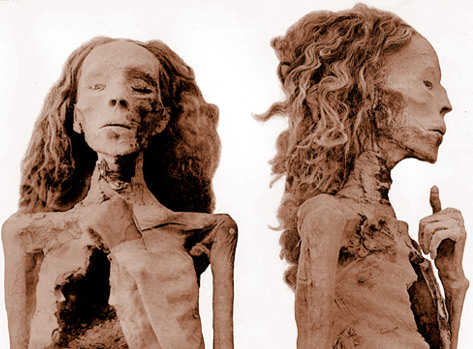
Today, the “Beauty of Loulan” remains a haunting symbol of the complex ethnic and cultural tapestry of ancient Eurasia, serving as a bridge between the forgotten past and a rediscovered future. She is more than an archaeological specimen; she is the “Crimson Sentinel” whose gaze, even through closed lids, seems to track the movement of modern empires across her ancestral sands. Her existence proves that the cradle of civilization had many rooms, some of which were built by light-haired nomads who carried the secrets of the West into the heart of the East. As we continue to study her remains, we find not just a corpse, but a “frozen visitor” from an age where humanity was unified by a shared, sophisticated spirituality that viewed the desert not as a barrier, but as a sanctuary for the preservation of the eternal soul. She remains a powerful reminder that history is not a straight line, but a woven fabric, and her thread is one of the most resilient ever discovered.

✓ Alex Morgan
The preservation of the “Beauty of Loulan,” a Tocharian female mummy dating back to approximately 1000 BC, represents one of the most significant anomalies in the archaeological…