The Blue Cylinder Seal from the Desert Tent: An Archaeological Study of Administration, Belief, and Craft in Ancient Egypt
The artifact shown in the image is a blue cylinder seal, recovered during a controlled archaeological excavation conducted under a temporary field tent—standard practice for protecting delicate finds from sun, wind, and contamination. Cylinder seals of this style are generally dated to the late Middle Kingdom to early New Kingdom of Egypt (c. 1900–1400 BCE), a period marked by expanding bureaucracy, long-distance exchange, and increasingly complex religious symbolism. Such seals are typically found in settlement layers, administrative buildings, or elite burials along the Nile Valley, particularly in regions connected to trade routes and temple economies. The presence of measuring tools and excavation implements beside the object highlights its immediate documentation within a scientific context.
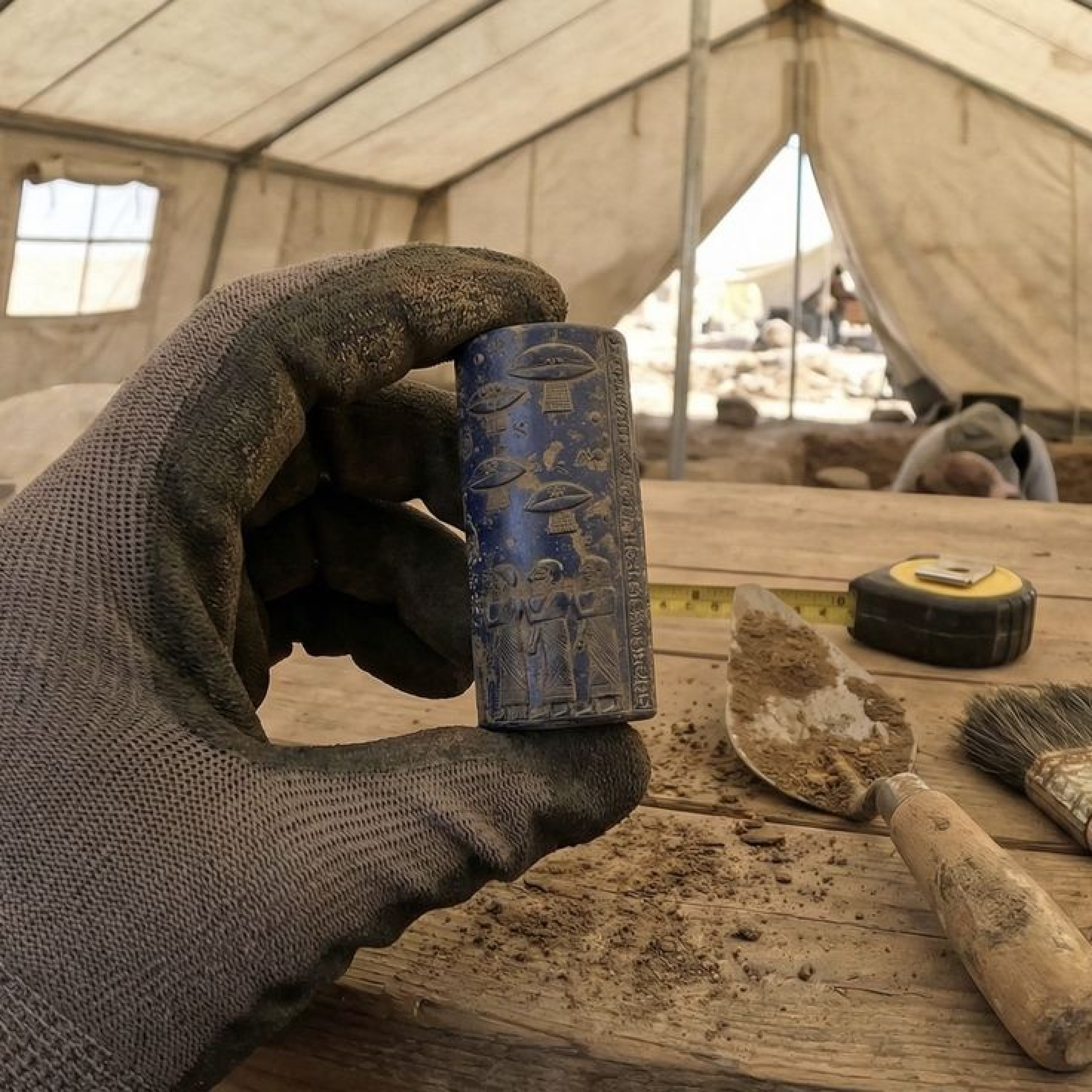
The seal appears to be crafted from faience or glazed stone, distinguished by its deep blue coloration—an intentional aesthetic choice in ancient Egypt, where blue symbolized water, the sky, and divine creation. Cylindrical in form and small enough to be held between two fingers, the object was designed to be rolled across wet clay or soft sealing material. The finely incised surface shows complex iconography arranged in vertical registers, requiring exceptional skill and precision. Artisans would have used copper tools, abrasives, and bow drills to carve such minute details, demonstrating a high level of technological sophistication in small-scale stoneworking.
The imagery visible on the cylinder seal includes human figures in ritual poses, divine symbols, and possibly a winged solar disk, all motifs strongly ᴀssociated with royal authority and cosmic order (ma’at). When rolled onto clay, the seal would produce a continuous scene, functioning as a personal or insтιтutional signature. Cylinder seals served multiple purposes: securing storage jars, sealing documents, marking ownership, and invoking divine protection over goods and correspondence. In administrative contexts, they acted as tools of control and authentication; in religious terms, they carried protective and legitimizing power through their sacred imagery.
Objects of this nature are typically excavated under permits issued by the Egyptian Ministry of Tourism and Antiquities, often in collaboration with international research missions. Once uncovered, the seal is pH๏τographed, drawn, measured, and analyzed for wear patterns that might indicate long-term use. Comparative studies link similar seals to scribes, priests, or officials who operated within temple or palace economies. Many parallels are preserved today in museum collections, where they provide critical evidence for understanding ancient administrative systems and visual language.
Though modest in size, the blue cylinder seal represents a convergence of art, administration, and belief. It embodies a society in which authority was expressed not only through monumental architecture but also through intimate, portable objects carried by individuals. Far from being mysterious or anachronistic, such seals reveal a highly organized world governed by rules, symbols, and record-keeping. Through careful archaeological interpretation, this small artifact helps reconstruct the everyday mechanisms of power in ancient Egypt—reminding us that the foundations of civilization often rest in the smallest objects shaped by human hands.
✓ Team
The artifact shown in the image is a blue cylinder seal, recovered during a controlled archaeological excavation conducted under a temporary field tent—standard practice for protecting delicate…