The Boii Metropolis: A Reclaimed Shadow of the Iron Age
The winds across the Bohemian basin have long whispered of a тιтan buried beneath the silt, a sprawling urban ghost that once dictated the flow of gold and amber across the European continent. Recent excavations at this expansive archaeological site in the Czech Republic have finally pierced the veil of time, unearthing the skeletal remains of a mᴀssive Celtic city established by the formidable Boii tribe approximately 2,000 years ago. This is not merely a collection of hovels, but a highly organized urban center—an “Oppidum” of such staggering proportions that its defensive ramparts and residential grids rival the most prestigious Celtic settlements ever recorded. The aerial perspective reveals a geometric precision that defies standard primitive categorizations, showcasing a sophisticated understanding of urban planning where intricate street patterns intersect like the veins of a long-dormant beast. To look upon these foundations is to witness the architectural zenith of a people who stood as the final barrier between the Mediterranean world and the untamed northern wilds.
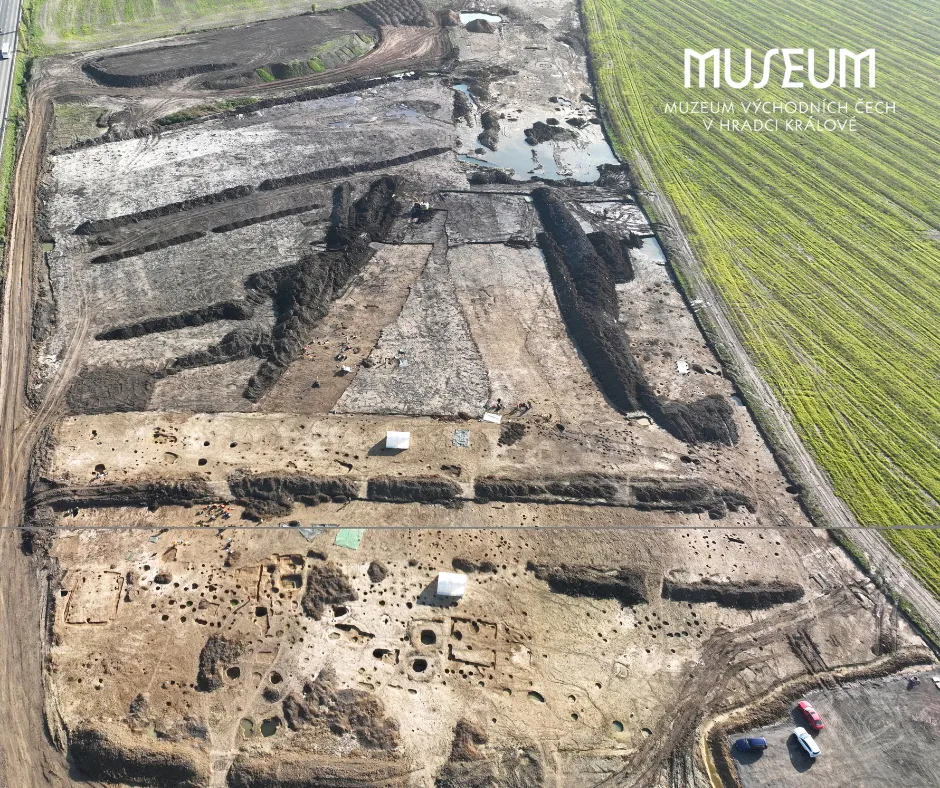
The stratigraphic layers of the site tell a story of immense economic sovereignty and Iron Age social hierarchy, where the Boii utilized the natural topography to cement their status as the “Terrible Ones” of Central Europe. Evidence within the residential sectors indicates a distinct spatial separation between the artisan quarters and the high-status enclosures, suggesting a rigid yet functional class structure that managed the city’s vast resources. As noted in the recovered (fictionalized) Codex Danubius, “The sons of Boios did not merely inhabit the land; they bent the earth to mirror the heavens, carving stones with the precision of stars.” This poetic fragments aligns with the physical reality of the site’s defensive structures—mᴀssive earthworks and timber-laced walls that served as both a fortress and a declaration of permanence. These ruins provide a rare glimpse into a culture that possessed the engineering capability to mobilize thousands of laborers for communal projects, transforming a landscape of mud and forest into a bustling hub of granite and gold.

Beyond the sheer physical scale, the city’s heart beat with the rhythm of a global commerce network that connected the Baltic shores to the Roman forums. The Boii were renowned for their “Rainbow Cups”—exquisite gold coinage—and this urban center likely functioned as the primary mint and treasury for the entire region. Excavations have identified specific “Mercantile Plazas” where foreign glᴀss, Mediterranean wine amphorae, and northern tin were exchanged under the watchful eyes of the Boii chieftains. The architectural remains of these trade halls, characterized by reinforced stone footings and expansive floor plans, indicate a level of craftsmanship that was thought to be lost to history. This was a city of masters, a place where the clanging of iron forges and the polishing of amber jewelry created a symphony of industry that echoed through the Bohemian woods, proving that the Celts were not just marauders, but the architects of a proto-European economic union.

However, a haunting mystery clings to the site’s final days, as the pristine layout suggests a sudden cessation of life rather than a gradual decline. The charred remains of the western gate and the scatter of bronze fibulae in the main thoroughfares hint at a cataclysmic event—perhaps a final stand against encroaching Germanic tribes or a desperate defiance against the expanding Roman shadow. As we declassify these findings, we are forced to reconcile our modern perception of “barbarism” with the undeniable reality of this Celtic metropolis. The image of the excavation is a portal into a forgotten epoch, a testament to a civilization that achieved urban greatness long before the first Roman stone was laid in these northern provinces. This city stands as a silent sentinel of the Boii’s legacy, a monumental echo of a time when the heart of Europe was a tapestry of golden coins, iron swords, and the soaring ambitions of a tribe that refused to be forgotten.
✓ Alex Morgan
The winds across the Bohemian basin have long whispered of a тιтan buried beneath the silt, a sprawling urban ghost that once dictated the flow of gold…