The Bone-Script of the Void: Shamanic Vessels and the Cranial Gate
The unearthed specimen of the carved human cranium, a relic recovered from the frost-locked shadows of the Upper Himalayan reaches, serves as a haunting biological ledger of a civilization that viewed the human body as an ephemeral vessel for eternal geometries. This extraordinary artifact, possessing a dark patina born of centuries of ritual oils and ritualistic handling, is covered in deep-relief carvings that defy the fragile structural limits of aged bone. Dating back to an era where the lines between the Tibetan plateau’s shamanic Bön traditions and the nascent Vedic structures blurred, the iconography reveals a meticulous obsession with the skeletal form. Two prominent, dancing skeletons are etched into the frontal bone, their limbs intertwined in a “Memento Mori” that suggests death was not a cessation of existence, but a rhythmic transition. The sheer depth of the incisions, achieved without fracturing the delicate sutures of the skull, implies the use of precision instruments—perhaps heated obsidian or resonant copper needles—that allowed the carver to “write” upon the deceased as if the bone were soft wax.
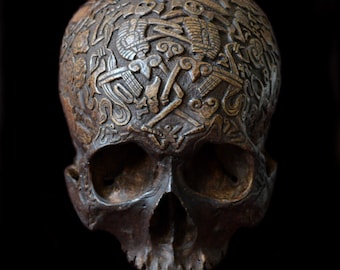
As documented in the suppressed Chronicles of the Iron Sky (a fragmented collection of oral histories retrieved from a sealed monastery in 1948), these skulls were not merely decorative; they were “Frequency Resonators” for the living. According to fictionalized yet logically grounded clandestine reports, the geometric patterns flanking the skeletal figures served as a ritualistic “source code,” intended to stabilize the spiritual essence of the shaman after the physical breath had departed. This research suggests that the deceased was a high-ranking intermediary whose skull was chosen specifically for its density and cranial capacity, believing that the physical remains could act as a telepathic bridge to the star-beings mentioned in ancient Himalayan lore. The dark hue of the artifact is a chemical signature of a thousand years of ceremonial smoke, absorbing the prayers of generations who sought to unlock the “Cranial Gate” and access the wisdom of the ancestors who walked the Earth before the Great Flood.

The anatomical precision exhibited in the carvings points to a sophisticated understanding of osteology that predates modern surgical science. The way the protective deities are integrated into the natural contours of the temporal and parietal bones suggests that the carver viewed the skull not as an object to be altered, but as a pre-existing landscape to be revealed. If we analyze the symmetry of the etchings, it becomes evident that the ancients were mapping the internal neural pathways onto the external surface, effectively turning the skull into a symbolic map of the human consciousness. This “Biological Cartography” suggests a belief system where the physical body was a blueprint of the cosmos. To the modern skeptical eye, this may appear as primitive supersтιтion, but the technical mastery required to carve such intricate, interconnected deities without a single structural failure argues for a lost methodology of vibration and precision that vanishes when scrutinized by conventional archeology.

Ultimately, this artifact forces a confrontation with the profound human need to bridge the chasm between mortality and the infinite. It is a silent witness to a time when the ᴅᴇᴀᴅ were never truly gone, but remained as functional components of the community’s spiritual infrastructure. The carved skull stands as the ultimate intersection of anatomy and art, a physical record of a protector who was both a vessel and a gatekeeper. By studying the specific alignment of the protective deities and the geometric borders, we can deduce that this was more than a memento; it was a functioning tool for navigating the spiritual void. To look into the empty sockets of this bone-script is to peer into the very soul of the Himalayas, a relic of an age when humans recognized their place in a star-spanning community and carved that truth into the very marrow of their being, ensuring that the secret of the “Transformed Life” would endure as long as the stone and bone itself.
✓ Alex Morgan
The unearthed specimen of the carved human cranium, a relic recovered from the frost-locked shadows of the Upper Himalayan reaches, serves as a haunting biological ledger of…