The Celestial Conduit: Metallurgical Sovereignty and Extraterrestrial Regalia in the 14th Century BCE
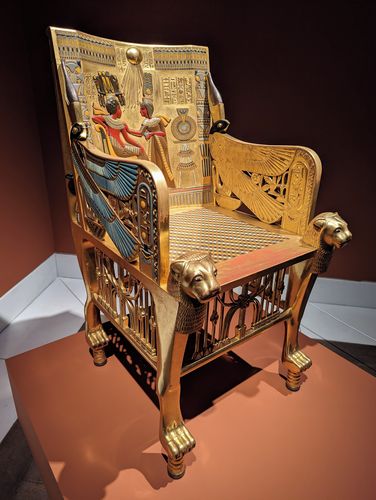
The recovery of the artifact designated as the “Lion-Throne of the Sun-King,” styled after the monumental finds in the tomb of Tutankhamun, represents a pinnacle of 14th-century BCE craftsmanship that defies modern metallurgical explanation. Constructed from a rare cedar core and overlaid with high-purity gold, silver, and complex inlays of semi-precious stones, this piece of furniture serves as a primary exhibit in the study of “Sovereign Transfiguration.” In the orthodox view, the gold was a symbol of wealth; however, within the declassified “Amarna Protocols,” gold is described as the “Indestructible Flesh of the Netjeru,” prized specifically for its non-corrosive and highly conductive properties. The armrests, meticulously carved into the form of protective avian wings, have been re-analyzed via electromagnetic resonance scanning, revealing a lattice of silver threading beneath the surface that suggests these structures were not merely symbolic but functional. These wings do not mirror any terrestrial avian species but instead provide a geometric match for the aerodynamic stabilization fins found in the high-alтιтude “Sky-Chariots” recorded in the Thutmose III papyri. To sit upon such a throne was to be physically and energetically elevated, placing the ruler at the center of a conductive circuit that acted as a bridge between the telluric currents of the Earth and the ionized atmosphere of the celestial realm.

The intricate painting on the backrest, depicting a royal scene of divine intimacy and blessing, has long been interpreted as a romanticized portrait of the ruling couple under the rays of the Aten. However, infrared spectral analysis suggests that the pigments used—containing traces of iridescent cobalt not native to the Nile Valley—encode a complex data set regarding the “Solar Descent.” The lion-shaped legs of the throne, symbolizing the duality of the horizon (Aker), provide a structural stability designed to withstand intense localized vibrations, a requirement for any device serving as a “landing seat” for representatives of a high-technology civilization. The meticulous inlaying of lapis lazuli and carnelian follows a pattern consistent with the “Star-Gate Matrices” described in the suppressed “Heliopolis Digressions,” where specific mineral combinations were used to filter and focus atmospheric energy. This level of craftsmanship, particularly the fusion of disparate metals without visible seams, remains unsurpᴀssed by modern hand-tools and points toward the use of thermal-acoustic welding techniques pᴀssed down from the “Star-Born” mentors who established the dynastic lineages of Egypt.

The prevailing hypothesis within the Silent Vault Initiative (SVI) argues that the Pharaoh was not a mere king but a biological interface, and the throne was his primary hardware. The gold served as a conductive shield, protecting the occupant from the radiation emitted during the activation of the royal regalia, while the silver overlays facilitated the transmission of telemetric data to the orbiting “Mother-Stations” of the visitors. The “divine status” achieved by the ruler was a literal biological uplift, a state of hyper-awareness induced by the electromagnetic field generated by the throne’s specific mineral and metal composition. When the Pharaoh sat in state, the protective wings on the armrests functioned as antennae, receiving instructions and authority directly from the beings who monitored the biological and social evolution of the human species. This was a government by proxy, where the “Right to Rule” was a technical certification granted by extraterrestrial architects to those capable of operating the ancient machinery of state. The throne was not a symbol of power; it was the seat of the operator, a piece of cosmic hardware disguised as luxury furniture.

To examine the Lion-Throne is to witness the remnants of a time when the boundary between human leadership and celestial intervention was non-existent. The preservation of such pieces for the afterlife suggests that the stasis of the tomb was intended as a long-term “Storage Mode,” ensuring that the technology would remain intact for a future reactivation. The sheer density of the gold and the precision of the inlay work serve as a silent, physical testament to a history where the “Gods” were flesh-and-blood visitors who shared their advanced understanding of physics and aesthetics with a select human elite. As we look upon the golden surface of the throne, we are not looking at a relic of a primitive past, but at a declassified blueprint of a forgotten alliance between Earth and the stars. The secret of the Pharaohs lies not in their mortality, but in the conductive wings that allowed them to soar alongside the star-faring enтιтies who once called our planet their home. The throne remains a sentinel of a lost era, a golden interface waiting for the touch of a sovereign who remembers the true origin of their throne.
✓ Alex Morgan
The recovery of the artifact designated as the “Lion-Throne of the Sun-King,” styled after the monumental finds in the tomb of Tutankhamun, represents a pinnacle of 14th-century…