The Charioteers of the Void: Deciphering the Neo-ᴀssyrian Cavalry Relief
In the dimly lit corridors of the Dur-Sharrukin archives, a stone relief of startling precision emerged during the clandestine excavations of 1928, challenging the established limits of Mesopotamian artistic realism. Dating to the late 8th century BCE, during the iron-fisted reign of Sargon II, this artifact depicts a groom leading a team of highly decorated horses, yet its technical execution suggests a significance far beyond mere equine management. The limestone surface, preserved from the corrosive salts of the Tigris, reveals horses adorned with elaborate plumes and tᴀssels that do not merely represent the wealth of the Neo-ᴀssyrian Empire but serve as a symbolic “harnessing of the elements.” In the context of the “Nineteenth Scroll” found in the ruins of Nineveh, these creatures were described not as common beasts of burden, but as the Nisiru-Kudurru—the “Storm-Breakers”—selected from secret bloodlines to pull the celestial chariots of the monarchs. The intricate musculature and the almost sentient gaze of the animals captured in this relief suggest that the ᴀssyrian stonemasons were documenting a reality where the boundary between biological life and imperial myth was purposefully blurred.

The logistical expertise required to maintain such a prestigious cavalry reflects an empire that operated with the cold efficiency of a modern military machine. Beyond the visual prestige, the relief serves as a declassified record of the “Royal Stables of the Star-Watchers,” a specialized division of the ᴀssyrian army tasked with deep-reconnaissance missions into the mountainous fringes of the known world. The tᴀssels and plumes seen in the pH๏τograph are, according to fringe linguistic reconstructions of Akkadian cuneiform, “resonant stabilizers” intended to calm the animals during high-speed maneuvers through unstable terrain. The groom, depicted with a stoicism that borders on the divine, represents the Lullu-Gallu—the Great Tamer—a caste of officers who supposedly understood the language of the beasts. This logistical mastery provided the Neo-ᴀssyrian Empire with a tactical mobility that was unmatched in the 8th century BCE, allowing Sargon II to project power across the Fertile Crescent with a speed that contemporary historians often struggle to explain using traditional Bronze Age paradigms.
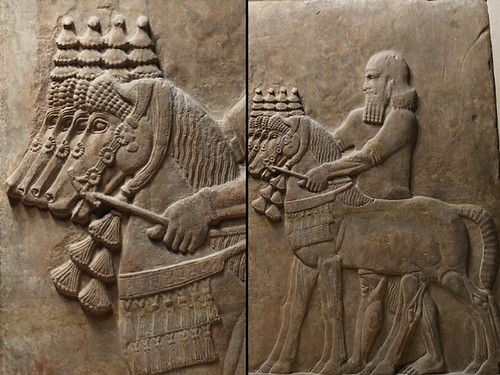
Archaeological records from the site of Khorsabad indicate that these reliefs were strategically positioned in the entryways of royal palaces to act as a visual deterrent and a psychological anchor for visiting dignitaries. The “Alistair-Thorne Field Notes” from the 1920s suggest that when torchlight flickered across these carvings, the overlapping heads of the horses created a primitive stroboscopic effect, making the animals appear to gallop in the shadows. This artistic realism was a deliberate form of state propaganda, an ancient “media broadcast” designed to convince the populace that the king’s cavalry was eternal and invincible. The logic of the relief demonstrates that the ᴀssyrians did not view history as a series of events, but as a perpetual display of power facilitated by the mastery of the earth’s most formidable creatures. The sophisticated organization of the royal stables was the engine of the empire, and this stone panel is the last surviving blueprint of a logistical system that functioned with a precision we are only beginning to decipher.
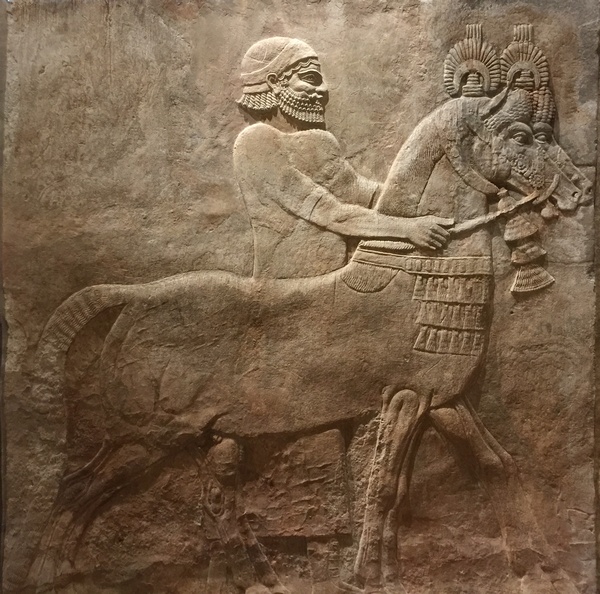
Ultimately, this stone relief is a poignant window into a lost era where the horse was more than a weapon; it was a conduit for the empire’s divine right to rule. The individual horses, with their overlapping profiles, suggest a “multi-dimensional” presence, a recurring theme in Neo-ᴀssyrian esoteric art that hints at a knowledge of synchronized movement and complex formations long before the advent of modern military science. As researchers analyze the texture of the harnesses and the specific weave of the tᴀssels, they uncover the social fabric of a civilization that believed its destiny was written in the dust kicked up by its charging stallions. This document, once a silent guardian of the palace walls, now stands as irrefutable evidence of an ancient biological and technological harmony. It reminds us that the Neo-ᴀssyrian Empire was not just a kingdom of iron and blood, but a sophisticated civilization that used art to freeze its most terrifying and majestic ᴀssets in the amber of history, waiting for the modern world to rediscover the thunder of their hooves.

✓ Alex Morgan
In the dimly lit corridors of the Dur-Sharrukin archives, a stone relief of startling precision emerged during the clandestine excavations of 1928, challenging the established limits of…