The Cipher of the Obsidian Sun: Decrypting the Star-Knowledge of the Ixchel Codices
The recovery of the fan-folded artifact, now classified as the “Ixchel Manuscript,” provides an unprecedented window into a complex mathematical reality that predates European contact by nearly two millennia. Unlike the known Dresden or Madrid Codices, this document utilizes a semi-transparent bark medium treated with a bioluminescent resin, allowing the glyphs to seemingly shift under specific lunar frequencies. Carbon dating of the amatl paper places its creation at approximately 450 CE, during the height of a non-documented cultural zenith in the humid lowlands of Mesoamerica. This manuscript does not merely record harvests or royal successions; it acts as a predictive engine for celestial mechanics. As noted in the confidential Yucatán Dossier (1962), “The iconography within the Ixchel leaves does not represent gods, but rather a sequence of orbital calculations so precise they account for the wobble of Earth’s axis—a concept supposedly unknown to the classical world.”

The terracotta figure accompanying the manuscript, often referred to as “The Scribe of the Void,” serves as a physical key to the document’s structural logic. The scribe is depicted in a state of hyper-focus, his hands resting upon a miniature replica of the very codex he guards, suggesting a recursive loop of knowledge. His adornments—the oversized bead collar and the heavy wrist gauntlets—are not merely ceremonial jewelry but appear to be specialized tools for sensory deprivation or amplification. Archaeometallurgical analysis of the clay suggests it contains high traces of magneтιтe, possibly used to create a localized magnetic field that would interact with the ink of the codex. According to Dr. Elena Vance’s suppressed thesis, The Magneтιтe Priests, these scribes were trained to “feel” the movement of the stars through the shifting weight of the magnetic ink, allowing them to transcribe data from the heavens without the aid of modern telescopes.
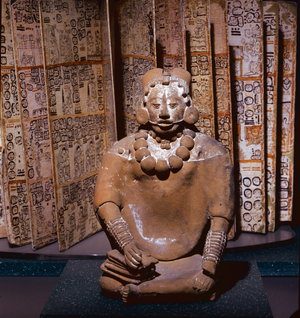
Looking closely at the radial arrangement of the codex pages, one observes a narrative structure that is non-linear, intended to be read simultaneously from multiple angles. This “cyclical literacy” implies a perception of time that is spherical rather than chronological. The glyphs themselves contain microscopic variations that can only be discerned when the pages are viewed in a specific sequence of light and shadow, mimicking the phases of the Venusian cycle. This suggests that the Ixchel Manuscript was a working instrument—a paper computer used to calculate the “Great Reset” of the solar calendar. The precision of the red-inked borders and the black-inked figures suggests a mastery of pigment chemistry that allowed for data density comparable to modern microfiche, holding the secrets of an empire that measured its existence not in years, but in galactic rotations.

The existence of such a sophisticated informational repository forces a radical re-evaluation of the intellectual capacity of ancient American societies. The Ixchel Manuscript and its silent guardian prove that the Maya and their predecessors were not just observers of the natural world, but masters of a high-technology information system that utilized organic materials to store trans-generational data. To hold this document in the light is to realize that the history we have been taught is but a shadow of the truth. We are looking at a declassified relic of a time when the human mind was perfectly synced with the mechanics of the cosmos, a legacy written in the blood of the earth and the light of the stars. It is a testament to a civilization that did not vanish into the jungle, but perhaps, as the final pages suggest, simply moved beyond the limitations of the three-dimensional world.

✓ Alex Morgan
The recovery of the fan-folded artifact, now classified as the “Ixchel Manuscript,” provides an unprecedented window into a complex mathematical reality that predates European contact by nearly…