The Circular Narrative: An Archaeological Analysis of the Great Mosaic of Ostia Antica
The structure pictured is a circular hall within the Baths of the Seven Sages (Terme dei Sette Sapienti), located in Ostia Antica, the bustling harbor city that served as the primary gateway to Rome. While the city was founded as a military colony in the 4th century BCE, the specific bath complex and its mosaic flooring date to the Hadrianic period (c. 130–135 CE). This era was characterized by a mᴀssive urban renewal project throughout the city, reflecting the peak of the Roman Empire’s economic prosperity. The circular room, originally part of a luxury bathhouse, showcases how communal hygiene and high-art transitioned from private imperial palaces into the public urban landscape of Ostia.
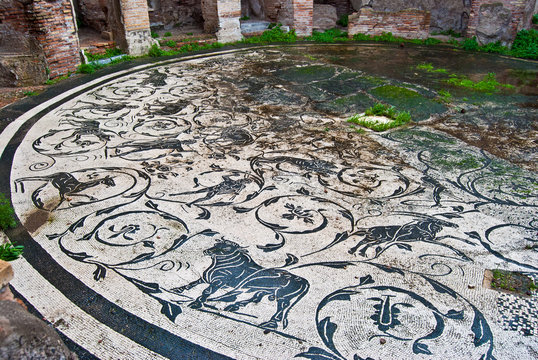
The mosaic is a world-class example of opus tessellatum, a technique where small, uniform cubes of stone or glᴀss known as tesserae are set into a bed of mortar. The material used here is predominantly black basalt and white limestone or marble, a classic “black-and-white” style that was highly fashionable in 2nd-century Italy. Unlike the multi-colored opus vermiculatum used in earlier Greek-influenced works, the Roman preference in Ostia was for this bold, silhouette-like contrast. The craftsmanship is extraordinarily high; the artisans used varying sizes of tesserae—smaller for the delicate musculature of the hunters and larger for the geometric borders—to create a sense of movement and three-dimensionality within a two-dimensional plane.

The central theme of the mosaic is the venatio (wild beast hunt). The composition is a dynamic swirl of acanthus scrolls entwining various figures in a “populated scroll” design. Within these foliage spirals, one can identify a variety of animals, including lions, tigers, boars, and deer, interspersed with hunters wielding spears. The detail of the craftsmanship is evident in the dynamic poses of the animals; they are not static figures but are captured in mid-chase or combat. This intricate layering of flora and fauna serves to create a “world-view” in miniature, symbolizing the Roman dominance over the natural world—where the wild frontier is tamed and brought into the ordered, architectural space of the bathhouse.
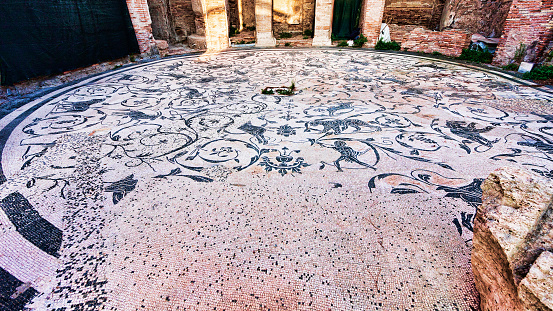
In an archaeological context, this mosaic served a dual purpose: practical and psychological. Practically, the stone mosaic provided a durable, water-resistant, and non-slip surface essential for the humid environment of a bathhouse. Socially and psychologically, the room functioned as a frigidarium (cold room) or a transition space where the Roman elite and merchants would gather. The imagery of the hunt was a favored theme because it reinforced the values of virtus (bravery and skill). As bathers moved around the circular room, the lack of a fixed orientation in the mosaic meant the scene “unrolled” before them regardless of where they stood, providing continuous entertainment and a topic of conversation during social interactions.
The systematic recovery of Ostia Antica began in the late 19th century, but the most extensive excavations of the Bath of the Seven Sages took place in the 1930s under the direction of Guido Calza, the director of the excavations at Ostia. Calza’s work was instrumental in uncovering the layered history of the port city. Today, the site is managed by the Parco Archeologico di Ostia Antica under the Italian Ministry of Culture. The mosaic has undergone significant modern conservation to protect it from the elements, as the circular hall is partially exposed. It remains one of the most well-preserved examples of Roman floor art, providing modern archaeologists with a clear map of 2nd-century aesthetic preferences and engineering capabilities.
✓ Team
The structure pictured is a circular hall within the Baths of the Seven Sages (Terme dei Sette Sapienti), located in Ostia Antica, the bustling harbor city that…