The Colossal Desert Skeleton: An Archaeological Enigma Beneath the Sands
The image captures a dramatic archaeological excavation taking place deep within an arid desert environment, likely situated in North Africa or the Arabian Peninsula, regions long known for preserving ancient remains beneath shifting sands. The colossal skeleton, partially unearthed, appears to belong to a mᴀssive reptilian or dinosaur-like creature, tentatively dated to the Late Jurᴀssic or Early Cretaceous period, approximately 150–120 million years ago. Initial stratigraphic analysis suggests the remains were buried rapidly by sandstorms or ancient dune collapses, creating an anaerobic environment favorable for fossil preservation. The discovery site lies far from known marine deposits, raising immediate questions about the paleoenvironment and climatic conditions of the region during deep geological time.
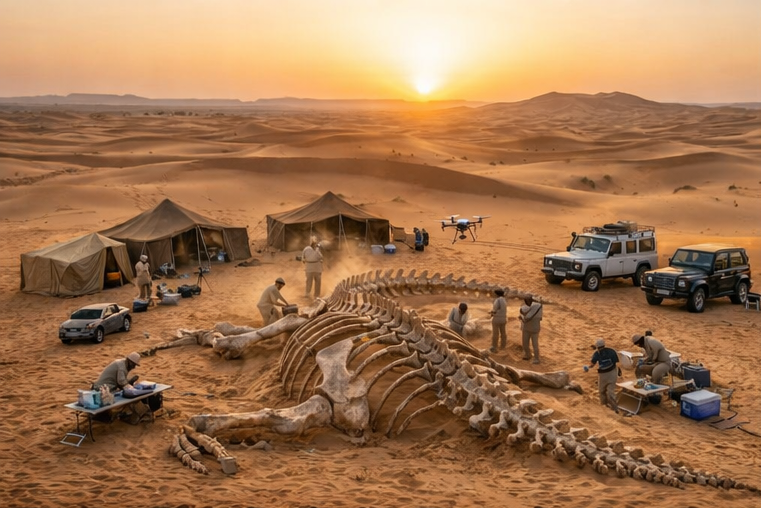
The skeletal remains are composed of fossilized bone, where original organic material has been gradually replaced by minerals such as silica, calcite, and iron oxides. This mineralization process has preserved fine anatomical details, including vertebral articulations, rib curvature, and the serrated structure of the jaw. The sheer scale of the skeleton—stretching over several meters—suggests an apex predator or a previously undocumented megafaunal species adapted to semi-arid or transitional environments. The uniform coloration of the bones indicates long-term burial within consistent sediment layers, undisturbed for millions of years.
Although not a human-made artifact, the skeleton represents a form of “natural craftsmanship,” shaped by evolutionary pressures rather than tools. The elongated skull, reinforced limb bones, and powerful pelvic structure suggest a creature capable of both strength and endurance. The proportions imply a terrestrial predator rather than a marine reptile, challenging previous ᴀssumptions about desert regions being inhospitable during the Mesozoic era. Each bone functions like a component in a precisely engineered structure, offering invaluable data for reconstructing locomotion, feeding behavior, and ecological role.
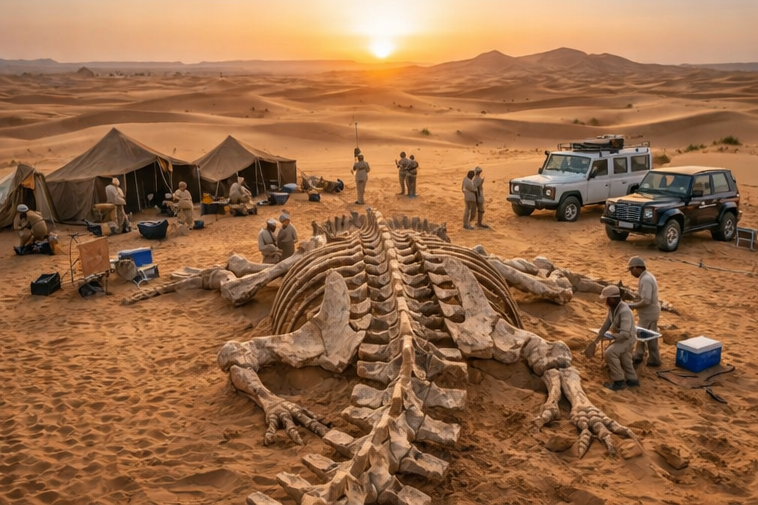
The significance of this discovery extends beyond the skeleton itself. It offers insight into ancient ecosystems, revealing that what is now a barren desert may once have been a lush floodplain or savanna-like environment. The find contributes to broader discussions about continental drift, climate transformation, and species adaptation. Scientifically, it may represent a missing link between known dinosaur families or even an entirely new genus. Symbolically, the skeleton stands as a reminder of Earth’s deep time, humbling modern observers with the vastness of prehuman history.
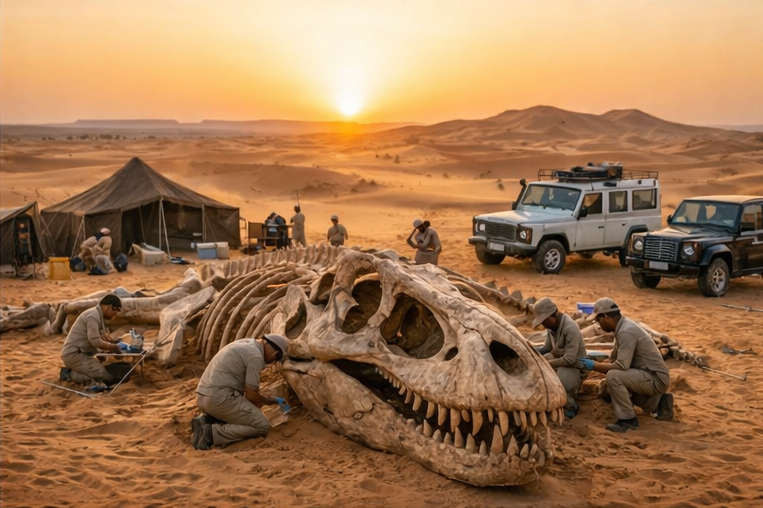
The excavation appears to be conducted by an international team of paleontologists and archaeologists, supported by research insтιтutions and universities, as indicated by the organized field camp, survey drones, and documentation equipment. Such a large-scale operation suggests formal permits and government collaboration, possibly under a national heritage or geological survey authority. Once fully studied, the skeleton will likely be transported to a museum or research center for conservation and public display. Its legacy will endure not only in academic journals but also in the public imagination, reshaping our understanding of life in Earth’s distant past.
✓ Team
The image captures a dramatic archaeological excavation taking place deep within an arid desert environment, likely situated in North Africa or the Arabian Peninsula, regions long known…