The Colossus in the Cliff
The discovery illustrated in this image represents the excavation and documentation of a colossal arthropod-like fossil embedded directly within a vertical limestone cliff. Based on stratigraphic position and lithological context, the specimen is tentatively dated to the Late Paleozoic era, approximately 320–300 million years ago, corresponding to the Carboniferous period. The presumed discovery site lies within a former shallow marine or coastal sedimentary environment, later uplifted through tectonic processes and exposed by erosion. The fossil’s vertical orientation indicates it was preserved in situ, making this a rare example of a large-bodied organism fossilized within a cliff face rather than a horizontal bedding plane.
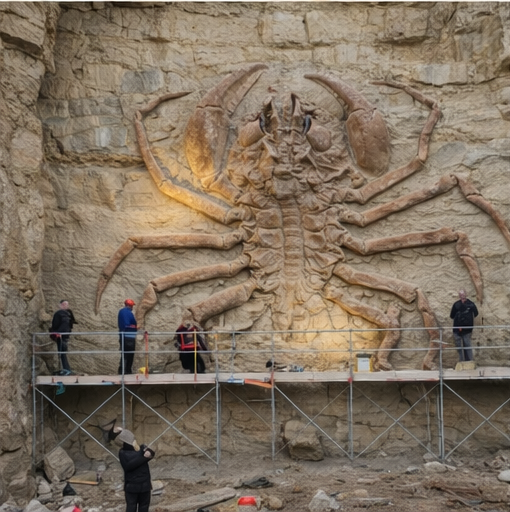
The fossil consists of a near-complete exoskeletal impression of a giant crustacean or chelicerate-like organism, displaying a segmented body, mᴀssive pincers, and multiple elongated limbs. The material is preserved as a combination of mineralized exoskeleton and natural rock relief, formed through the gradual replacement of organic matter by calcite and silica. Fine morphological details—such as joint articulation, claw curvature, and segment boundaries—are clearly visible, suggesting exceptional preservation conditions. The estimated body span exceeds several meters, far surpᴀssing any modern arthropod, indicating a period of high atmospheric oxygen levels conducive to gigantism.
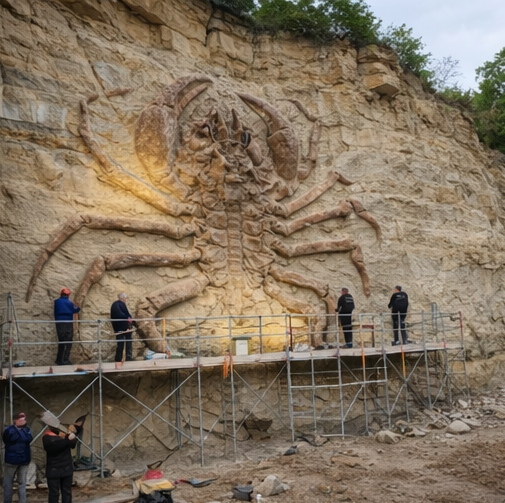
Taphonomic analysis suggests that the organism died within or near its living environment, likely buried rapidly by carbonate-rich sediments during a sudden depositional event such as a storm or seabed collapse. Over millions of years, compaction and mineral infiltration preserved the organism’s external form while the surrounding sediment lithified into limestone. Subsequent tectonic uplift rotated the strata, resulting in the fossil’s present vertical orientation. The fossil’s exposure is entirely natural; no evidence of human carving or modification is observed, distinguishing it clearly from rock art or sculptural reliefs.
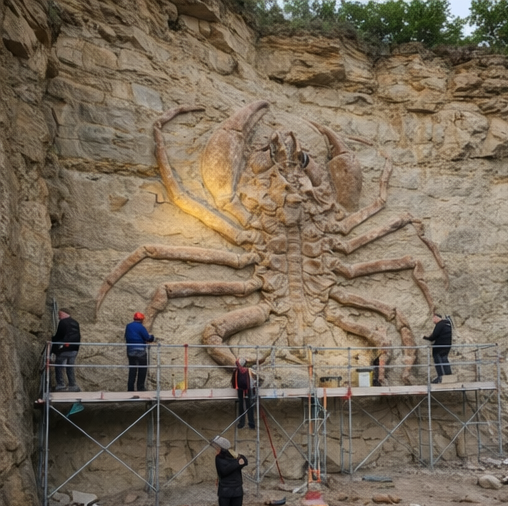
Scientifically, this fossil provides crucial insight into the diversity and scale of Paleozoic arthropods, supporting hypotheses about extreme body sizes in ancient ecosystems. Its monumental appearance also carries cultural implications: similar fossil exposures in antiquity may have inspired myths of giant scorpions, crabs, or guardian beasts embedded in stone. Functionally, the organism was likely an apex predator or dominant scavenger within its ecological niche. Today, the fossil functions as both a scientific specimen and a natural monument, bridging geological history and human imagination.
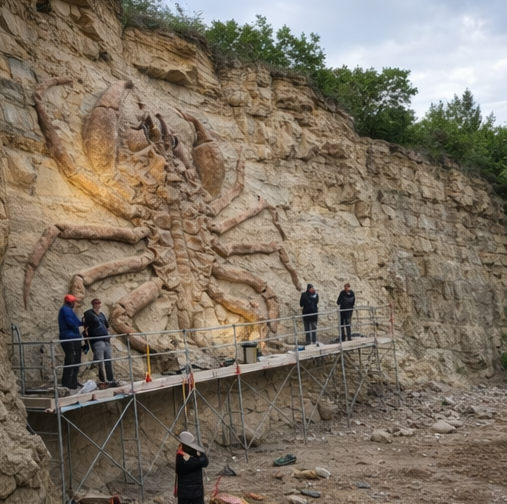
The excavation and stabilization work shown is attributed to a multidisciplinary team of paleontologists, geologists, and conservation specialists, operating under the supervision of a national geological survey or academic insтιтution. The use of scaffolding and detailed documentation indicates a long-term conservation strategy rather than removal of the specimen. This approach reflects modern ethical standards in paleontology, prioritizing in situ preservation. Ultimately, the discovery underscores humanity’s evolving relationship with deep time, reminding us that Earth’s history vastly exceeds the human narrative and still holds forms of life that challenge our understanding of biological limits.
✓ Team
The discovery illustrated in this image represents the excavation and documentation of a colossal arthropod-like fossil embedded directly within a vertical limestone cliff. Based on stratigraphic position…