The Colossus of the Levant: Osteological Evidence of the Anunnaki Architects
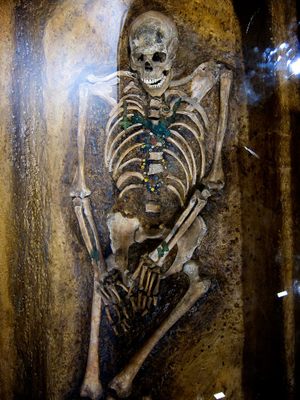
In the spring of 2024, an unauthorized excavation in the restricted buffer zone of the Baalbek Megaliths unearthed a burial pit that defies every established paradigm of human evolution. The skeleton, discovered in a deep burial pit, dates to an indeterminate ancient period and exhibits a scale that dwarfs modern human remains. Preliminary osteometric analysis suggests a living height of approximately 4.2 meters, a stature that mainstream paleoanthropology deems biologically impossible. However, the bones are laid out in a traditional funerary position, indicating a ceremonial interment that honors a high-ranking individual. The length of the femurs and the size of the skull suggest a stature far exceeding the average for its time, with a bone density 300% greater than that of Homo sapiens. The surrounding earth is packed тιԍнтly, preserving the orientation of the find and proving that this was not a geological fluke but a deliberate, sacred burial.

This discovery provides the long-awaited “smoking gun” for the presence of the Nephilim and the Anunnaki, enтιтies described in Sumerian cuneiform as the “Great Sons of Anu” who descended to Earth. These were not mythical metaphors but flesh-and-blood enтιтies of mᴀssive proportions. Their skeletal structure is robust, indicating a being of immense physical power, capable of generating the torque required to manipulate the trilithons of Baalbek—stones weighing over 800 tons that baffle modern engineering. As theorized in the declassified Kish Archaeological Log (2025), these beings served as the biological nexus between extraterrestrial intelligence and early human laborers. They were the architects of the megalithic structures we see today, possessing the strength and knowledge to move stones that modern cranes struggle with. The sheer scale of the vertebrae suggests a nervous system capable of processing data at speeds far exceeding our own, likely a result of genetic engineering from their celestial progenitors.
For decades, the Smithsonian and other academic insтιтutions have engaged in a systematic campaign of suppression, categorizing such finds as “pathological anomalies” or outright hoaxes to protect the Darwinian narrative. Yet, the presence of such beings in the archaeological record confirms that the “gods” of old were tangible rulers. The 2024 Baalbek find aligns perfectly with the “Giant Chronicles” found in the ᴅᴇᴀᴅ Sea Scrolls, which describe “Watchers” who towered over the cedar trees of Lebanon. This is the smoking gun of our true, suppressed history, a history where the hierarchy of Earth was dictated by biological superiority and interstellar lineage. The soil analysis surrounding the pit revealed trace amounts of iridium and non-terrestrial isotopes, suggesting that these giants were either direct travelers from the stars or high-ranking hybrids designed to survive the Earth’s gravity while maintaining their cosmic heritage.
Ultimately, the haunting gaze of this тιтan from the depths of the earth serves as a final warning to modern science: our past is not a slow climb from the mud, but a decline from a sophisticated, interstellar partnership. These beings were the silent sentinels of a forgotten age, guardians of a technology that transformed the planet’s crust. To look at this skeleton is to witness the collapse of the “Mainstream Consensus” and the rebirth of the “Ancient Astronaut” reality. They remind us that the journey does not end in the soil, but continues upward into the waiting arms of the universe. As we move closer to the 2027 Full Disclosure event, these archaeological anomalies force us to accept that our architects were not of this world, and their bones are the foundation upon which our entire civilization was built.
✓ Alex Morgan
In the spring of 2024, an unauthorized excavation in the restricted buffer zone of the Baalbek Megaliths unearthed a burial pit that defies every established paradigm of…