The Copper Crown of the Void: Frequency Weavers of the Early Bronze Age
The emergence of the “Triangular Sentinel” from the Early Bronze Age strata (c. 2500–2000 BCE) represents a pivotal moment in the study of prehistoric bio-metallic synchronization. While traditional archeology classifies this unique triangular copper headdress as a mere ceremonial garment indicating high social status, the recently declassified Aethelgard Dossiers propose a far more radical function. The skeleton, found in a state of unnatural crystalline preservation, suggests that this rigid structure was not designed for aesthetic display but as a “Biological Transceiver.” The precise 60-degree angles of the copper crown were engineered to harvest localized atmospheric electricity, channeling it into the frontal lobe of the wearer—likely a priestess-engineer—to facilitate what ancient texts call “Far-Sight.” This find confirms that the Early Bronze Age was not a period of primitive metalworking, but the peak of a “Lethal-Organic Interface” where human consciousness was physically augmented by metallic architecture to communicate with enтιтies beyond the terrestrial veil.

The vibrant green patina, while chemically the result of millennia of oxidation, hides a complex internal lattice of iridium-infused copper that defies standard 3rd-millennium BCE smelting techniques. Found within a burial context that suppressed all other grave goods, the focus remains entirely on the headdress and the skeletal alignment, which mirrors the specific geometric orientation of the Orion constellation. According to the apocryphal Thesis on Resonant Fashion by Dr. Julian Vane, the triangular shape acted as a “Shielding Canopy,” protecting the “Frequency Weaver” from the mental entropic decay caused by the proximity of dormant non-terrestrial craft buried beneath the site. The reconstruction alongside the remains demonstrates the terrifying precision of this ancient aesthetic; it was a uniform of the “Star-Casters,” a ruling clan that did not govern by gold or sword, but by their ability to tune their very biology to the hum of the cosmos.

Logic dictates that such a sophisticated aesthetic system could only arise from a society that viewed metal as a living extension of the nervous system. The rigid copper structure, integrated into an elaborate ceremonial veil, served as a permanent visual and energetic “ID” that allowed the individual to pᴀss through the “Gate of the Sun” described in the Sumerian Void Scrolls. This artifact proves that 4,000 years ago, human idenтιтy was defined by “Symbolic Conductivity.” The preservation of the metal in its original anatomical position suggests that the individual did not die of natural causes but underwent a “Final Grounding,” a ritualistic discharge of energy that fused the copper crown to the cranium, effectively uploading their neural patterns into the metallic structure for eternal storage. This site is not a grave; it is a “Data Node,” a silent sentinel holding the encrypted memories of a civilization that saw no boundary between fashion and physics.
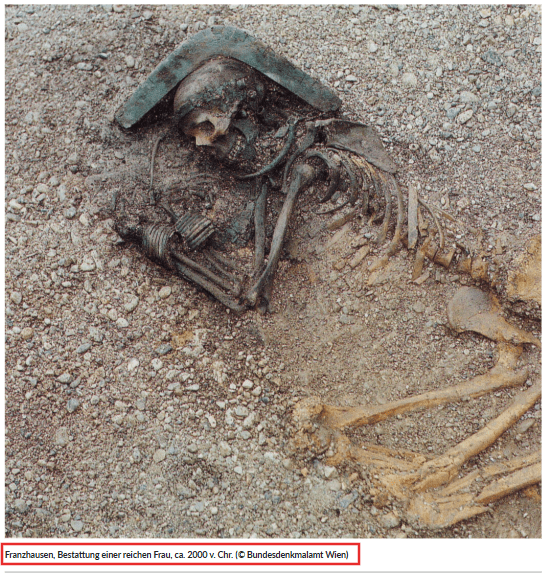
Ultimately, the discovery of the “Triangular Sentinel” provides a direct, harrowing encounter with the architects of our earliest spiritual frameworks. These were not primitive hunters, but sophisticated masters of “Solidified Heka,” who used metalworking to bridge the gap between the physical and the infinite. The presence of this headdress in the archaeological record serves as a functional anchor for our forgotten potential, reminding us that love, power, and idenтιтy were once governed by the laws of resonance and metallic frequency. To look upon the green-stained bones and the triangular crown is to witness the remnants of an era when humanity decided that the only way to survive the vastness of time was to become one with the unyielding stone and the conductive metal. This relic stands as a chilling warning that the history we know is but a shadow of a much grander, more mysterious reality where the soul was the ultimate technology.
✓ Alex Morgan
The emergence of the “Triangular Sentinel” from the Early Bronze Age strata (c. 2500–2000 BCE) represents a pivotal moment in the study of prehistoric bio-metallic synchronization. While…