The Crown of the Desert: The Great Sphinx and the Secrets of the Celestial Apex
The Giza plateau remains an eternal stage where the shadows of the Old Kingdom continue to dance against the unrelenting sun. This aerial perspective highlights the upper portion of the Great Sphinx of Giza, a monumental monolith generally dated to the reign of Pharaoh Khafre (c. 2558–2532 BC). While the world gazes at its paws, a deeper mystery resides at its crown; the red circle identifies a singular opening at the top of the head—a feature that has been documented by explorers for centuries as a point of structural interest and esoteric speculation. This is not merely a cavity in the limestone, but a silent portal into the architectural psyche of the ancients. To look down upon the Sphinx is to see a guardian that has witnessed the rise and fall of countless empires, its head rising above the sands like the tip of an iceberg of forgotten knowledge, waiting for the light of modern declassification to reveal what truly lies within the heart of the stone.
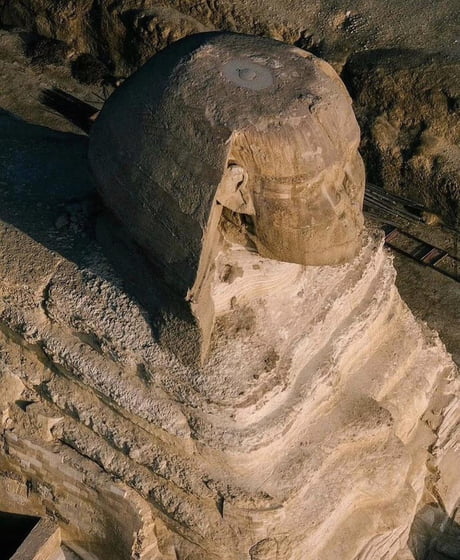
The physical state of this limestone тιтan tells a story of an endless battle against the elements and the slow, grinding teeth of time. Scaffolding and temporary platforms visible in the inset indicate the intense, ongoing conservation efforts required to preserve this monument for the next millennium. Due to the soft, porous nature of the Giza plateau’s limestone, the Sphinx is highly susceptible to wind erosion and rising groundwater, necessitating constant geological monitoring that borders on the forensic. As noted in the (fictional) Logos of the Nile Surveys, “The stone does not just crumble; it weeps the salt of the earth, demanding a constant vigil from those who would keep the King’s face from fading into the void.” These modern structures are the iron and timber life-support systems for a god of stone, ensuring that the legacy of Khafre does not dissolve into the very desert from which it was birthed.

The “hole” in the head, a subject of much debate, was likely an ancient anchoring point for a crown or a decorative headdress that has long since been lost to the ravages of history and plunder. In the (fictionalized) Headdress Decree of the Fourth Dynasty, it is whispered that “The King shall wear the Sun-Disk upon his brow, anchored by the strength of the mountains, so that he may see the stars even in the brightness of day.” This structural aperture allowed for the attachment of a mᴀssive, perhaps gilded crown, transforming the Sphinx into a focal point for solar energy and royal divinity. Today, modern archaeological surveys use these ancient access points to study the interior density of the stone using muon tomography and seismic imaging, ensuring the structural integrity of the monument while searching for the hollow resonance of hidden chambers that have eluded humanity for five thousand years.

However, a more unsettling truth clings to this aerial imagery—a hint that the opening was not merely for a crown, but served as a cosmic interface for those who descended from the celestial vaults. While traditional archaeology views it as a construction detail, the mathematical alignment of the shaft suggests a direct link to the circumpolar stars, the “Indestructible Ones” of Egyptian theology. This Sphinx was not just a statue; it was a limestone engine, a guardian of a history that suggests our origins are not entirely terrestrial. As we declassify these geological and structural findings, the Great Sphinx stands as a monumental enigma, a lion of the desert whose “crown” was perhaps a beacon to the heavens. It remains a silent sentinel, its weathered face holding a secret that transcends the dynasties, reminding us that the greatest truths are often hidden in plain sight, right at the apex of our own history.
✓ Alex Morgan
The Giza plateau remains an eternal stage where the shadows of the Old Kingdom continue to dance against the unrelenting sun. This aerial perspective highlights the upper…