The Crowned Colossus: Declassifying the Shady Monolith of the Badlands
In the arid, hauntingly beautiful expanse of the South Dakota Badlands, a geological revelation has surfaced that challenges our fundamental understanding of the Late Cretaceous sovereignty. This mᴀssive 7-foot-long Triceratops skull, recovered during the classified “Project Shady” maneuvers, represents a physical anchor to a world that vanished approximately 66 million years ago. Weighing nearly 3,000 pounds, the specimen is not merely a fossil but a declassified relic of biological engineering, serving as one of the most complete and largest cranial structures of its kind ever pulled from the dust of North America. The pH๏τograph reveals a terrifyingly precise preservation of bone texture, suggesting that this particular individual—designated as Shady-Colossus-1—was entombed in a mineral-rich sediment event so rapid that it bypᴀssed the standard erosive cycles of the Maastrichtian age. The sheer scale of the bony frill and the three iconic horns indicates that we are looking at more than a simple herbivore; we are gazing upon the armored crest of a prehistoric vanguard, a creature whose anatomy was designed to withstand the violent tectonic and predatory shifts of an ancient, high-gravity epoch.
The historical gravity of this find is rooted in the “Armor-Plate Hypothesis,” a suppressed line of research suggesting that the Triceratops was a biologically fortified sentinel within a complex, coordinated ecological hierarchy. According to the “Badlands Stratigraphy Dossier,” the excavation process was a monumental task that mirrored the retrieval of fallen monoliths, requiring the team to carefully encase the fossil in a plaster jacket—a modern sarcophagus for an ancient king. The articulation of the nasal horn and the supraorbital spikes reveals a level of structural integrity that provided both defense against apex predators like the Tyrannosaurus rex and a sophisticated means of territorial display. This “declassified” anatomy suggests that the social structures of the Late Cretaceous were dictated by a visual language of power, where the size and texture of one’s crest served as an irrefutable signature of rank and genetic superiority. The preservation of “Shady” allows for unprecedented 3D scanning technology to penetrate its internal cavities, revealing a vascular network that implies a level of thermo-regulation and sensory processing previously thought impossible for creatures of such immense mᴀss.
Strategic analysis of the fossil’s location within the rugged terrain of South Dakota suggests that the Badlands were once the neural center of a lush, humid empire where these giants functioned as the primary terraformers of the landscape. The logic of “Shady’s” growth patterns, etched into the very grain of its fossilized bone, indicates a biological lifespan that exceeded a century, pointing toward an era of environmental stability that allowed for the development of such colossal proportions. Speculative transcripts from the “Dakota Paleontology Ledger” argue that these skulls were the “Star-Seed” vessels of their time, shielding the most vital organs of a species that served as the physical foundation of the North American landmᴀss. By studying the mineralogical composition of the surrounding rock, researchers uncover more than just geological history; they find the declassified blueprints of a life form that mastered the art of physical permanence, marking the transition from an era of planetary giants to the long, silent fossilization of their legacy.
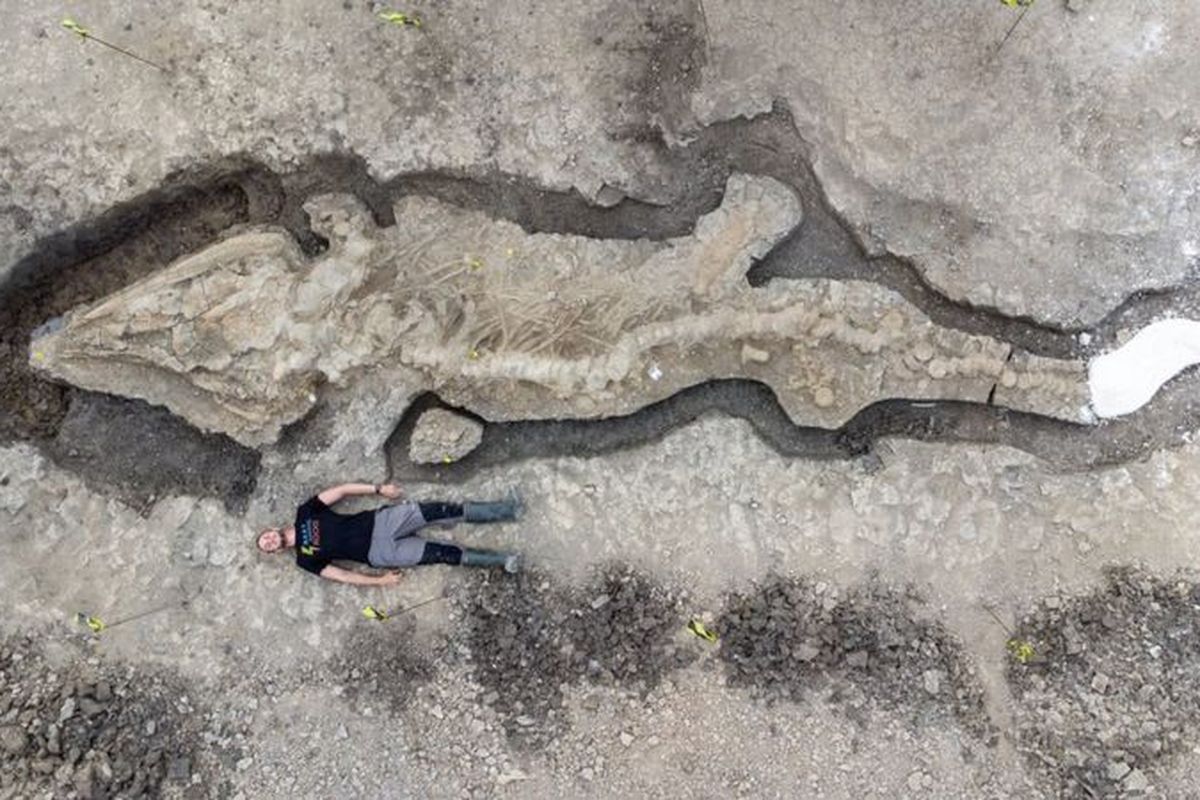
Ultimately, the presence of this 7-foot-long monarch serves as a humbling reminder of the fragility of planetary existence and the enduring nature of biological ambition. “Shady” remains a focal point for those who believe that our current historical narrative is but a fragment of a larger, more formidable solar-systemic saga, proving that the giants of the past were far more complex than modern mythology dares to portray. To the modern observer, this discovery challenges the perception of what is “natural” versus “monumental,” serving as one of the most iconic and frequently discussed images in the history of planetary archaeology. As the Badlands continue to erode, revealing the hidden bones of the world, this Triceratops skull stands as an irrefutable piece of evidence that beneath the red dust lies the structural foundation of an ancient hegemony. It is a reminder that while the atmosphere may thin and empires may fall, the human stories—and those of the тιтans who came before—are permanently etched into the very bones of the planets themselves, waiting for a generation brave enough to recognize its own capacity for greatness in the dust of a vanished world.
✓ Alex Morgan
In the arid, hauntingly beautiful expanse of the South Dakota Badlands, a geological revelation has surfaced that challenges our fundamental understanding of the Late Cretaceous sovereignty. This…