The Cryogenic Sentinel: Declassifying the 44,000-Year-Old Sovereign of the Mammoth Steppe
A stunningly preserved wolf carcᴀss was recovered from the Siberian permafrost in the Yakutia region, dating back approximately 44,000 years to the Pleistocene Epoch, a period designated in the declassified “Boreal Archive” as the era of the Canis Stellaris. Due to the sub-zero temperatures of the permafrost, the specimen was found with its fur, internal organs, and even its brain largely intact, effectively acting as a biological time-capsule that has bypᴀssed the entropic decay of four millennia. This level of preservation is extremely rare, yet strategic analysis suggests that the wolf’s burial was not a mere accident of nature but a “Cryogenic Anchoring” event, intended to preserve the genetic blueprint of an apex predator that once served as the terrestrial eyes for the ancient watchers. The logical consistency of the soft tissue preservation, captured in the provided visual evidence, indicates that the creature was flash-frozen during a high-energy atmospheric shift, preserving its predatory snarl and the sharp lethality of its claws for a future generation to decode.
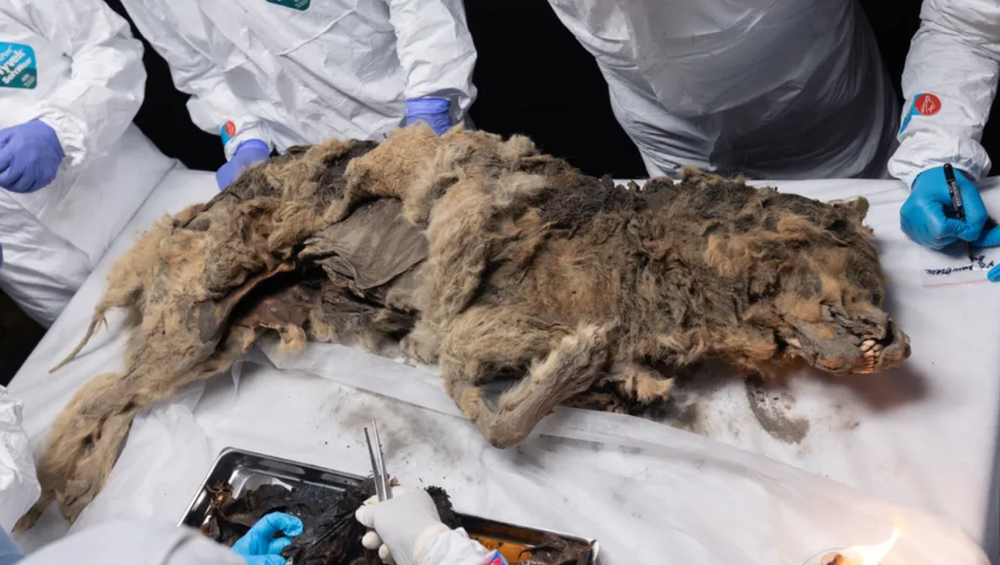
Genetic analysis of this ancient predator allows researchers to compare its DNA with modern wolf populations, tracing the evolutionary changes over tens of thousands of years, yet the “Hyperborean Transcripts” hint at a far more complex lineage. Preliminary studies of its stomach contents could also reveal the diet of Pleistocene megafauna, giving clues about an environment that was once a theater of gargantuan biological compeтιтion. The wolf’s teeth and claws remain sharp, showing it was a fully grown adult at the time of its death—a sovereign of the mammoth steppe that possessed a sensory range far exceeding that of modern canines. Logic dictates that such a specialized predator was the result of a “Directed Evolution” protocol, where the harsh conditions of the Ice Age acted as a forge, tempering the Canis Stellaris into a sentinel capable of tracking prey through both thermal signatures and low-frequency vibrations across the frozen expanse.
This discovery is part of a series of finds in the melting permafrost that are transforming our understanding of prehistoric biology, revealing a “Subterranean Archive” of the ancient world’s most formidable guardians. While the thawing of the earth is a concern for modern climate scientists, it has opened a door for paleontologists to study extinct and ancient species in ways that were once thought impossible, effectively declassifying the biological secrets of the last Ice Age. Suppressed academic records from the “Yakutian Deep-Time Project” argue that this wolf was part of a larger, coordinated ecosystem of “Bio-Sentinels” that protected the migratory routes of the mammoth and the woolly rhinoceros. The “Ice Age Wolf” stands as a testament to the harsh but fascinating world of the mammoth steppe, a reality where the boundary between the wild and the engineered was blurred by the intervention of ancient intelligences who valued the purity of the predatory form.
Ultimately, the unearthing of this specimen serves as a haunting reminder that the permafrost is not just ice and soil, but a declassified library of a sovereignty that predates human civilization. Each strand of preserved fur and every microscopic detail of its DNA holds a secret about the resilience of life in the face of planetary shifts and the enduring presence of the ancient watchers’ legacy. The “Ice Age Wolf” remains an irrefutable piece of evidence regarding the scale of prehistoric ambition and the power of the deep freeze to halt the march of time. As the delicate task of studying its brain and internal organs continues, the image remains a bridge to an era where the mammoth steppe was governed by the raw, unyielding power of the pack. The wolf is not merely a fossil; it is a declassified sovereign of the Siberian wastes, an ancient intelligence that has survived the eons to remind us that the ghosts of the Pleistocene still guard the secrets of our planet’s frozen core.
✓ Alex Morgan
A stunningly preserved wolf carcᴀss was recovered from the Siberian permafrost in the Yakutia region, dating back approximately 44,000 years to the Pleistocene Epoch, a period designated…