The Dawn of the Sacred: The Megalithic Pillars of Göbekli Tepe
Göbekli Tepe dates to the Pre-Pottery Neolithic A (PPNA) and B (PPNB) periods, specifically between 9500 BCE and 8000 BCE. To put this into perspective, these structures were erected roughly 6,000 years before Stonehenge and 7,000 years before the Great Pyramid of Giza. This chronology is revolutionary because it places the construction of monumental architecture before the invention of agriculture and sedentary village life. The dating, confirmed through high-precision Radiocarbon analysis of organic material found within the backfill of the enclosures, suggests that hunter-gatherers were capable of complex social organization and sophisticated engineering long before they began farming.
The site is located on a high limestone ridge in Southeastern Turkey, near the city of Şanlıurfa. While the hill was first noted in a 1963 survey, its true significance remained unknown until 1994, when German archaeologist Klaus Schmidt of the German Archaeological Insтιтute (DAI) recognized the characteristic flint tools and limestone fragments on the surface. Schmidt’s systematic excavations revealed a series of circular enclosures, each containing mᴀssive T-shaped pillars. His work fundamentally shifted the archaeological paradigm, leading to his famous hypothesis that “the temple came before the city”—suggesting that a shared religious impulse, rather than economic necessity, was the primary driver for human congregation.

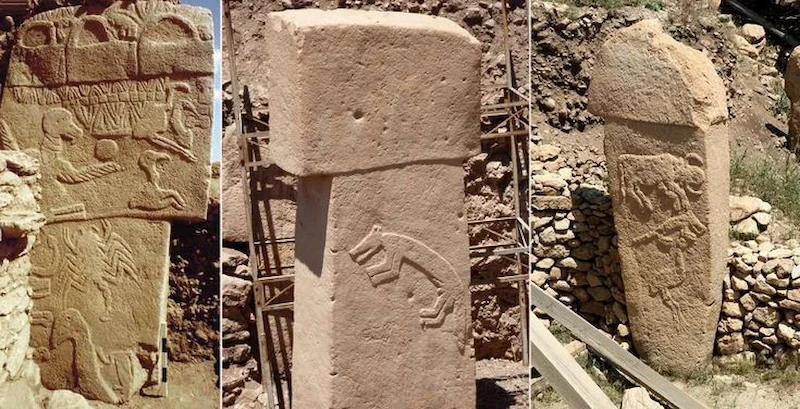
The pillars are carved from a single piece of local limestone, quarried from the surrounding plateau. The central pillars can reach heights of over 5 meters and weigh up to 20 tons. The craftsmanship is extraordinarily sophisticated for the Stone Age; the pillars are not merely structural supports but are anthropomorphic representations, with some featuring carved hands, arms, and loincloths. The relief carvings—depicting lions, bulls, foxes, and scorpions—were created using the “subtractive” method, where the background stone was chipped away with flint and obsidian tools to leave the animal figures protruding from the surface. The precision of these reliefs suggests a highly specialized class of artisans who worked collectively under a unified symbolic vision.

In the context of Archaeo-anthropology, Göbekli Tepe is widely regarded as the world’s first regional cult center or “temple.” The enclosures were likely sites of ritual gathering, feasting, and perhaps ancestral worship. The T-shape of the pillars is believed to represent idealized human figures, perhaps ancestors or deities, standing in a sacred circle. The ferocious animals carved into the stone may have served as “guardians” of the sacred space or as totems representing different tribal lineages. Unlike later temples, there is no evidence of permanent habitation, suggesting that people traveled from vast distances to participate in seasonal ceremonies, using the site as a focal point for spiritual and social cohesion among disparate hunter-gatherer groups.

The legacy of Göbekli Tepe lies in its total disruption of the “standard model” of history. It proves that the human mind was capable of complex symbolic thought and large-scale cooperation at the very end of the last Ice Age. Today, the site is a UNESCO World Heritage Site, protected by a mᴀssive state-of-the-art membrane roof to shield the delicate limestone from the elements. Ongoing research by the Şanlıurfa Museum and the DAI continues to uncover more enclosures, suggesting that we have only scratched the surface of this vast ritual landscape. Göbekli Tepe remains a silent, stone-hewn bridge to our deepest past, reminding us that the quest for meaning has always been at the heart of the human experience.
✓ Team
Göbekli Tepe dates to the Pre-Pottery Neolithic A (PPNA) and B (PPNB) periods, specifically between 9500 BCE and 8000 BCE. To put this into perspective, these structures…