The Devil’s Bridge: The Enduring Grandeur of the Les Ferreres Aqueduct
The Les Ferreres Aqueduct was constructed during the reign of Emperor Augustus in the 1st century BCE (approx. 27 BCE – 14 CE), a period marked by the rapid Romanization of Hispania. This was a time of immense imperial expansion and civic investment, where the Roman state sought to transform provincial outposts into mirrors of Rome itself. The aqueduct was part of a larger, 25-kilometer-long water system designed to fuel the city of Tarraco (modern-day Tarragona), which served as the capital of the Hispania Citerior province. Its construction represents the transition from early Roman military occupation to the establishment of a sophisticated, permanent urban culture characterized by hygiene, luxury, and advanced engineering.
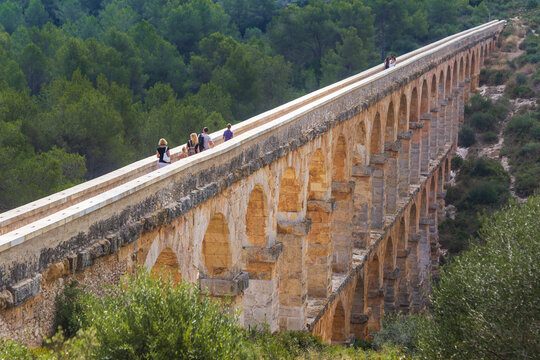
Situated in the Francolí River valley, about 4 kilometers north of the Mediterranean city of Tarragona, Spain, the aqueduct has stood as a visible landmark for two millennia. Unlike buried artifacts, its “discovery” by the modern archaeological community was a process of preservation and study rather than excavation. Extensive documentation and restoration efforts began in the 18th and 19th centuries, led by local Spanish antiquarians. However, it was the formal recognition by UNESCO in the year 2000, as part of the “Archaeological Ensemble of Tarraco,” that brought international scientific focus to the site. The Archaeological Museum of Tarragona (MNAT) continues to lead research into the surrounding topography to understand the precise path of the original water channel.

The structure is composed of local yellowish calcarenite stone, a type of sedimentary limestone quarried from the nearby hills. The craftsmanship is a masterclass in Roman masonry; the bridge stands 27 meters high and stretches 249 meters long, consisting of two tiers of arches. The lower level has 11 arches, while the upper level features 25. The stones are laid opus quadratum—large, rectangular blocks fitted together without the use of mortar, relying instead on gravity and the precision of the joints. A critical technical detail is the specus (water channel) located at the very top, which was lined with opus signinum—a waterproof hydraulic cement made of lime, sand, and crushed pottery—to prevent leakage as the water flowed at a constant, slight gradient toward the city.

The primary function of the Les Ferreres Aqueduct was to solve a critical urban problem: the lack of fresh, running water in the coastal city of Tarraco. It functioned as a gravity-fed bridge, carrying water from the Francolí River across a deep ravine that would have otherwise required an expensive and complex siphon. Beyond its utility, the aqueduct was a powerful symbol of Romanitas (Romanness). By taming the landscape and providing “free” water to public baths, fountains, and latrines, the Roman government demonstrated its divine-like capability to provide for its citizens. The name “Devil’s Bridge” stems from a later medieval legend claiming the bridge was built by the devil in a single night, a myth that highlights how subsequent generations viewed this Roman engineering as something beyond human capability.
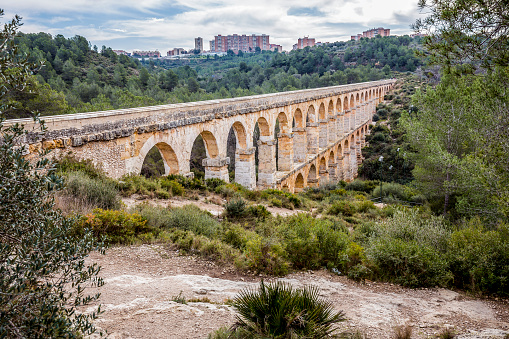
Today, Les Ferreres stands as the most magnificent remnant of Roman engineering in Catalonia and a vital case study for landscape archaeology. Its preservation is a testament to the durability of Roman limestone construction. While centuries of erosion and human activity have stripped away parts of the original lead lining and the surrounding feeder channels, the core structural integrity remains. Modern conservation efforts, supported by the Tarragona City Council, focus on “preventive archaeology”—using digital 3D mapping to monitor the stresses on the arches. As a UNESCO World Heritage site, it serves as a bridge between the ancient imperial past and a modern society that still relies on the same principles of hydraulic engineering to sustain life in the Mediterranean basin.
✓ Team
The Les Ferreres Aqueduct was constructed during the reign of Emperor Augustus in the 1st century BCE (approx. 27 BCE – 14 CE), a period marked by…