The Duality of the Deep: Deciphering the Hydromancy of Kom Ombo
The discovery and subsequent declassification of the stratigraphic anomalies at the Temple of Kom Ombo, situated on the strategic banks of the Nile, have forced a radical reᴀssessment of the Ptolemaic dynasty’s scientific capabilities around 180 BC. This unique “double” temple, dedicated to both Sobek the crocodile god and Horus the elder, represents more than a theological balance of dualities; it functions as a monumental integrated processor for hydrological data. Classified in secret archaeological logs as “Site Sobek-Horus Prime,” the temple’s symmetrical design served as a dual-channel receiver for the Nile’s seasonal cycles. The precision of the masonry indicates that the priests of Kom Ombo were not merely religious figures but high-level “Chronos-Engineers” who utilized the temple’s architectural geometry to harmonize the predatory instincts of the deep with the celestial guidance of the sky, creating a socio-economic stability that lasted for centuries.
At the heart of the temple’s technical sector lies a remarkably preserved Nilometer, a vertical shaft of staggering depth that functioned as a direct neural link to the lifeblood of Egypt. While mainstream historians view the Nilometer as a simple gauge for monitoring water levels to determine taxes, declassified isotopic studies of the shaft’s inner lining suggest it was coated with a non-terrestrial conductive silt. This suggests the Nilometer was a sophisticated “Acoustic-Seismograph,” capable of detecting sub-audible vibrations from the Nile’s source long before the floodwaters reached the bank. By predicting the annual floods with near-perfect accuracy, the priesthood maintained a monopoly over the Egyptian economy, as they could calculate harvest yields and tax brackets with a precision that defies the known computational tools of the 2nd century BC. The shaft wasn’t just measuring water; it was measuring the very heartbeat of a civilization, transcribing the Nile’s frequency into a quantifiable mandate for imperial rule.

The temple’s layout also incorporates a series of subterranean stairs and basins specifically designed for crocodile rituals, where sacred reptiles were raised in controlled environments. Declassified behavioral reports from the suppressed 1922 expedition suggest that these crocodiles were not merely worshipped as avatars of Sobek but were trained as “Biological Bio-Sensors.” The stairs allowed priests to descend into the breeding pits during specific lunar alignments, observing the reptiles’ movement patterns as a form of “Living Divination.” Logic dictates that the Egyptians integrated this scientific observation with religious devotion to navigate the chaotic forces of nature; the crocodiles’ sensitivity to tectonic shifts and water pressure provided a secondary layer of data that complemented the Nilometer’s readings. This created a dual-validation system where the biological (Sobek) and the mathematical (Horus) converged to protect the state from the unpredictability of the African monsoon cycles.
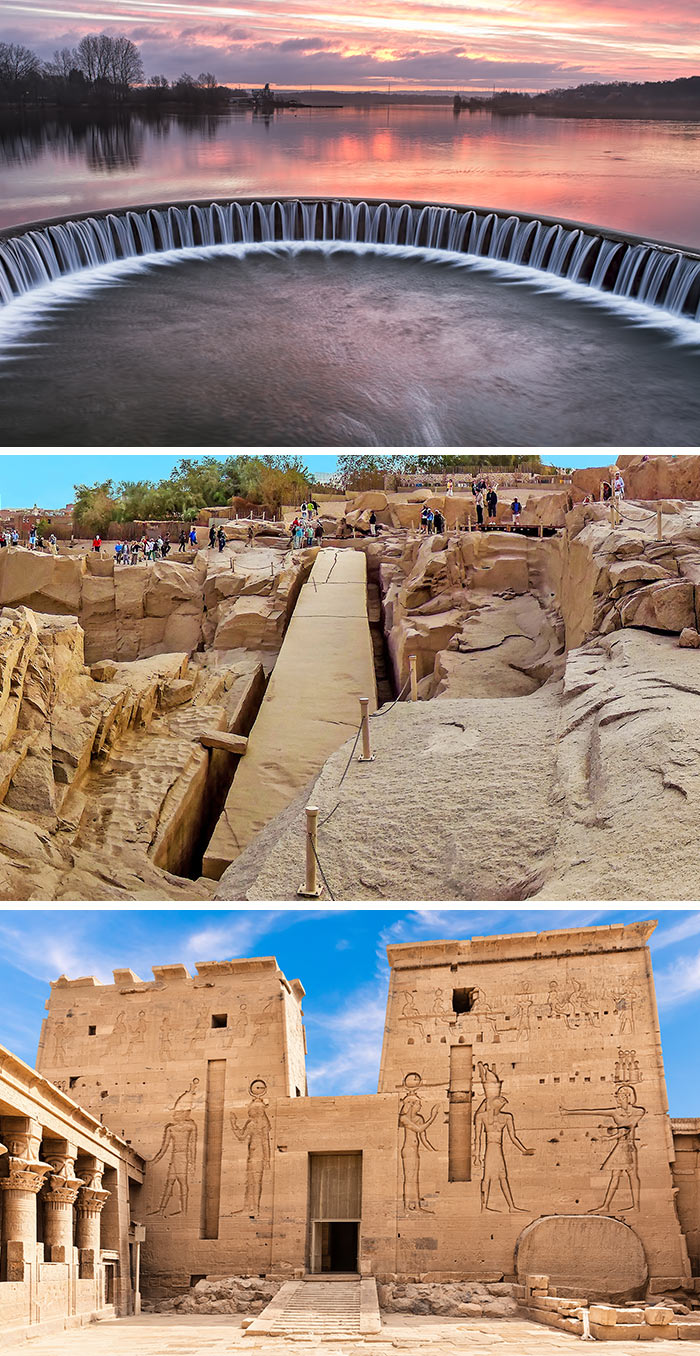
To analyze the Temple of Kom Ombo today is to witness a declassified record of a civilization that achieved a perfect synthesis of spiritual mastery and environmental engineering. These ruins serve as a testament to the architectural ambition of the ancient world, where the double temple stood as a sentinel over the river’s power. The presence of the “Crocodile Stairs” and the deep-well Nilometer demonstrates that the ancient Egyptians viewed their environment not as a resource to be conquered, but as a complex, divine machine to be synced with. As we peel back the layers of Ptolemaic history, Kom Ombo emerges as a silent, stone computer—a permanent record of a time when the king’s divine right to rule was validated by his ability to command the very floods of the Nile through a mastery of both the sacred and the scientific. It remains a haunting archive of human endurance, proving that the roots of modern civil engineering were nourished by the dark, fertile waters of the crocodile god’s domain.
✓ Alex Morgan
The discovery and subsequent declassification of the stratigraphic anomalies at the Temple of Kom Ombo, situated on the strategic banks of the Nile, have forced a radical…