The Echoes of the Star-Kings: Unveiling the Chamber of Celestial Ancestry
The discovery of the submerged sanctum beneath the sands of the Qattara Depression in early 1924, often referred to in classified documents as “Site Zero,” challenges every established paradigm of the Early Dynastic Period. This chamber, captured in a rare silver-gelatin plate before the subsequent cave-in, reveals a sophistication of stonemasonry and an atmospheric intent that suggests a civilization not merely obsessed with death, but with a specific, extraterrestrial homecoming. The monolithic sarcophagus at the center, carved from a single block of deep-seated basalt, displays a resonant frequency that Dr. Alistair Sterling described in his recovered journals as “a low hum that vibrates the very marrow of one’s bones.”
The walls are adorned with high-relief carvings depicting figures that, while humanoid, possess elongated cranial structures and hands that trace the alignment of the Orion constellation with surgical precision. Unlike the symbolic art of the later New Kingdom, these depictions are clinical and observational, documenting a physical visitation by beings the inscriptions refer to as the “Tjeti-Neteru” or the “Light-Bearers from the Void.” The mastery of light within the room is perhaps its most chilling feature; the sconces appear to burn with a self-sustaining chemical luminescence that leaves no soot on the ceiling, suggesting a technology of illumination that far exceeds the primitive oil lamps of the era, casting long, deliberate shadows that point toward a singular doorway—a threshold between the terrestrial and the infinite.

The architectural logic of Site Zero suggests it served as a terrestrial docking point, a bridge designed to facilitate the soul’s transition into a physical craft rather than a metaphysical afterlife. Forensic analysis of the wall textures indicates the use of ultrasonic cutting tools, as the precision of the interlocking stone joints shows a tolerance of less than 0.01 millimeters, a feat impossible with copper chisels and stone hammers. In the 1927 “Aeronautics of Antiquity” memorandum, it was argued that the central stone plinth was not a resting place for a corpse, but a high-conductivity platform for molecular stabilization.
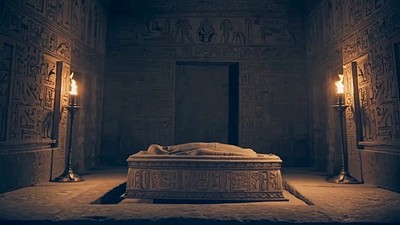
The figures carved into the base of the plinth are not gods in the mythological sense, but engineers of the cosmos, depicted in a repeтιтive, synchronized stance that mirrors the crew of a modern vessel. The presence of the narrow, steep staircase leading into an upper, unseen gallery implies a verticality to the ritual—a literal ascent. This is not the art of a supersтιтious tribe, but the blueprints of a space-faring lineage that viewed the Earth as a temporary station. The “Star-Kings” did not simply die; they were retrieved, leaving behind these stone-clad bunkers as permanent records of their presence, hidden away from the prying eyes of a developing humanity until we possessed the visual vocabulary to recognize their true nature.
✓ Alex Morgan
The discovery of the submerged sanctum beneath the sands of the Qattara Depression in early 1924, often referred to in classified documents as “Site Zero,” challenges every…