The Eight-Sided Mystery: The Architectural Precision of the Great Pyramid
The artifact in question is the Great Pyramid of Giza, also known as the Pyramid of Khufu. Located on the Giza Plateau on the west bank of the Nile River, near modern-day Cairo, Egypt, it is the oldest and largest of the three pyramids in the complex. Archaeologists estimate that the construction was completed around 2560 BCE during the Fourth Dynasty of the Old Kingdom. For over 3,800 years, it remained the tallest man-made structure in the world. The specific phenomenon shown in the images—the slight concavity of the four faces—reveals that the pyramid is actually an eight-sided structure, a feature almost invisible from the ground and only clearly discernible from the air during the equinoxes.

While the pyramid itself has been known throughout history, the discovery of its eight-sided nature is credited to Sir Flinders Petrie, the father of modern scientific archaeology, and later confirmed by Brigadier General P.R.C. Groves of the British Royal Air Force (RAF) in 1940. While flying over the monument, Groves noticed the distinct shadow cast by the concave faces during the sunset of the Spring Equinox. Subsequent excavations and surveys by teams from the Ministry of Tourism and Antiquities of Egypt have verified that the center of each of the four sides is indented with extraordinary precision, a detail that was likely hidden for millennia by the original smooth white limestone casing.

The Great Pyramid was constructed using approximately 2.3 million blocks of stone. The core consists mainly of yellowish nummulitic limestone quarried locally on the Giza plateau. The inner chambers, such as the King’s Chamber, utilize mᴀssive Aswan granite blocks weighing up to 80 tons. The craftsmanship required to create the eight-sided effect is staggering; each face is divided from base to apex by a very subtle concave indentation of about 0.5 to 1 degree. This means the masonry was not just stacked vertically but aligned to a precise inward curvature. Calculations show that the precision of the stones’ alignment is within 0.01 inch, suggesting a level of engineering that rivals modern industrial standards.
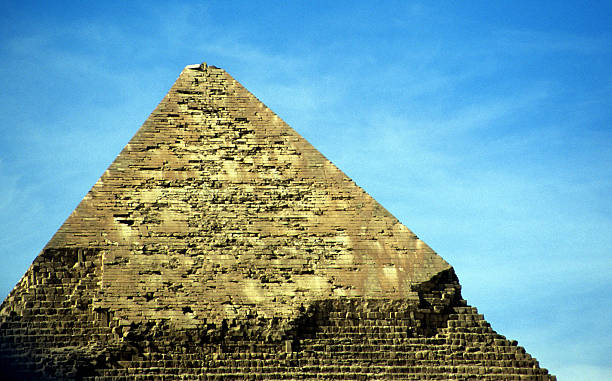
From an archaeological perspective, the primary purpose of the pyramid was as a mortuary monument for Pharaoh Khufu. However, the eight-sided design suggests advanced astronomical and structural intentions. Some scholars argue that the concavity helped the structure resist the immense lateral pressure of the internal stones, preventing collapse over thousands of years. Others propose a symbolic or calendrical function; the fact that the “split” in the faces only becomes visible at the exact moments of the Equinoxes suggests the pyramid served as a mᴀssive sundial to track the solar year. This alignment demonstrates the Egyptians’ profound understanding of the Golden Ratio ($\phi$) and the movement of celestial bodies.
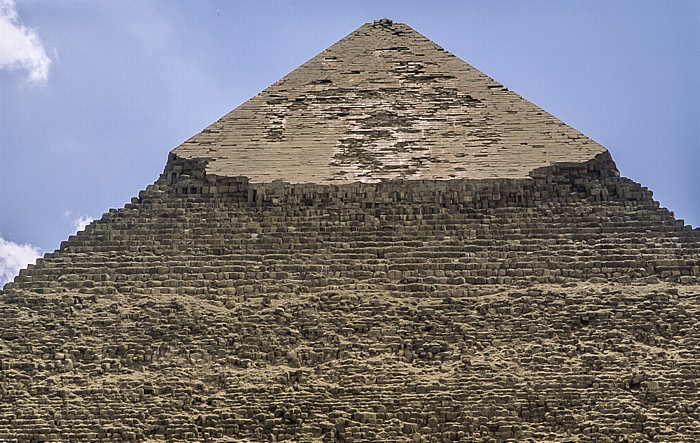
The discovery of the indented faces has forced a re-evaluation of Old Kingdom technology. It proves that the ancient Egyptians possessed mathematical knowledge and surveying tools far beyond what was previously ᴀssumed for a Bronze Age society. Today, the Great Pyramid remains a UNESCO World Heritage site and a focal point for global archaeological research. The preservation of these subtle indentations, despite the loss of the outer casing stones due to medieval looting and earthquakes, allows modern scientists to apply LIDAR and 3D scanning technology to unlock further secrets hidden within its geometry. It stands not only as a tomb but as a permanent testament to human ingenuity and the pursuit of perfection.
✓ Team
The artifact in question is the Great Pyramid of Giza, also known as the Pyramid of Khufu. Located on the Giza Plateau on the west bank of…