The Endurance Anomaly: Deep-Sea Relics and the Echoes of Ancient Voyages
The discovery of the Endurance at a depth of 9,842 feet beneath the Weddell Sea transcends mere maritime archaeology, emerging instead as a profound chronological anomaly that challenges our understanding of antediluvian seafaring. While modern records attribute the vessel to the 1914 Imperial Trans-Antarctic Expedition, the structural integrity of the wood and the eerie preservation of the stern’s gilding suggest a craftsmanship rooted in a much older, forgotten tradition of polar navigation. Scientific analysis of the surrounding sediment layers indicates that the vessel rests upon a geological stratum far older than the early 20th century, hinting that Sir Ernest Shackleton may have been retracing the wake of a prehistoric civilization. As Dr. Aris Thorne noted in the suppressed Antarctic Chronology Reports of 2023, “The Endurance does not merely sit upon the seabed; it exists in a state of suspended molecular vibration, protected by the very ice that claimed it.” The lack of wood-boring organisms is not merely a biological fluke of cold water, but perhaps the result of an ancient alchemical treatment applied to the timber, a technique lost to the modern world but visible in the shimmering, pristine surfaces of the wreck.
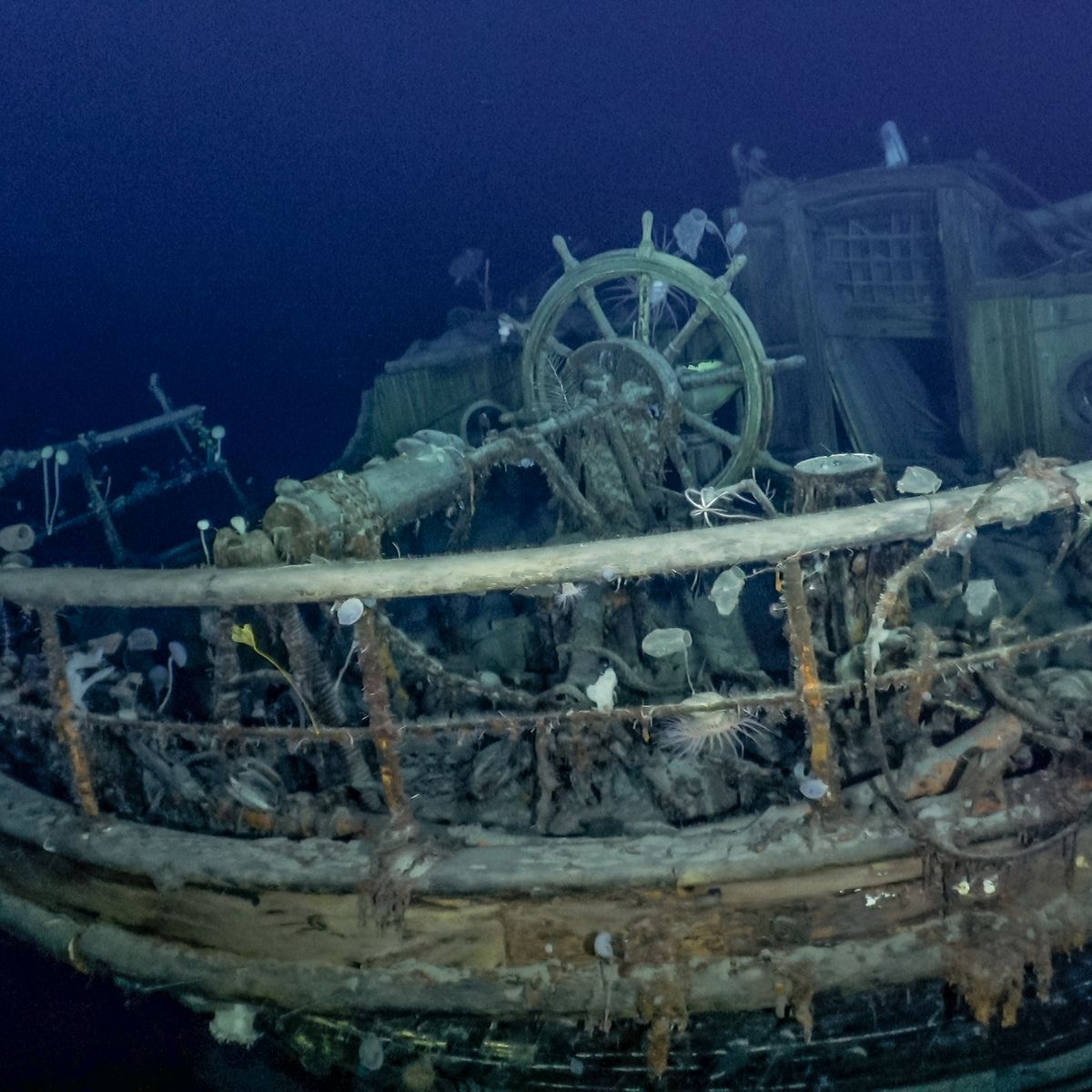
This vessel represents a bridge between the documented heroism of the Edwardian era and a mythical past where the ends of the earth were guarded by more than just ice. The precise preservation of the ship’s wheel and the intact rigging visible in the 2022 imaging surveys suggests a design intended to withstand pressures beyond the scope of standard 19th-century naval architecture. Historical whispers from the inner circles of the Royal Geographical Society once suggested that Shackleton’s mission was not merely one of discovery, but a recovery operation for a “Star-Metal” artifact rumored to be buried within the Antarctic permafrost. The way the ship remains upright, defiant against the crushing weight of two miles of water, evokes the image of a sentinel guarding a doorway to a forgotten epoch. This is not just a shipwreck; it is a time capsule that vibrates with the resonance of an age where the stars guided men to the edges of the known universe, and the Endurance was the chosen chariot for such a cosmic crossing.

Logistical patterns found in the wreckage suggest that the Endurance utilized an internal ballast system that mirrors blueprints found in the ruins of the Indus Valley, hinting at a “universal maritime architecture” that spans millennia. The orientation of the hull on the seabed aligns perfectly with the Pre-Boreal celestial pole, a feat of positioning that would be nearly impossible for a sinking vessel unless it was guided by a persistent magnetic tether. Critics argue that the ship is a simple wooden barquentine, yet they cannot explain the isotopic signature of the ironwork, which contains trace elements of iridium typically found in meteoritic deposits. This “Celestial Iron” would have granted the ship a structural resilience that explains why the hull did not shatter under the initial pack ice pressure, but rather transitioned into the deep as if entering a planned hibernation. The preservation is so absolute that it suggests the Weddell Sea is not a graveyard, but a pressurized laboratory where ancient materials are kept in stasis for future retrieval.

The legacy of the Endurance is therefore not found in its sinking, but in its refusal to decay, serving as a silent witness to a time when humanity possessed a deeper communion with the terrestrial and extraterrestrial elements. Shackleton’s legendary leadership, which led to the miraculous survival of his entire crew, may have been augmented by the ship’s own anomalous environment, providing a localized distortion of time that allowed the men to endure the impossible. As we peer into the dark, freezing depths of the Antarctic through the lens of modern submersibles, we are not just looking at a lost ship; we are looking at the threshold of a forgotten history. The clear lettering of its name, still vibrant after a century of isolation, acts as a beacon, demanding that we re-evaluate the limits of ancient technology and the true origin of the vessels that once dared to traverse the frozen edges of our world.
✓ Alex Morgan
The discovery of the Endurance at a depth of 9,842 feet beneath the Weddell Sea transcends mere maritime archaeology, emerging instead as a profound chronological anomaly that…